

Sustainability of Concrete Structures in Terms …
69
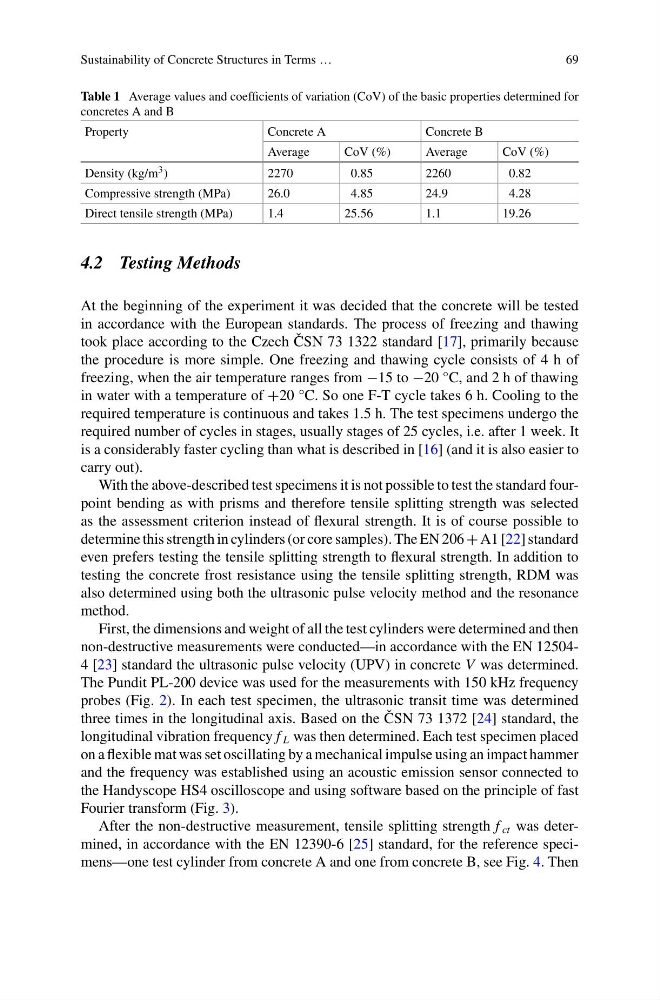
Table 1 Average values and coefficients of variation (CoV) of the basic properties determined for
concretes A and B
Property
Concrete A
Concrete B
Average
CoV (%)
Average
CoV (%)
Density (kg/m 3 )
2270
0.85
2260
0.82
Compressive strength (MPa)
26.0
4.85
24.9
4.28
Direct tensile strength (MPa)
1.4
25.56
1.1
19.26
4.2 Testing Methods
At the beginning of the experiment it was decided that the concrete will be tested
in accordance with the European standards. The process of freezing and thawing
took place according to the Czech ˇ
CSN 73 1322 standard [17], primarily because
the procedure is more simple. One freezing and thawing cycle consists of 4 h of
freezing, when the air temperature ranges from −15 to −20 °C, and 2 h of thawing
in water with a temperature of +20 °C. So one F-T cycle takes 6 h. Cooling to the
required temperature is continuous and takes 1.5 h. The test specimens undergo the
required number of cycles in stages, usually stages of 25 cycles, i.e. after 1 week. It
is a considerably faster cycling than what is described in [16] (and it is also easier to
carry out).
With the above-described test specimens it is not possible to test the standard fourpoint bending as with prisms and therefore tensile splitting strength was selected
as the assessment criterion instead of flexural strength. It is of course possible to
determine this strength in cylinders (or core samples). The EN 206 + A1 [22] standard
even prefers testing the tensile splitting strength to flexural strength. In addition to
testing the concrete frost resistance using the tensile splitting strength, RDM was
also determined using both the ultrasonic pulse velocity method and the resonance
method.
First, the dimensions and weight of all the test cylinders were determined and then
non-destructive measurements were conducted—in accordance with the EN 125044 [23] standard the ultrasonic pulse velocity (UPV) in concrete V was determined.
The Pundit PL-200 device was used for the measurements with 150 kHz frequency
probes (Fig. 2). In each test specimen, the ultrasonic transit time was determined
three times in the longitudinal axis. Based on the ˇ
CSN 73 1372 [24] standard, the
longitudinal vibration frequency f L was then determined. Each test specimen placed
on a flexible mat was set oscillating by a mechanical impulse using an impact hammer
and the frequency was established using an acoustic emission sensor connected to
the Handyscope HS4 oscilloscope and using software based on the principle of fast
Fourier transform (Fig. 3).
After the non-destructive measurement, tensile splitting strength f ct was determined, in accordance with the EN 12390-6 [25] standard, for the reference specimens—one test cylinder from concrete A and one from concrete B, see Fig. 4. Then
69
Table 1 Average values and coefficients of variation (CoV) of the basic properties determined for
concretes A and B
Property
Concrete A
Concrete B
Average
CoV (%)
Average
CoV (%)
Density (kg/m 3 )
2270
0.85
2260
0.82
Compressive strength (MPa)
26.0
4.85
24.9
4.28
Direct tensile strength (MPa)
1.4
25.56
1.1
19.26
4.2 Testing Methods
At the beginning of the experiment it was decided that the concrete will be tested
in accordance with the European standards. The process of freezing and thawing
took place according to the Czech ˇ
CSN 73 1322 standard [17], primarily because
the procedure is more simple. One freezing and thawing cycle consists of 4 h of
freezing, when the air temperature ranges from −15 to −20 °C, and 2 h of thawing
in water with a temperature of +20 °C. So one F-T cycle takes 6 h. Cooling to the
required temperature is continuous and takes 1.5 h. The test specimens undergo the
required number of cycles in stages, usually stages of 25 cycles, i.e. after 1 week. It
is a considerably faster cycling than what is described in [16] (and it is also easier to
carry out).
With the above-described test specimens it is not possible to test the standard fourpoint bending as with prisms and therefore tensile splitting strength was selected
as the assessment criterion instead of flexural strength. It is of course possible to
determine this strength in cylinders (or core samples). The EN 206 + A1 [22] standard
even prefers testing the tensile splitting strength to flexural strength. In addition to
testing the concrete frost resistance using the tensile splitting strength, RDM was
also determined using both the ultrasonic pulse velocity method and the resonance
method.
First, the dimensions and weight of all the test cylinders were determined and then
non-destructive measurements were conducted—in accordance with the EN 125044 [23] standard the ultrasonic pulse velocity (UPV) in concrete V was determined.
The Pundit PL-200 device was used for the measurements with 150 kHz frequency
probes (Fig. 2). In each test specimen, the ultrasonic transit time was determined
three times in the longitudinal axis. Based on the ˇ
CSN 73 1372 [24] standard, the
longitudinal vibration frequency f L was then determined. Each test specimen placed
on a flexible mat was set oscillating by a mechanical impulse using an impact hammer
and the frequency was established using an acoustic emission sensor connected to
the Handyscope HS4 oscilloscope and using software based on the principle of fast
Fourier transform (Fig. 3).
After the non-destructive measurement, tensile splitting strength f ct was determined, in accordance with the EN 12390-6 [25] standard, for the reference specimens—one test cylinder from concrete A and one from concrete B, see Fig. 4. Then