

Pull-Out Tests and Numerical Simulations …
51
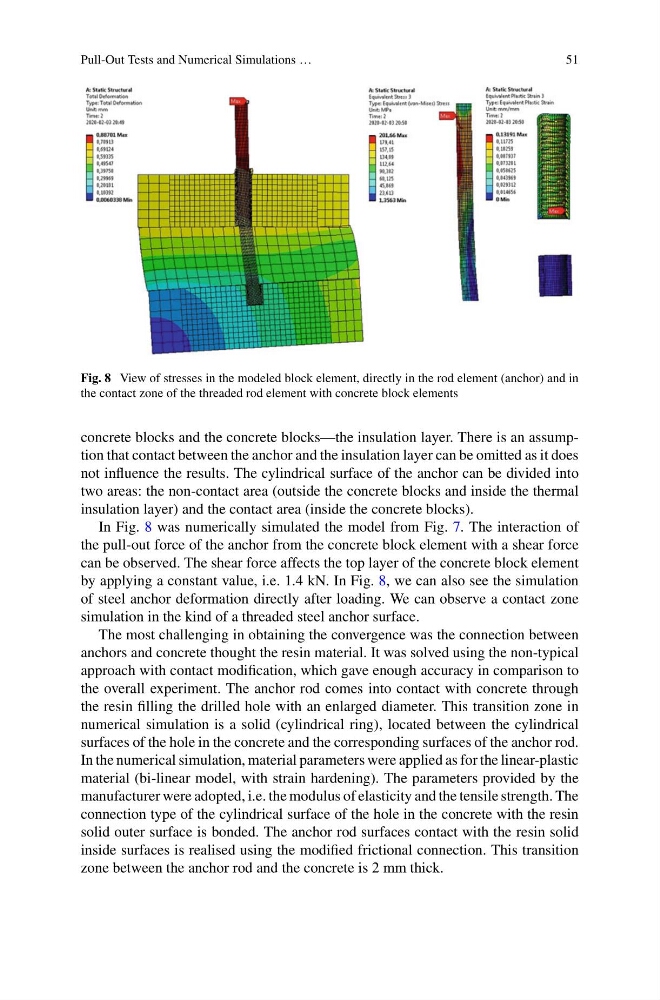
Fig. 8 View of stresses in the modeled block element, directly in the rod element (anchor) and in
the contact zone of the threaded rod element with concrete block elements
concrete blocks and the concrete blocks—the insulation layer. There is an assumption that contact between the anchor and the insulation layer can be omitted as it does
not influence the results. The cylindrical surface of the anchor can be divided into
two areas: the non-contact area (outside the concrete blocks and inside the thermal
insulation layer) and the contact area (inside the concrete blocks).
In Fig. 8 was numerically simulated the model from Fig. 7. The interaction of
the pull-out force of the anchor from the concrete block element with a shear force
can be observed. The shear force affects the top layer of the concrete block element
by applying a constant value, i.e. 1.4 kN. In Fig. 8, we can also see the simulation
of steel anchor deformation directly after loading. We can observe a contact zone
simulation in the kind of a threaded steel anchor surface.
The most challenging in obtaining the convergence was the connection between
anchors and concrete thought the resin material. It was solved using the non-typical
approach with contact modification, which gave enough accuracy in comparison to
the overall experiment. The anchor rod comes into contact with concrete through
the resin filling the drilled hole with an enlarged diameter. This transition zone in
numerical simulation is a solid (cylindrical ring), located between the cylindrical
surfaces of the hole in the concrete and the corresponding surfaces of the anchor rod.
In the numerical simulation, material parameters were applied as for the linear-plastic
material (bi-linear model, with strain hardening). The parameters provided by the
manufacturer were adopted, i.e. the modulus of elasticity and the tensile strength. The
connection type of the cylindrical surface of the hole in the concrete with the resin
solid outer surface is bonded. The anchor rod surfaces contact with the resin solid
inside surfaces is realised using the modified frictional connection. This transition
zone between the anchor rod and the concrete is 2 mm thick.
51
Fig. 8 View of stresses in the modeled block element, directly in the rod element (anchor) and in
the contact zone of the threaded rod element with concrete block elements
concrete blocks and the concrete blocks—the insulation layer. There is an assumption that contact between the anchor and the insulation layer can be omitted as it does
not influence the results. The cylindrical surface of the anchor can be divided into
two areas: the non-contact area (outside the concrete blocks and inside the thermal
insulation layer) and the contact area (inside the concrete blocks).
In Fig. 8 was numerically simulated the model from Fig. 7. The interaction of
the pull-out force of the anchor from the concrete block element with a shear force
can be observed. The shear force affects the top layer of the concrete block element
by applying a constant value, i.e. 1.4 kN. In Fig. 8, we can also see the simulation
of steel anchor deformation directly after loading. We can observe a contact zone
simulation in the kind of a threaded steel anchor surface.
The most challenging in obtaining the convergence was the connection between
anchors and concrete thought the resin material. It was solved using the non-typical
approach with contact modification, which gave enough accuracy in comparison to
the overall experiment. The anchor rod comes into contact with concrete through
the resin filling the drilled hole with an enlarged diameter. This transition zone in
numerical simulation is a solid (cylindrical ring), located between the cylindrical
surfaces of the hole in the concrete and the corresponding surfaces of the anchor rod.
In the numerical simulation, material parameters were applied as for the linear-plastic
material (bi-linear model, with strain hardening). The parameters provided by the
manufacturer were adopted, i.e. the modulus of elasticity and the tensile strength. The
connection type of the cylindrical surface of the hole in the concrete with the resin
solid outer surface is bonded. The anchor rod surfaces contact with the resin solid
inside surfaces is realised using the modified frictional connection. This transition
zone between the anchor rod and the concrete is 2 mm thick.