

Peculiarities of Reconstruction Work …
19
weight of 160–200 kg (depending on the place of the attack), this framework will
be completely destroyed and cannot be renovated. However, the adjacent bridge
framework will generally survive, and therefore it is quite possible to operate it further
after necessary repairs have been completed. In this context, we draw attention to
the obvious fact that the indicated amount of explosives can be delivered onto the
bridge exclusively by means of a vehicle, because a person alone is not able to bring
such an amount to the bridge.
So, during the numerical studies of the Paton Bridge, taking into account the
existing defects in developed technical solutions for reconstruction work on the
bridge, four most likely variants were considered for the bridge structure destruction,
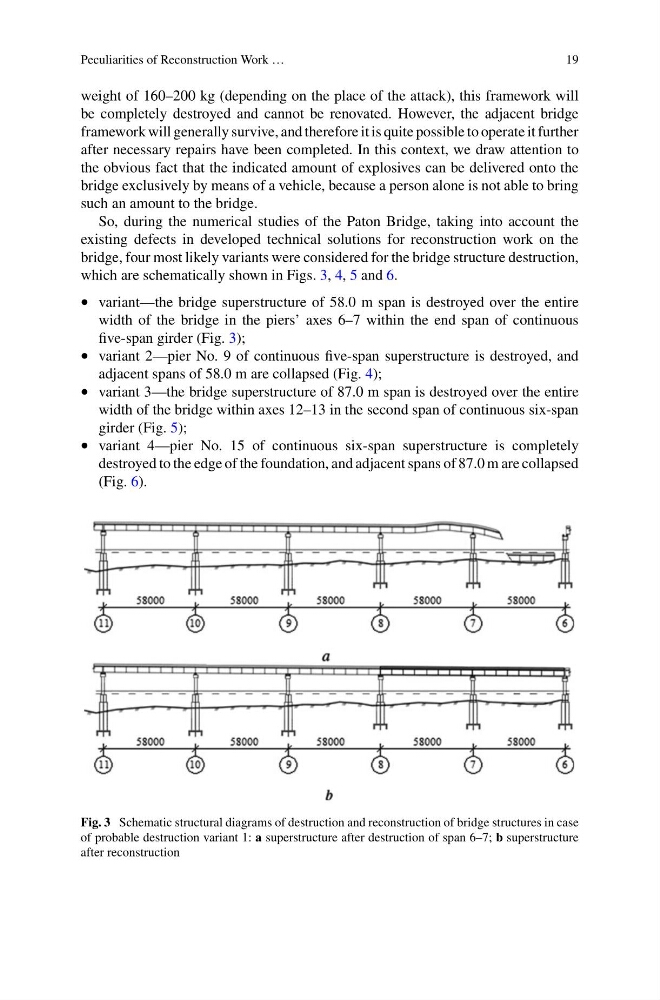
which are schematically shown in Figs. 3, 4, 5 and 6.
• variant—the bridge superstructure of 58.0 m span is destroyed over the entire
width of the bridge in the piers’ axes 6–7 within the end span of continuous
five-span girder (Fig. 3);
• variant 2—pier No. 9 of continuous five-span superstructure is destroyed, and
adjacent spans of 58.0 m are collapsed (Fig. 4);
• variant 3—the bridge superstructure of 87.0 m span is destroyed over the entire
width of the bridge within axes 12–13 in the second span of continuous six-span
girder (Fig. 5);
• variant 4—pier No. 15 of continuous six-span superstructure is completely
destroyed to the edge of the foundation, and adjacent spans of 87.0 m are collapsed
(Fig. 6).
Fig. 3 Schematic structural diagrams of destruction and reconstruction of bridge structures in case
of probable destruction variant 1: a superstructure after destruction of span 6–7; b superstructure
after reconstruction
19
weight of 160–200 kg (depending on the place of the attack), this framework will
be completely destroyed and cannot be renovated. However, the adjacent bridge
framework will generally survive, and therefore it is quite possible to operate it further
after necessary repairs have been completed. In this context, we draw attention to
the obvious fact that the indicated amount of explosives can be delivered onto the
bridge exclusively by means of a vehicle, because a person alone is not able to bring
such an amount to the bridge.
So, during the numerical studies of the Paton Bridge, taking into account the
existing defects in developed technical solutions for reconstruction work on the
bridge, four most likely variants were considered for the bridge structure destruction,
which are schematically shown in Figs. 3, 4, 5 and 6.
• variant—the bridge superstructure of 58.0 m span is destroyed over the entire
width of the bridge in the piers’ axes 6–7 within the end span of continuous
five-span girder (Fig. 3);
• variant 2—pier No. 9 of continuous five-span superstructure is destroyed, and
adjacent spans of 58.0 m are collapsed (Fig. 4);
• variant 3—the bridge superstructure of 87.0 m span is destroyed over the entire
width of the bridge within axes 12–13 in the second span of continuous six-span
girder (Fig. 5);
• variant 4—pier No. 15 of continuous six-span superstructure is completely
destroyed to the edge of the foundation, and adjacent spans of 87.0 m are collapsed
(Fig. 6).
Fig. 3 Schematic structural diagrams of destruction and reconstruction of bridge structures in case
of probable destruction variant 1: a superstructure after destruction of span 6–7; b superstructure
after reconstruction