

Peculiarities of Reconstruction Work …
17
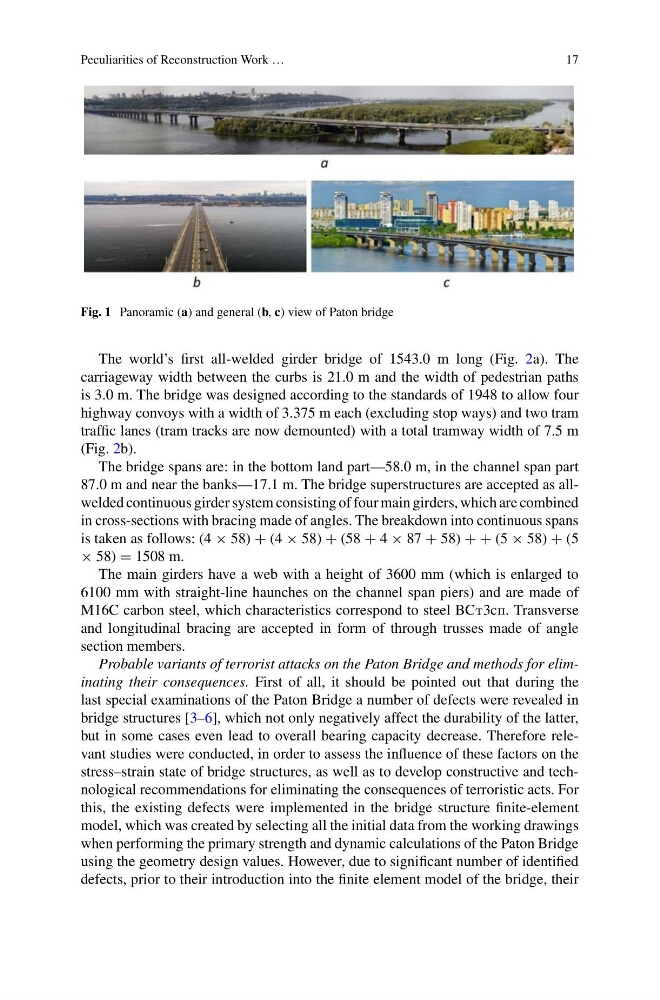
Fig. 1 Panoramic (a) and general (b, c) view of Paton bridge
The world’s first all-welded girder bridge of 1543.0 m long (Fig. 2a). The
carriageway width between the curbs is 21.0 m and the width of pedestrian paths
is 3.0 m. The bridge was designed according to the standards of 1948 to allow four
highway convoys with a width of 3.375 m each (excluding stop ways) and two tram
traffic lanes (tram tracks are now demounted) with a total tramway width of 7.5 m
(Fig. 2b).
The bridge spans are: in the bottom land part—58.0 m, in the channel span part
87.0 m and near the banks—17.1 m. The bridge superstructures are accepted as allwelded continuous girder system consisting of four main girders, which are combined
in cross-sections with bracing made of angles. The breakdown into continuous spans
is taken as follows: (4 × 58) + (4 × 58) + (58 + 4 × 87 + 58) + + (5 × 58) + (5
× 58) = 1508 m.
The main girders have a web with a height of 3600 mm (which is enlarged to
6100 mm with straight-line haunches on the channel span piers) and are made of
M16C carbon steel, which characteristics correspond to steel BCt3cp. Transverse
and longitudinal bracing are accepted in form of through trusses made of angle
section members.
Probable variants of terrorist attacks on the Paton Bridge and methods for eliminating their consequences. First of all, it should be pointed out that during the
last special examinations of the Paton Bridge a number of defects were revealed in
bridge structures [3–6], which not only negatively affect the durability of the latter,
but in some cases even lead to overall bearing capacity decrease. Therefore relevant studies were conducted, in order to assess the influence of these factors on the
stress–strain state of bridge structures, as well as to develop constructive and technological recommendations for eliminating the consequences of terroristic acts. For
this, the existing defects were implemented in the bridge structure finite-element
model, which was created by selecting all the initial data from the working drawings
when performing the primary strength and dynamic calculations of the Paton Bridge
using the geometry design values. However, due to significant number of identified
defects, prior to their introduction into the finite element model of the bridge, their
17
Fig. 1 Panoramic (a) and general (b, c) view of Paton bridge
The world’s first all-welded girder bridge of 1543.0 m long (Fig. 2a). The
carriageway width between the curbs is 21.0 m and the width of pedestrian paths
is 3.0 m. The bridge was designed according to the standards of 1948 to allow four
highway convoys with a width of 3.375 m each (excluding stop ways) and two tram
traffic lanes (tram tracks are now demounted) with a total tramway width of 7.5 m
(Fig. 2b).
The bridge spans are: in the bottom land part—58.0 m, in the channel span part
87.0 m and near the banks—17.1 m. The bridge superstructures are accepted as allwelded continuous girder system consisting of four main girders, which are combined
in cross-sections with bracing made of angles. The breakdown into continuous spans
is taken as follows: (4 × 58) + (4 × 58) + (58 + 4 × 87 + 58) + + (5 × 58) + (5
× 58) = 1508 m.
The main girders have a web with a height of 3600 mm (which is enlarged to
6100 mm with straight-line haunches on the channel span piers) and are made of
M16C carbon steel, which characteristics correspond to steel BCt3cp. Transverse
and longitudinal bracing are accepted in form of through trusses made of angle
section members.
Probable variants of terrorist attacks on the Paton Bridge and methods for eliminating their consequences. First of all, it should be pointed out that during the
last special examinations of the Paton Bridge a number of defects were revealed in
bridge structures [3–6], which not only negatively affect the durability of the latter,
but in some cases even lead to overall bearing capacity decrease. Therefore relevant studies were conducted, in order to assess the influence of these factors on the
stress–strain state of bridge structures, as well as to develop constructive and technological recommendations for eliminating the consequences of terroristic acts. For
this, the existing defects were implemented in the bridge structure finite-element
model, which was created by selecting all the initial data from the working drawings
when performing the primary strength and dynamic calculations of the Paton Bridge
using the geometry design values. However, due to significant number of identified
defects, prior to their introduction into the finite element model of the bridge, their