

10
J. Bujnak et al.
2.2 Bridge Types for Larger Spans
Trusses can require a very small amount of material for construction and result in a
cost-effective bridge form, thanks to forces distribution across almost entire structure
span using a diagonal mesh of triangle-shaped. Moreover, the single span Warren
truss without verticals in the parallel chord shape is also aesthetically pleasing truss
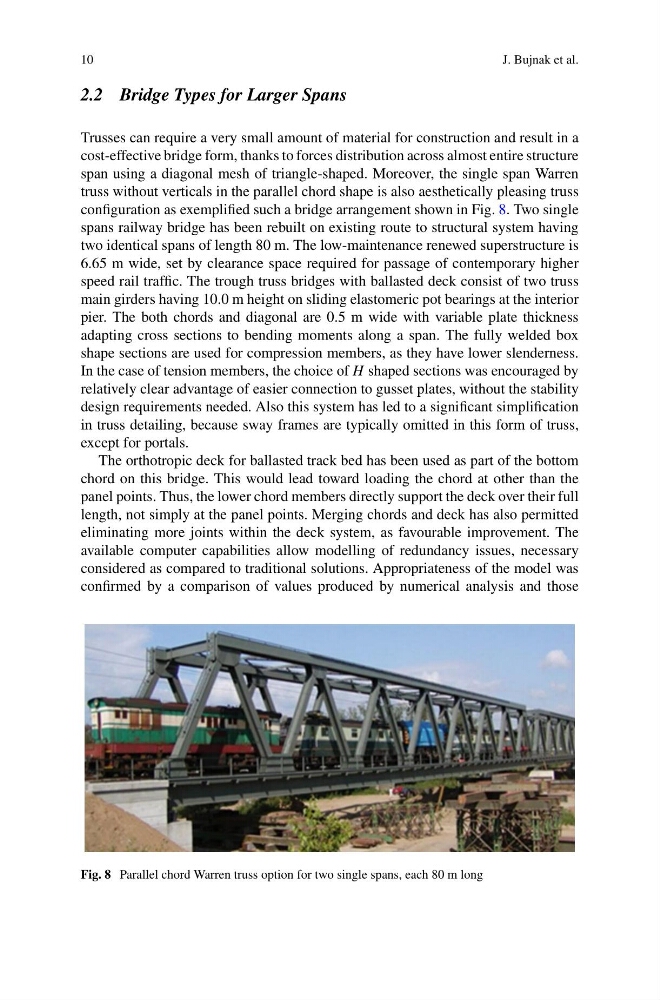
configuration as exemplified such a bridge arrangement shown in Fig. 8. Two single
spans railway bridge has been rebuilt on existing route to structural system having
two identical spans of length 80 m. The low-maintenance renewed superstructure is
6.65 m wide, set by clearance space required for passage of contemporary higher
speed rail traffic. The trough truss bridges with ballasted deck consist of two truss
main girders having 10.0 m height on sliding elastomeric pot bearings at the interior
pier. The both chords and diagonal are 0.5 m wide with variable plate thickness
adapting cross sections to bending moments along a span. The fully welded box
shape sections are used for compression members, as they have lower slenderness.
In the case of tension members, the choice of H shaped sections was encouraged by
relatively clear advantage of easier connection to gusset plates, without the stability
design requirements needed. Also this system has led to a significant simplification
in truss detailing, because sway frames are typically omitted in this form of truss,
except for portals.
The orthotropic deck for ballasted track bed has been used as part of the bottom
chord on this bridge. This would lead toward loading the chord at other than the
panel points. Thus, the lower chord members directly support the deck over their full
length, not simply at the panel points. Merging chords and deck has also permitted
eliminating more joints within the deck system, as favourable improvement. The
available computer capabilities allow modelling of redundancy issues, necessary
considered as compared to traditional solutions. Appropriateness of the model was
confirmed by a comparison of values produced by numerical analysis and those
Fig. 8 Parallel chord Warren truss option for two single spans, each 80 m long
J. Bujnak et al.
2.2 Bridge Types for Larger Spans
Trusses can require a very small amount of material for construction and result in a
cost-effective bridge form, thanks to forces distribution across almost entire structure
span using a diagonal mesh of triangle-shaped. Moreover, the single span Warren
truss without verticals in the parallel chord shape is also aesthetically pleasing truss
configuration as exemplified such a bridge arrangement shown in Fig. 8. Two single
spans railway bridge has been rebuilt on existing route to structural system having
two identical spans of length 80 m. The low-maintenance renewed superstructure is
6.65 m wide, set by clearance space required for passage of contemporary higher
speed rail traffic. The trough truss bridges with ballasted deck consist of two truss
main girders having 10.0 m height on sliding elastomeric pot bearings at the interior
pier. The both chords and diagonal are 0.5 m wide with variable plate thickness
adapting cross sections to bending moments along a span. The fully welded box
shape sections are used for compression members, as they have lower slenderness.
In the case of tension members, the choice of H shaped sections was encouraged by
relatively clear advantage of easier connection to gusset plates, without the stability
design requirements needed. Also this system has led to a significant simplification
in truss detailing, because sway frames are typically omitted in this form of truss,
except for portals.
The orthotropic deck for ballasted track bed has been used as part of the bottom
chord on this bridge. This would lead toward loading the chord at other than the
panel points. Thus, the lower chord members directly support the deck over their full
length, not simply at the panel points. Merging chords and deck has also permitted
eliminating more joints within the deck system, as favourable improvement. The
available computer capabilities allow modelling of redundancy issues, necessary
considered as compared to traditional solutions. Appropriateness of the model was
confirmed by a comparison of values produced by numerical analysis and those
Fig. 8 Parallel chord Warren truss option for two single spans, each 80 m long