

164
A. Repelewicz
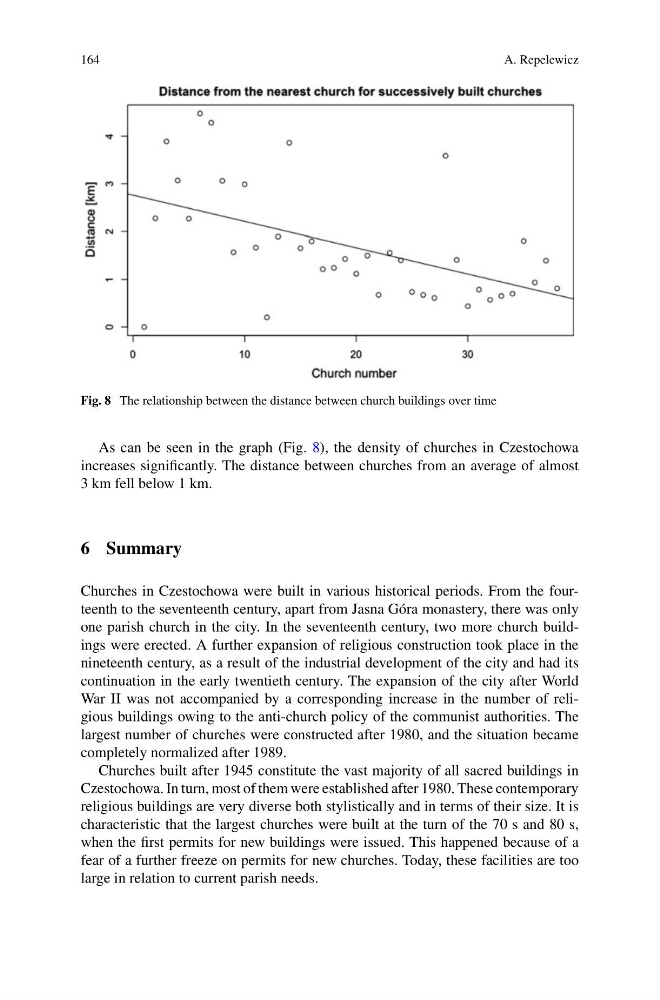
Fig. 8 The relationship between the distance between church buildings over time
As can be seen in the graph (Fig. 8), the density of churches in Czestochowa
increases significantly. The distance between churches from an average of almost
3 km fell below 1 km.
6 Summary
Churches in Czestochowa were built in various historical periods. From the fourteenth to the seventeenth century, apart from Jasna Góra monastery, there was only
one parish church in the city. In the seventeenth century, two more church buildings were erected. A further expansion of religious construction took place in the
nineteenth century, as a result of the industrial development of the city and had its
continuation in the early twentieth century. The expansion of the city after World
War II was not accompanied by a corresponding increase in the number of religious buildings owing to the anti-church policy of the communist authorities. The
largest number of churches were constructed after 1980, and the situation became
completely normalized after 1989.
Churches built after 1945 constitute the vast majority of all sacred buildings in
Czestochowa. In turn, most of them were established after 1980. These contemporary
religious buildings are very diverse both stylistically and in terms of their size. It is
characteristic that the largest churches were built at the turn of the 70 s and 80 s,
when the first permits for new buildings were issued. This happened because of a
fear of a further freeze on permits for new churches. Today, these facilities are too
large in relation to current parish needs.
A. Repelewicz
Fig. 8 The relationship between the distance between church buildings over time
As can be seen in the graph (Fig. 8), the density of churches in Czestochowa
increases significantly. The distance between churches from an average of almost
3 km fell below 1 km.
6 Summary
Churches in Czestochowa were built in various historical periods. From the fourteenth to the seventeenth century, apart from Jasna Góra monastery, there was only
one parish church in the city. In the seventeenth century, two more church buildings were erected. A further expansion of religious construction took place in the
nineteenth century, as a result of the industrial development of the city and had its
continuation in the early twentieth century. The expansion of the city after World
War II was not accompanied by a corresponding increase in the number of religious buildings owing to the anti-church policy of the communist authorities. The
largest number of churches were constructed after 1980, and the situation became
completely normalized after 1989.
Churches built after 1945 constitute the vast majority of all sacred buildings in
Czestochowa. In turn, most of them were established after 1980. These contemporary
religious buildings are very diverse both stylistically and in terms of their size. It is
characteristic that the largest churches were built at the turn of the 70 s and 80 s,
when the first permits for new buildings were issued. This happened because of a
fear of a further freeze on permits for new churches. Today, these facilities are too
large in relation to current parish needs.