

Contemporary Churches of Czestochowa—Architectural …
161
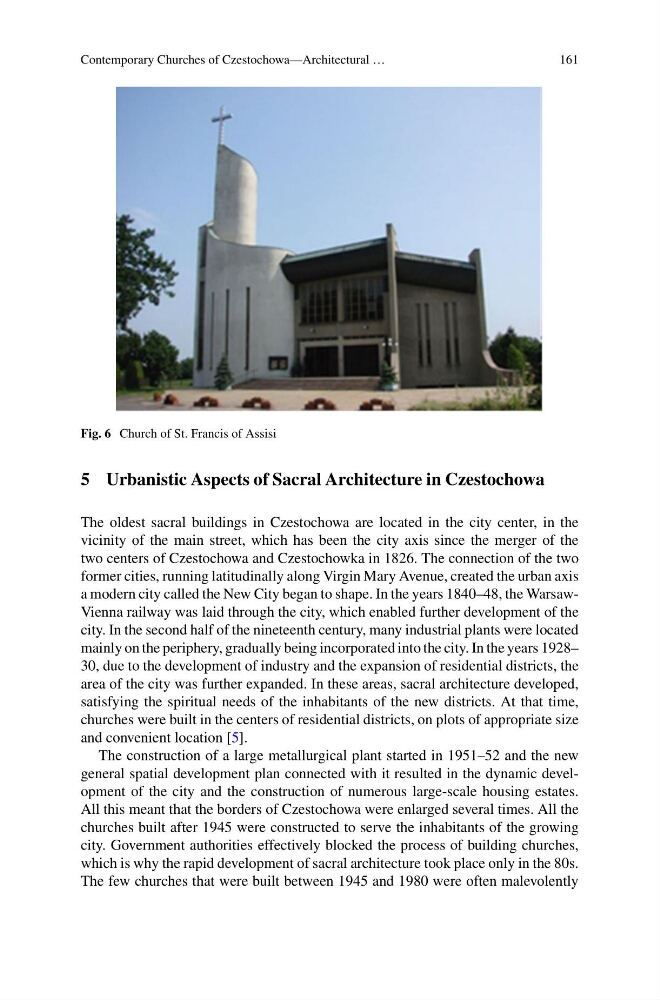
Fig. 6 Church of St. Francis of Assisi
5 Urbanistic Aspects of Sacral Architecture in Czestochowa
The oldest sacral buildings in Czestochowa are located in the city center, in the
vicinity of the main street, which has been the city axis since the merger of the
two centers of Czestochowa and Czestochowka in 1826. The connection of the two
former cities, running latitudinally along Virgin Mary Avenue, created the urban axis
a modern city called the New City began to shape. In the years 1840–48, the WarsawVienna railway was laid through the city, which enabled further development of the
city. In the second half of the nineteenth century, many industrial plants were located
mainly on the periphery, gradually being incorporated into the city. In the years 1928–
30, due to the development of industry and the expansion of residential districts, the
area of the city was further expanded. In these areas, sacral architecture developed,
satisfying the spiritual needs of the inhabitants of the new districts. At that time,
churches were built in the centers of residential districts, on plots of appropriate size
and convenient location [5].
The construction of a large metallurgical plant started in 1951–52 and the new
general spatial development plan connected with it resulted in the dynamic development of the city and the construction of numerous large-scale housing estates.
All this meant that the borders of Czestochowa were enlarged several times. All the
churches built after 1945 were constructed to serve the inhabitants of the growing
city. Government authorities effectively blocked the process of building churches,
which is why the rapid development of sacral architecture took place only in the 80s.
The few churches that were built between 1945 and 1980 were often malevolently
161
Fig. 6 Church of St. Francis of Assisi
5 Urbanistic Aspects of Sacral Architecture in Czestochowa
The oldest sacral buildings in Czestochowa are located in the city center, in the
vicinity of the main street, which has been the city axis since the merger of the
two centers of Czestochowa and Czestochowka in 1826. The connection of the two
former cities, running latitudinally along Virgin Mary Avenue, created the urban axis
a modern city called the New City began to shape. In the years 1840–48, the WarsawVienna railway was laid through the city, which enabled further development of the
city. In the second half of the nineteenth century, many industrial plants were located
mainly on the periphery, gradually being incorporated into the city. In the years 1928–
30, due to the development of industry and the expansion of residential districts, the
area of the city was further expanded. In these areas, sacral architecture developed,
satisfying the spiritual needs of the inhabitants of the new districts. At that time,
churches were built in the centers of residential districts, on plots of appropriate size
and convenient location [5].
The construction of a large metallurgical plant started in 1951–52 and the new
general spatial development plan connected with it resulted in the dynamic development of the city and the construction of numerous large-scale housing estates.
All this meant that the borders of Czestochowa were enlarged several times. All the
churches built after 1945 were constructed to serve the inhabitants of the growing
city. Government authorities effectively blocked the process of building churches,
which is why the rapid development of sacral architecture took place only in the 80s.
The few churches that were built between 1945 and 1980 were often malevolently