

160
A. Repelewicz
Table 1 (continued)
No. The name of the
church
Address
Year of the
project creation
Designer
Years of the
church
construction
34
Blessed Rafał
Kalinowski
ul. ˙
Zródlana 4
About 1998
Ziemowit
Domagała
1999–2000
35
St. John of
Dukla
ul. Mirowska
51/59
1994
Beata
Król-Stroba
1999–2010
36
St. Kazimierz
the Prince
ul. Brze´ znicka 45 1999
Maria Musialska 1999–2005
37
St. John
Sarkander
ul. Cegielniana
7/11
2002
Ziemowit
Domagała
2002–2007
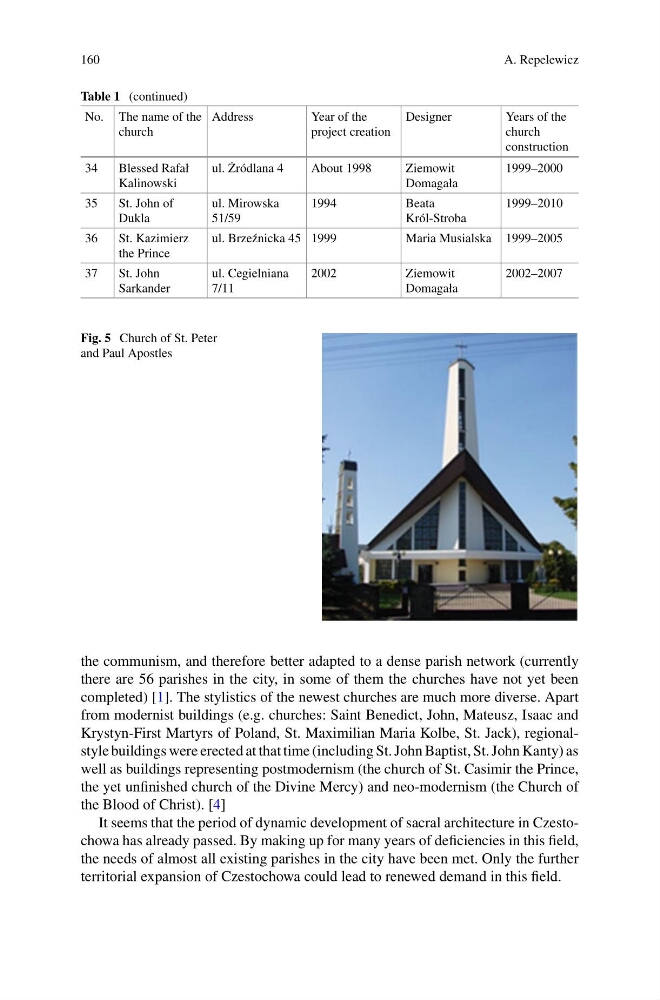
Fig. 5 Church of St. Peter
and Paul Apostles
the communism, and therefore better adapted to a dense parish network (currently
there are 56 parishes in the city, in some of them the churches have not yet been
completed) [1]. The stylistics of the newest churches are much more diverse. Apart
from modernist buildings (e.g. churches: Saint Benedict, John, Mateusz, Isaac and
Krystyn-First Martyrs of Poland, St. Maximilian Maria Kolbe, St. Jack), regionalstyle buildings were erected at that time (including St. John Baptist, St. John Kanty) as
well as buildings representing postmodernism (the church of St. Casimir the Prince,
the yet unfinished church of the Divine Mercy) and neo-modernism (the Church of
the Blood of Christ). [4]
It seems that the period of dynamic development of sacral architecture in Czestochowa has already passed. By making up for many years of deficiencies in this field,
the needs of almost all existing parishes in the city have been met. Only the further
territorial expansion of Czestochowa could lead to renewed demand in this field.
A. Repelewicz
Table 1 (continued)
No. The name of the
church
Address
Year of the
project creation
Designer
Years of the
church
construction
34
Blessed Rafał
Kalinowski
ul. ˙
Zródlana 4
About 1998
Ziemowit
Domagała
1999–2000
35
St. John of
Dukla
ul. Mirowska
51/59
1994
Beata
Król-Stroba
1999–2010
36
St. Kazimierz
the Prince
ul. Brze´ znicka 45 1999
Maria Musialska 1999–2005
37
St. John
Sarkander
ul. Cegielniana
7/11
2002
Ziemowit
Domagała
2002–2007
Fig. 5 Church of St. Peter
and Paul Apostles
the communism, and therefore better adapted to a dense parish network (currently
there are 56 parishes in the city, in some of them the churches have not yet been
completed) [1]. The stylistics of the newest churches are much more diverse. Apart
from modernist buildings (e.g. churches: Saint Benedict, John, Mateusz, Isaac and
Krystyn-First Martyrs of Poland, St. Maximilian Maria Kolbe, St. Jack), regionalstyle buildings were erected at that time (including St. John Baptist, St. John Kanty) as
well as buildings representing postmodernism (the church of St. Casimir the Prince,
the yet unfinished church of the Divine Mercy) and neo-modernism (the Church of
the Blood of Christ). [4]
It seems that the period of dynamic development of sacral architecture in Czestochowa has already passed. By making up for many years of deficiencies in this field,
the needs of almost all existing parishes in the city have been met. Only the further
territorial expansion of Czestochowa could lead to renewed demand in this field.