

156
A. Repelewicz
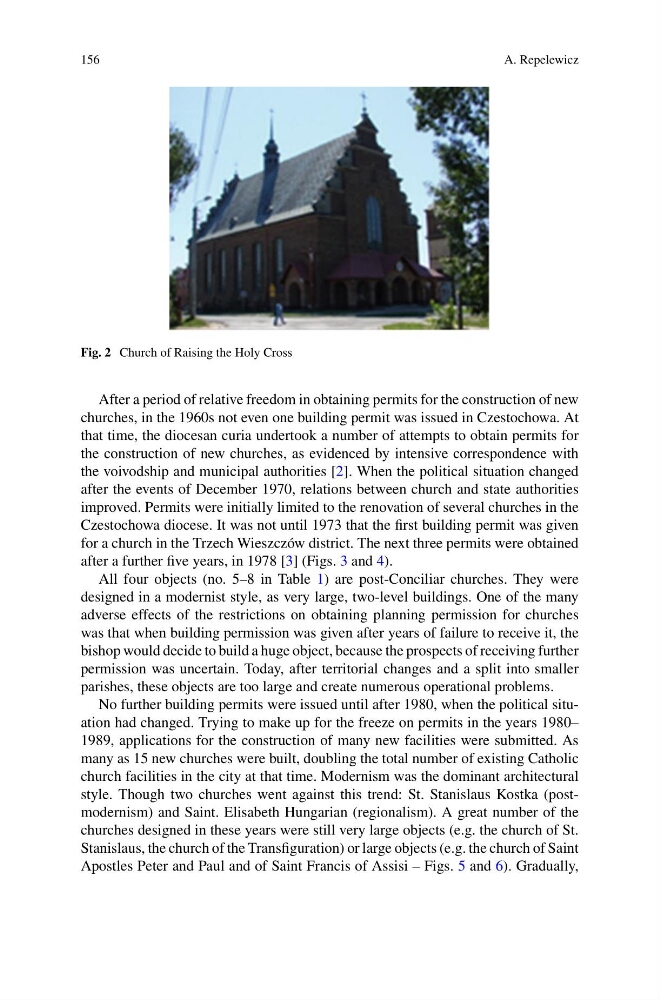
Fig. 2 Church of Raising the Holy Cross
After a period of relative freedom in obtaining permits for the construction of new
churches, in the 1960s not even one building permit was issued in Czestochowa. At
that time, the diocesan curia undertook a number of attempts to obtain permits for
the construction of new churches, as evidenced by intensive correspondence with
the voivodship and municipal authorities [2]. When the political situation changed
after the events of December 1970, relations between church and state authorities
improved. Permits were initially limited to the renovation of several churches in the
Czestochowa diocese. It was not until 1973 that the first building permit was given
for a church in the Trzech Wieszczów district. The next three permits were obtained
after a further five years, in 1978 [3] (Figs. 3 and 4).
All four objects (no. 5–8 in Table 1) are post-Conciliar churches. They were
designed in a modernist style, as very large, two-level buildings. One of the many
adverse effects of the restrictions on obtaining planning permission for churches
was that when building permission was given after years of failure to receive it, the
bishop would decide to build a huge object, because the prospects of receiving further
permission was uncertain. Today, after territorial changes and a split into smaller
parishes, these objects are too large and create numerous operational problems.
No further building permits were issued until after 1980, when the political situation had changed. Trying to make up for the freeze on permits in the years 1980–
1989, applications for the construction of many new facilities were submitted. As
many as 15 new churches were built, doubling the total number of existing Catholic
church facilities in the city at that time. Modernism was the dominant architectural
style. Though two churches went against this trend: St. Stanislaus Kostka (postmodernism) and Saint. Elisabeth Hungarian (regionalism). A great number of the
churches designed in these years were still very large objects (e.g. the church of St.
Stanislaus, the church of the Transfiguration) or large objects (e.g. the church of Saint
Apostles Peter and Paul and of Saint Francis of Assisi – Figs. 5 and 6). Gradually,
A. Repelewicz
Fig. 2 Church of Raising the Holy Cross
After a period of relative freedom in obtaining permits for the construction of new
churches, in the 1960s not even one building permit was issued in Czestochowa. At
that time, the diocesan curia undertook a number of attempts to obtain permits for
the construction of new churches, as evidenced by intensive correspondence with
the voivodship and municipal authorities [2]. When the political situation changed
after the events of December 1970, relations between church and state authorities
improved. Permits were initially limited to the renovation of several churches in the
Czestochowa diocese. It was not until 1973 that the first building permit was given
for a church in the Trzech Wieszczów district. The next three permits were obtained
after a further five years, in 1978 [3] (Figs. 3 and 4).
All four objects (no. 5–8 in Table 1) are post-Conciliar churches. They were
designed in a modernist style, as very large, two-level buildings. One of the many
adverse effects of the restrictions on obtaining planning permission for churches
was that when building permission was given after years of failure to receive it, the
bishop would decide to build a huge object, because the prospects of receiving further
permission was uncertain. Today, after territorial changes and a split into smaller
parishes, these objects are too large and create numerous operational problems.
No further building permits were issued until after 1980, when the political situation had changed. Trying to make up for the freeze on permits in the years 1980–
1989, applications for the construction of many new facilities were submitted. As
many as 15 new churches were built, doubling the total number of existing Catholic
church facilities in the city at that time. Modernism was the dominant architectural
style. Though two churches went against this trend: St. Stanislaus Kostka (postmodernism) and Saint. Elisabeth Hungarian (regionalism). A great number of the
churches designed in these years were still very large objects (e.g. the church of St.
Stanislaus, the church of the Transfiguration) or large objects (e.g. the church of Saint
Apostles Peter and Paul and of Saint Francis of Assisi – Figs. 5 and 6). Gradually,