

Contemporary Churches of Czestochowa—Architectural …
155
3 Churches in the Interwar Years
There were 8 catholic churches in Czestochowa (and Jasna Góra monastery) when
Poland regained its independence in 1918. Their number had increased to eleven by
the beginning of the Second War. Of these three, two were new objects and one was
a converted fire station. They were:
• Church of St. Joseph the Craftsman, erected in the village of Raków transformed
into an industrial settlement due to the construction of an ironworks [erection
1925, benediction 1933];
• Church of St. Anthony of Padua, built in the district of Ostatni Grosz, near textile
factories [erection 1938, benediction and consecration 1956];
• Church of St. Andrew Bobola was adapted in 1940 from a fire station. The development and modernization of the facility took place in the second half of the
1940s.
These three churches are located outside the city center. The first two were built for
residents of the new districts: Raków and Ostatni Grosz. Both served the faithful of
these industrial districts, created due to the development of the metallurgy and textile
industry in Czestochowa. The third one was located in the village of Kiedrzyn, now
a city district.
4 Years 1945-2007
A further four Catholic churches were built in Czestochowa after the Second World
War, in the 1950s. In the first decade after the war, this type of construction was not
subject to restrictions and single building permits were granted. The first four objects
in Table 1 are the so-called pre-Conciliar churches. The shape of their interior refers
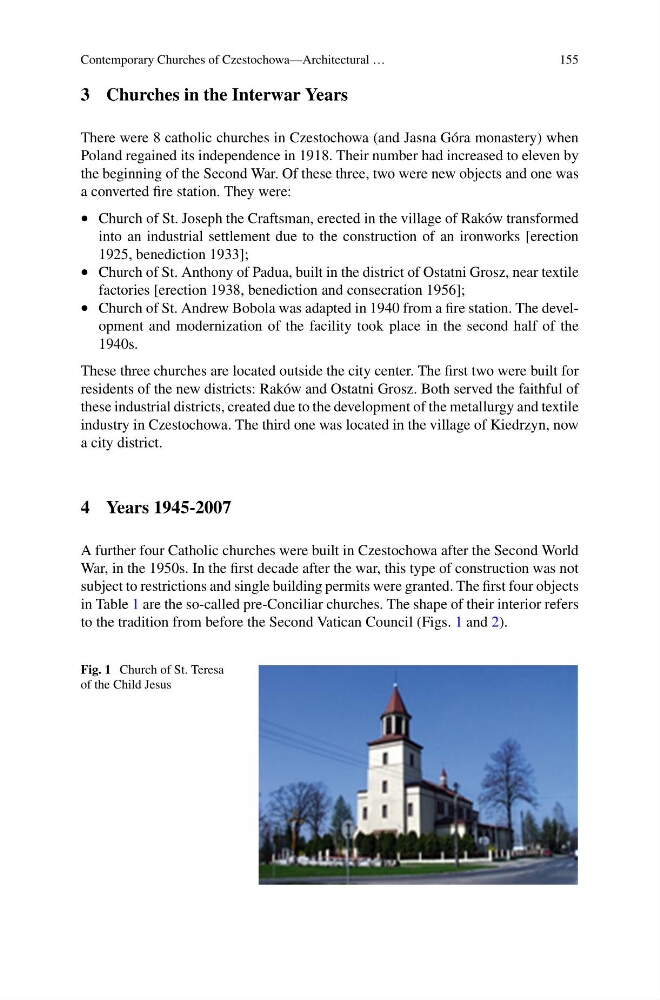
to the tradition from before the Second Vatican Council (Figs. 1 and 2).
Fig. 1 Church of St. Teresa
of the Child Jesus
155
3 Churches in the Interwar Years
There were 8 catholic churches in Czestochowa (and Jasna Góra monastery) when
Poland regained its independence in 1918. Their number had increased to eleven by
the beginning of the Second War. Of these three, two were new objects and one was
a converted fire station. They were:
• Church of St. Joseph the Craftsman, erected in the village of Raków transformed
into an industrial settlement due to the construction of an ironworks [erection
1925, benediction 1933];
• Church of St. Anthony of Padua, built in the district of Ostatni Grosz, near textile
factories [erection 1938, benediction and consecration 1956];
• Church of St. Andrew Bobola was adapted in 1940 from a fire station. The development and modernization of the facility took place in the second half of the
1940s.
These three churches are located outside the city center. The first two were built for
residents of the new districts: Raków and Ostatni Grosz. Both served the faithful of
these industrial districts, created due to the development of the metallurgy and textile
industry in Czestochowa. The third one was located in the village of Kiedrzyn, now
a city district.
4 Years 1945-2007
A further four Catholic churches were built in Czestochowa after the Second World
War, in the 1950s. In the first decade after the war, this type of construction was not
subject to restrictions and single building permits were granted. The first four objects
in Table 1 are the so-called pre-Conciliar churches. The shape of their interior refers
to the tradition from before the Second Vatican Council (Figs. 1 and 2).
Fig. 1 Church of St. Teresa
of the Child Jesus