

The Influence of Grinding Method on the Particle Size …
147
13
7
17
16
28
59
18
23
33
0
25
50
75
100
Dv(10)
Dv(50)
Dv(90)
Reduction of diameters
(%)
Cement
Fly ash
Ground granulated
blast furnace slag
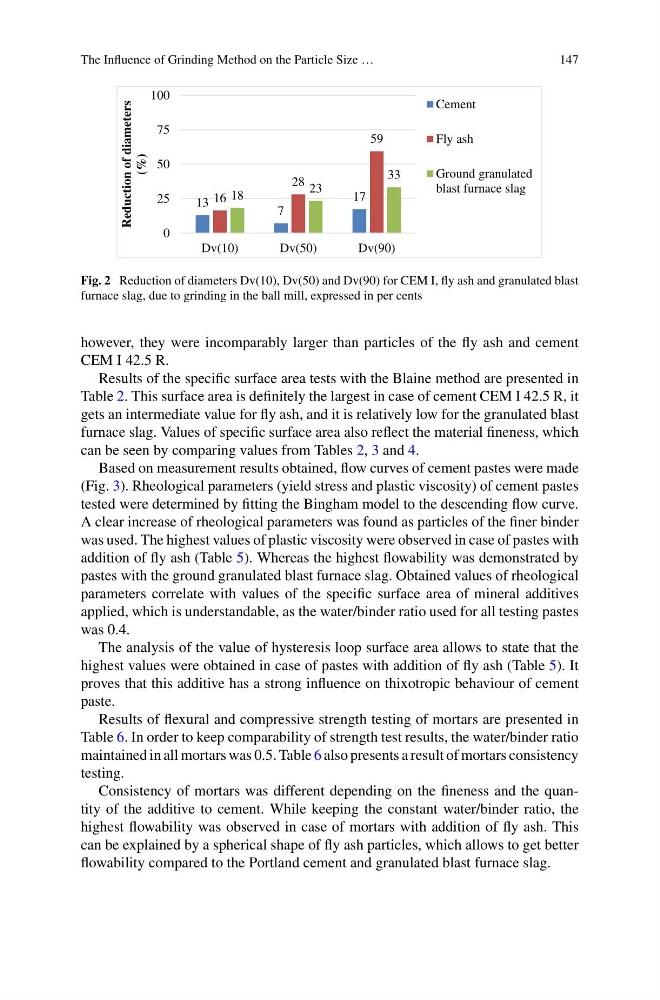
Fig. 2 Reduction of diameters Dv(10), Dv(50) and Dv(90) for CEM I, fly ash and granulated blast
furnace slag, due to grinding in the ball mill, expressed in per cents
however, they were incomparably larger than particles of the fly ash and cement
CEM I 42.5 R.
Results of the specific surface area tests with the Blaine method are presented in
Table 2. This surface area is definitely the largest in case of cement CEM I 42.5 R, it
gets an intermediate value for fly ash, and it is relatively low for the granulated blast
furnace slag. Values of specific surface area also reflect the material fineness, which
can be seen by comparing values from Tables 2, 3 and 4.
Based on measurement results obtained, flow curves of cement pastes were made
(Fig. 3). Rheological parameters (yield stress and plastic viscosity) of cement pastes
tested were determined by fitting the Bingham model to the descending flow curve.
A clear increase of rheological parameters was found as particles of the finer binder
was used. The highest values of plastic viscosity were observed in case of pastes with
addition of fly ash (Table 5). Whereas the highest flowability was demonstrated by
pastes with the ground granulated blast furnace slag. Obtained values of rheological
parameters correlate with values of the specific surface area of mineral additives
applied, which is understandable, as the water/binder ratio used for all testing pastes
was 0.4.
The analysis of the value of hysteresis loop surface area allows to state that the
highest values were obtained in case of pastes with addition of fly ash (Table 5). It
proves that this additive has a strong influence on thixotropic behaviour of cement
paste.
Results of flexural and compressive strength testing of mortars are presented in
Table 6. In order to keep comparability of strength test results, the water/binder ratio
maintained in all mortars was 0.5. Table 6 also presents a result of mortars consistency
testing.
Consistency of mortars was different depending on the fineness and the quantity of the additive to cement. While keeping the constant water/binder ratio, the
highest flowability was observed in case of mortars with addition of fly ash. This
can be explained by a spherical shape of fly ash particles, which allows to get better
flowability compared to the Portland cement and granulated blast furnace slag.
147
13
7
17
16
28
59
18
23
33
0
25
50
75
100
Dv(10)
Dv(50)
Dv(90)
Reduction of diameters
(%)
Cement
Fly ash
Ground granulated
blast furnace slag
Fig. 2 Reduction of diameters Dv(10), Dv(50) and Dv(90) for CEM I, fly ash and granulated blast
furnace slag, due to grinding in the ball mill, expressed in per cents
however, they were incomparably larger than particles of the fly ash and cement
CEM I 42.5 R.
Results of the specific surface area tests with the Blaine method are presented in
Table 2. This surface area is definitely the largest in case of cement CEM I 42.5 R, it
gets an intermediate value for fly ash, and it is relatively low for the granulated blast
furnace slag. Values of specific surface area also reflect the material fineness, which
can be seen by comparing values from Tables 2, 3 and 4.
Based on measurement results obtained, flow curves of cement pastes were made
(Fig. 3). Rheological parameters (yield stress and plastic viscosity) of cement pastes
tested were determined by fitting the Bingham model to the descending flow curve.
A clear increase of rheological parameters was found as particles of the finer binder
was used. The highest values of plastic viscosity were observed in case of pastes with
addition of fly ash (Table 5). Whereas the highest flowability was demonstrated by
pastes with the ground granulated blast furnace slag. Obtained values of rheological
parameters correlate with values of the specific surface area of mineral additives
applied, which is understandable, as the water/binder ratio used for all testing pastes
was 0.4.
The analysis of the value of hysteresis loop surface area allows to state that the
highest values were obtained in case of pastes with addition of fly ash (Table 5). It
proves that this additive has a strong influence on thixotropic behaviour of cement
paste.
Results of flexural and compressive strength testing of mortars are presented in
Table 6. In order to keep comparability of strength test results, the water/binder ratio
maintained in all mortars was 0.5. Table 6 also presents a result of mortars consistency
testing.
Consistency of mortars was different depending on the fineness and the quantity of the additive to cement. While keeping the constant water/binder ratio, the
highest flowability was observed in case of mortars with addition of fly ash. This
can be explained by a spherical shape of fly ash particles, which allows to get better
flowability compared to the Portland cement and granulated blast furnace slag.