

Underwater Concrete—Impact of Fine Particles in Cement …
133
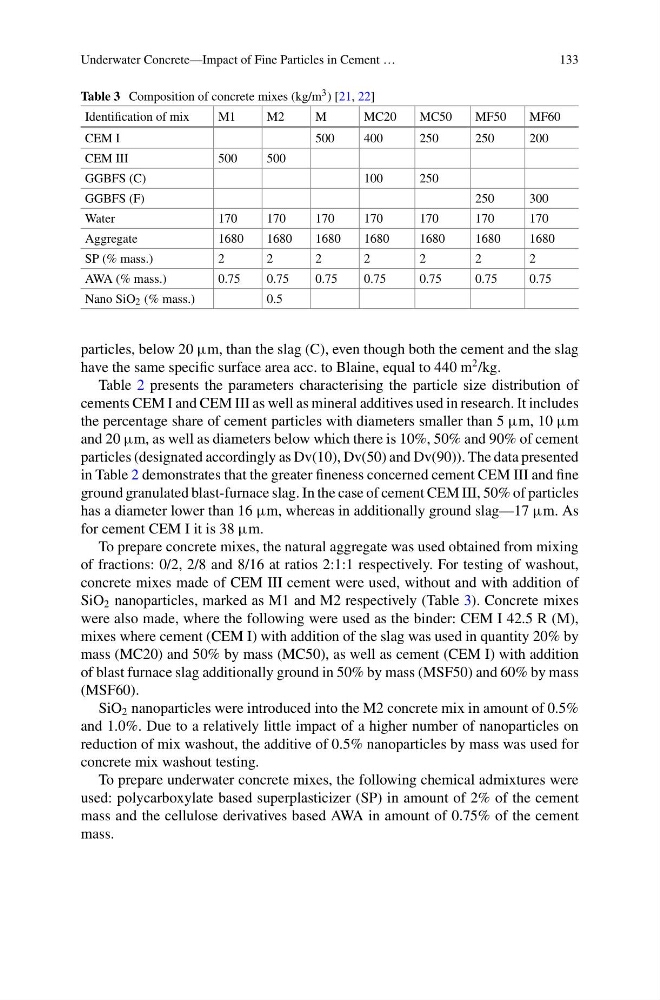
Table 3 Composition of concrete mixes (kg/m 3 ) [21, 22]
Identification of mix
M1
M2
M
MC20
MC50
MF50
MF60
CEM I
500
400
250
250
200
CEM III
500
500
GGBFS (C)
100
250
GGBFS (F)
250
300
Water
170
170
170
170
170
170
170
Aggregate
1680
1680
1680
1680
1680
1680
1680
SP (% mass.)
2
2
2
2
2
2
2
AWA (% mass.)
0.75
0.75
0.75
0.75
0.75
0.75
0.75
Nano SiO 2 (% mass.)
0.5
particles, below 20 µm, than the slag (C), even though both the cement and the slag
have the same specific surface area acc. to Blaine, equal to 440 m
2 /kg.
Table 2 presents the parameters characterising the particle size distribution of
cements CEM I and CEM III as well as mineral additives used in research. It includes
the percentage share of cement particles with diameters smaller than 5 µm, 10 µm
and 20 µm, as well as diameters below which there is 10%, 50% and 90% of cement
particles (designated accordingly as Dv(10), Dv(50) and Dv(90)). The data presented
in Table 2 demonstrates that the greater fineness concerned cement CEM III and fine
ground granulated blast-furnace slag. In the case of cement CEM III, 50% of particles
has a diameter lower than 16 µm, whereas in additionally ground slag—17 µm. As
for cement CEM I it is 38 µm.
To prepare concrete mixes, the natural aggregate was used obtained from mixing
of fractions: 0/2, 2/8 and 8/16 at ratios 2:1:1 respectively. For testing of washout,
concrete mixes made of CEM III cement were used, without and with addition of
SiO 2 nanoparticles, marked as M1 and M2 respectively (Table 3). Concrete mixes
were also made, where the following were used as the binder: CEM I 42.5 R (M),
mixes where cement (CEM I) with addition of the slag was used in quantity 20% by
mass (MC20) and 50% by mass (MC50), as well as cement (CEM I) with addition
of blast furnace slag additionally ground in 50% by mass (MSF50) and 60% by mass
(MSF60).
SiO 2 nanoparticles were introduced into the M2 concrete mix in amount of 0.5%
and 1.0%. Due to a relatively little impact of a higher number of nanoparticles on
reduction of mix washout, the additive of 0.5% nanoparticles by mass was used for
concrete mix washout testing.
To prepare underwater concrete mixes, the following chemical admixtures were
used: polycarboxylate based superplasticizer (SP) in amount of 2% of the cement
mass and the cellulose derivatives based AWA in amount of 0.75% of the cement
mass.
133
Table 3 Composition of concrete mixes (kg/m 3 ) [21, 22]
Identification of mix
M1
M2
M
MC20
MC50
MF50
MF60
CEM I
500
400
250
250
200
CEM III
500
500
GGBFS (C)
100
250
GGBFS (F)
250
300
Water
170
170
170
170
170
170
170
Aggregate
1680
1680
1680
1680
1680
1680
1680
SP (% mass.)
2
2
2
2
2
2
2
AWA (% mass.)
0.75
0.75
0.75
0.75
0.75
0.75
0.75
Nano SiO 2 (% mass.)
0.5
particles, below 20 µm, than the slag (C), even though both the cement and the slag
have the same specific surface area acc. to Blaine, equal to 440 m
2 /kg.
Table 2 presents the parameters characterising the particle size distribution of
cements CEM I and CEM III as well as mineral additives used in research. It includes
the percentage share of cement particles with diameters smaller than 5 µm, 10 µm
and 20 µm, as well as diameters below which there is 10%, 50% and 90% of cement
particles (designated accordingly as Dv(10), Dv(50) and Dv(90)). The data presented
in Table 2 demonstrates that the greater fineness concerned cement CEM III and fine
ground granulated blast-furnace slag. In the case of cement CEM III, 50% of particles
has a diameter lower than 16 µm, whereas in additionally ground slag—17 µm. As
for cement CEM I it is 38 µm.
To prepare concrete mixes, the natural aggregate was used obtained from mixing
of fractions: 0/2, 2/8 and 8/16 at ratios 2:1:1 respectively. For testing of washout,
concrete mixes made of CEM III cement were used, without and with addition of
SiO 2 nanoparticles, marked as M1 and M2 respectively (Table 3). Concrete mixes
were also made, where the following were used as the binder: CEM I 42.5 R (M),
mixes where cement (CEM I) with addition of the slag was used in quantity 20% by
mass (MC20) and 50% by mass (MC50), as well as cement (CEM I) with addition
of blast furnace slag additionally ground in 50% by mass (MSF50) and 60% by mass
(MSF60).
SiO 2 nanoparticles were introduced into the M2 concrete mix in amount of 0.5%
and 1.0%. Due to a relatively little impact of a higher number of nanoparticles on
reduction of mix washout, the additive of 0.5% nanoparticles by mass was used for
concrete mix washout testing.
To prepare underwater concrete mixes, the following chemical admixtures were
used: polycarboxylate based superplasticizer (SP) in amount of 2% of the cement
mass and the cellulose derivatives based AWA in amount of 0.75% of the cement
mass.