

124
E. Janowska-Renkas and D. Matyjaszczyk
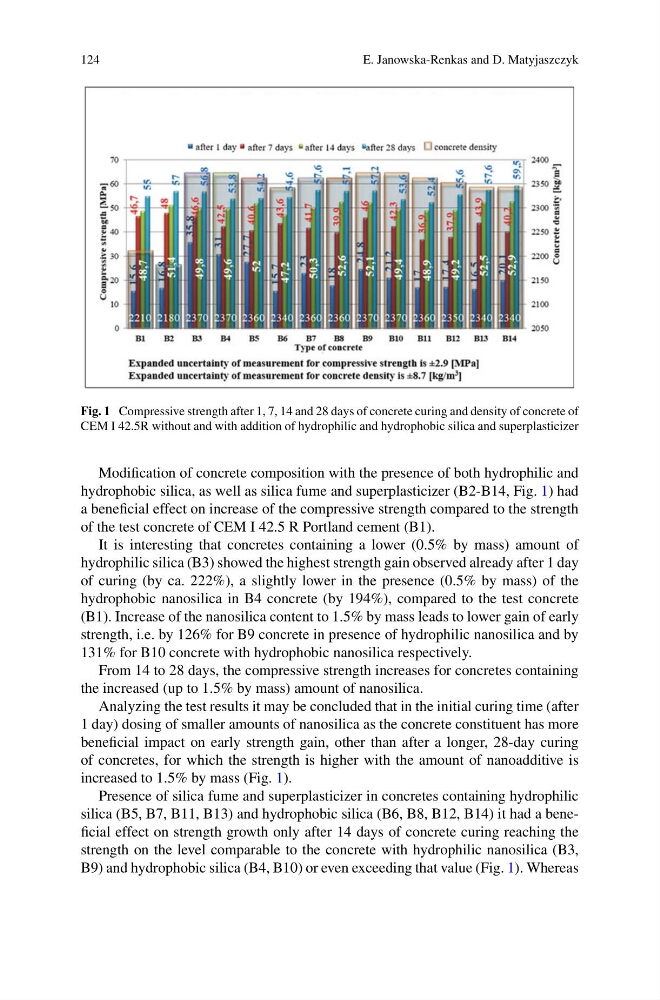
Fig. 1 Compressive strength after 1, 7, 14 and 28 days of concrete curing and density of concrete of
CEM I 42.5R without and with addition of hydrophilic and hydrophobic silica and superplasticizer
Modification of concrete composition with the presence of both hydrophilic and
hydrophobic silica, as well as silica fume and superplasticizer (B2-B14, Fig. 1) had
a beneficial effect on increase of the compressive strength compared to the strength
of the test concrete of CEM I 42.5 R Portland cement (B1).
It is interesting that concretes containing a lower (0.5% by mass) amount of
hydrophilic silica (B3) showed the highest strength gain observed already after 1 day
of curing (by ca. 222%), a slightly lower in the presence (0.5% by mass) of the
hydrophobic nanosilica in B4 concrete (by 194%), compared to the test concrete
(B1). Increase of the nanosilica content to 1.5% by mass leads to lower gain of early
strength, i.e. by 126% for B9 concrete in presence of hydrophilic nanosilica and by
131% for B10 concrete with hydrophobic nanosilica respectively.
From 14 to 28 days, the compressive strength increases for concretes containing
the increased (up to 1.5% by mass) amount of nanosilica.
Analyzing the test results it may be concluded that in the initial curing time (after
1 day) dosing of smaller amounts of nanosilica as the concrete constituent has more
beneficial impact on early strength gain, other than after a longer, 28-day curing
of concretes, for which the strength is higher with the amount of nanoadditive is
increased to 1.5% by mass (Fig. 1).
Presence of silica fume and superplasticizer in concretes containing hydrophilic
silica (B5, B7, B11, B13) and hydrophobic silica (B6, B8, B12, B14) it had a beneficial effect on strength growth only after 14 days of concrete curing reaching the
strength on the level comparable to the concrete with hydrophilic nanosilica (B3,
B9) and hydrophobic silica (B4, B10) or even exceeding that value (Fig. 1). Whereas
E. Janowska-Renkas and D. Matyjaszczyk
Fig. 1 Compressive strength after 1, 7, 14 and 28 days of concrete curing and density of concrete of
CEM I 42.5R without and with addition of hydrophilic and hydrophobic silica and superplasticizer
Modification of concrete composition with the presence of both hydrophilic and
hydrophobic silica, as well as silica fume and superplasticizer (B2-B14, Fig. 1) had
a beneficial effect on increase of the compressive strength compared to the strength
of the test concrete of CEM I 42.5 R Portland cement (B1).
It is interesting that concretes containing a lower (0.5% by mass) amount of
hydrophilic silica (B3) showed the highest strength gain observed already after 1 day
of curing (by ca. 222%), a slightly lower in the presence (0.5% by mass) of the
hydrophobic nanosilica in B4 concrete (by 194%), compared to the test concrete
(B1). Increase of the nanosilica content to 1.5% by mass leads to lower gain of early
strength, i.e. by 126% for B9 concrete in presence of hydrophilic nanosilica and by
131% for B10 concrete with hydrophobic nanosilica respectively.
From 14 to 28 days, the compressive strength increases for concretes containing
the increased (up to 1.5% by mass) amount of nanosilica.
Analyzing the test results it may be concluded that in the initial curing time (after
1 day) dosing of smaller amounts of nanosilica as the concrete constituent has more
beneficial impact on early strength gain, other than after a longer, 28-day curing
of concretes, for which the strength is higher with the amount of nanoadditive is
increased to 1.5% by mass (Fig. 1).
Presence of silica fume and superplasticizer in concretes containing hydrophilic
silica (B5, B7, B11, B13) and hydrophobic silica (B6, B8, B12, B14) it had a beneficial effect on strength growth only after 14 days of concrete curing reaching the
strength on the level comparable to the concrete with hydrophilic nanosilica (B3,
B9) and hydrophobic silica (B4, B10) or even exceeding that value (Fig. 1). Whereas