

484
Practical MATLAB
® Applications for Engineers
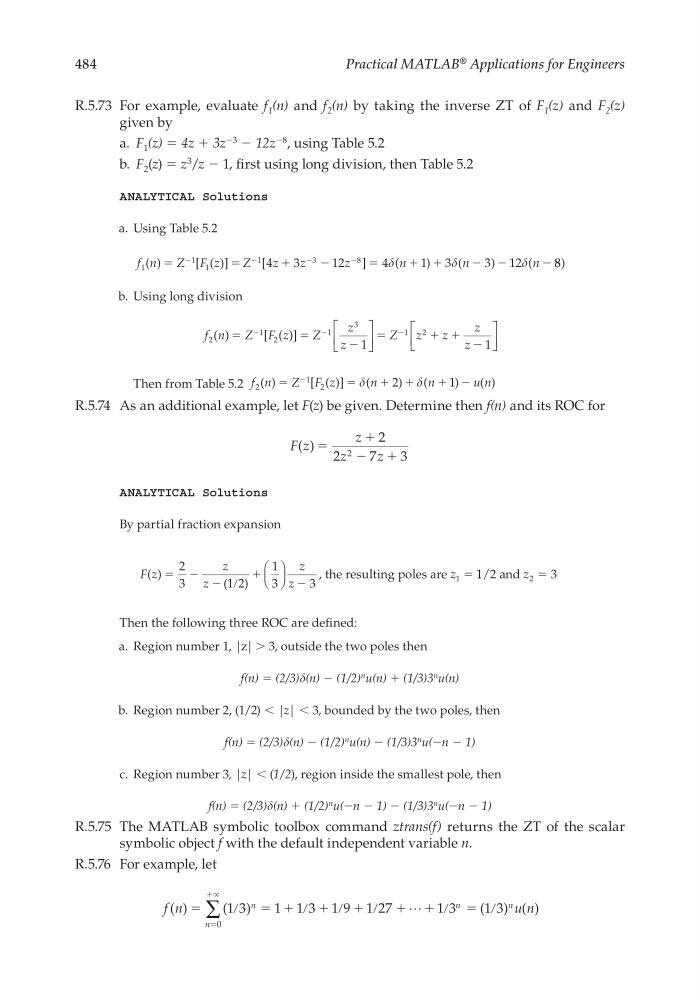
R.5.73 For example, evaluate f 1 (n) and f 2 (n) by taking the inverse ZT of F 1 (z) and F 2 (z)
given by
a. F 1 (z) = 4z + 3z
−3
− 12z
−8
, using Table 5.2
b. F 2 (z) = z
3
/z − 1, fi rst using long division, then Table 5.2
ANALYTICAL Solutions
a. Using Table 5.2
f n
Z F z
Z
z
z
z
n
n
n
1
1
1
1
3
8
4
3
12
4
1 3
3 12
( )
[ ( )]
[
]
(
)
(
)
(
ϭ
ϭ
ϩ
Ϫ
ϭ
ϩ ϩ
Ϫ Ϫ
Ϫ
Ϫ
Ϫ
Ϫ
Ϫ
8 8)
b. Using long division
f n
Z F z
Z
z
z
Z z
z
z
z
2
1
2
1
3
1
2
1
1
( )
[ ( )]
ϭ
ϭ
Ϫ
ϭ
ϩ ϩ Ϫ
Ϫ
Ϫ
Ϫ
Then from Table 5.2 f n
Z F z
n
n
u n
2
1
2
2
1
( )
[ ( )]
(
)
(
)
( )
ϭ
ϭ
ϩ ϩ
ϩ Ϫ
Ϫ
R.5.74 As an additional example, let F(z) be given. Determine then f(n) and its ROC for
F z
z
z
z
( ) ϭ
ϩ
Ϫ ϩ
2
2
7
3
2
ANALYTICAL Solutions
By partial fraction expansion
F z
z
z
z
z
( )
( )
ϭ Ϫ Ϫ ր
ϩ
Ϫ
2
3
12
1
3
3
, the resulting poles are 1
z ϭ 1 1/2 and
3
2
z ϭ
Then the following three ROC are defi ned:
a. Region number 1, |z| > 3, outside the two poles then
f(n) = (2/3)(n) − (1/2)
n u(n) + (1/3)3
n u(n)
b. Region number 2, (1/2) < |z| < 3, bounded by the two poles, then
f(n) = (2/3)(n) − (1/2)
n u(n) − (1/3)3
n u(−n − 1)
c. Region number 3, |z| < (1/2), region inside the smallest pole, then
f(n) = (2/3)(n) + (1/2)
n u(−n − 1) − (1/3)3
n u(−n − 1)
R.5.75 The MATLAB symbolic toolbox command ztrans(f) returns the ZT of the scalar
symbolic object f with the default independent variable n.
R.5.76 For example, let
f n
u n
n
n
n
n
( )
( )
( ) ( )
ϭ
ր
ϭ ϩ ր ϩ ր ϩ ր ϩ ϩ ր ϭ ր
ϭ
ϩϱ
1 3
1 1 3 1 9 1 27
1 3
1 3
0
∑
CRC_47760_CH005.indd 484
CRC_47760_CH005.indd 484
7/23/2008 1:47:24 PM
7/23/2008 1:47:24 PM
Practical MATLAB
® Applications for Engineers
R.5.73 For example, evaluate f 1 (n) and f 2 (n) by taking the inverse ZT of F 1 (z) and F 2 (z)
given by
a. F 1 (z) = 4z + 3z
−3
− 12z
−8
, using Table 5.2
b. F 2 (z) = z
3
/z − 1, fi rst using long division, then Table 5.2
ANALYTICAL Solutions
a. Using Table 5.2
f n
Z F z
Z
z
z
z
n
n
n
1
1
1
1
3
8
4
3
12
4
1 3
3 12
( )
[ ( )]
[
]
(
)
(
)
(
ϭ
ϭ
ϩ
Ϫ
ϭ
ϩ ϩ
Ϫ Ϫ
Ϫ
Ϫ
Ϫ
Ϫ
Ϫ
8 8)
b. Using long division
f n
Z F z
Z
z
z
Z z
z
z
z
2
1
2
1
3
1
2
1
1
( )
[ ( )]
ϭ
ϭ
Ϫ
ϭ
ϩ ϩ Ϫ
Ϫ
Ϫ
Ϫ
Then from Table 5.2 f n
Z F z
n
n
u n
2
1
2
2
1
( )
[ ( )]
(
)
(
)
( )
ϭ
ϭ
ϩ ϩ
ϩ Ϫ
Ϫ
R.5.74 As an additional example, let F(z) be given. Determine then f(n) and its ROC for
F z
z
z
z
( ) ϭ
ϩ
Ϫ ϩ
2
2
7
3
2
ANALYTICAL Solutions
By partial fraction expansion
F z
z
z
z
z
( )
( )
ϭ Ϫ Ϫ ր
ϩ
Ϫ
2
3
12
1
3
3
, the resulting poles are 1
z ϭ 1 1/2 and
3
2
z ϭ
Then the following three ROC are defi ned:
a. Region number 1, |z| > 3, outside the two poles then
f(n) = (2/3)(n) − (1/2)
n u(n) + (1/3)3
n u(n)
b. Region number 2, (1/2) < |z| < 3, bounded by the two poles, then
f(n) = (2/3)(n) − (1/2)
n u(n) − (1/3)3
n u(−n − 1)
c. Region number 3, |z| < (1/2), region inside the smallest pole, then
f(n) = (2/3)(n) + (1/2)
n u(−n − 1) − (1/3)3
n u(−n − 1)
R.5.75 The MATLAB symbolic toolbox command ztrans(f) returns the ZT of the scalar
symbolic object f with the default independent variable n.
R.5.76 For example, let
f n
u n
n
n
n
n
( )
( )
( ) ( )
ϭ
ր
ϭ ϩ ր ϩ ր ϩ ր ϩ ϩ ր ϭ ր
ϭ
ϩϱ
1 3
1 1 3 1 9 1 27
1 3
1 3
0
∑
CRC_47760_CH005.indd 484
CRC_47760_CH005.indd 484
7/23/2008 1:47:24 PM
7/23/2008 1:47:24 PM