

356
Practical MATLAB
® Applications for Engineers
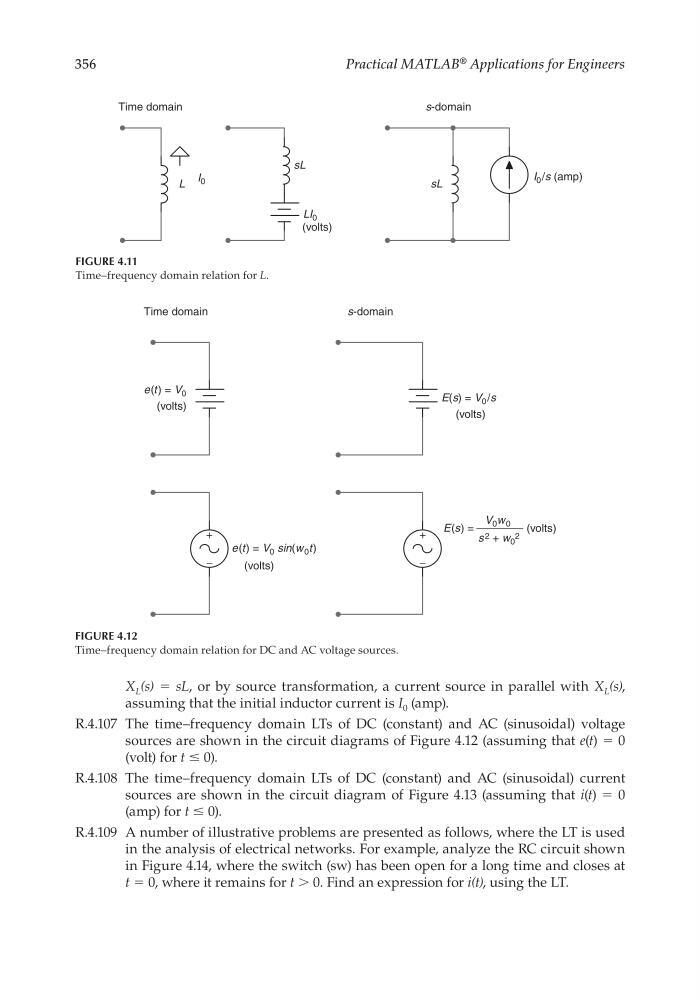
X L (s) = sL, or by source transformation, a current source in parallel with X L (s),
assuming that the initial inductor current is I 0 (amp).
R.4.107 The time–frequency domain LTs of DC (constant) and AC (sinusoidal) voltage
sources are shown in the circuit diagrams of Figure 4.12 (assuming that e(t) = 0
(volt) for t ≤ 0).
R.4.108 The time–frequency domain LTs of DC (constant) and AC (sinusoidal) current
sources are shown in the circuit diagram of Figure 4.13 (assuming that i(t) = 0
(amp) for t ≤ 0).
R.4.109 A number of illustrative problems are presented as follows, where the LT is used
in the analysis of electrical networks. For example, analyze the RC circuit shown
in Figure 4.14, where the switch (sw) has been open for a long time and closes at
t = 0, where it remains for t > 0. Find an expression for i(t), using the LT.
Time domain
s-domain
LI 0
I 0 /s (amp)
L
sL
sL
I 0
(volts)
FIGURE 4.11
Time–frequency domain relation for L.
s-domain
Time domain
E(s) = V 0 /s
e(t ) = V 0
E(s) =
e(t) = V 0 sin(w 0 t)
−
+
−
+
(volts)
(volts)
(volts)
(volts)
V 0 w 0
s 2 + w 0
2
FIGURE 4.12
Time–frequency domain relation for DC and AC voltage sources.
CRC_47760_CH004.indd 356
CRC_47760_CH004.indd 356
7/28/2008 12:26:00 PM
7/28/2008 12:26:00 PM
Practical MATLAB
® Applications for Engineers
X L (s) = sL, or by source transformation, a current source in parallel with X L (s),
assuming that the initial inductor current is I 0 (amp).
R.4.107 The time–frequency domain LTs of DC (constant) and AC (sinusoidal) voltage
sources are shown in the circuit diagrams of Figure 4.12 (assuming that e(t) = 0
(volt) for t ≤ 0).
R.4.108 The time–frequency domain LTs of DC (constant) and AC (sinusoidal) current
sources are shown in the circuit diagram of Figure 4.13 (assuming that i(t) = 0
(amp) for t ≤ 0).
R.4.109 A number of illustrative problems are presented as follows, where the LT is used
in the analysis of electrical networks. For example, analyze the RC circuit shown
in Figure 4.14, where the switch (sw) has been open for a long time and closes at
t = 0, where it remains for t > 0. Find an expression for i(t), using the LT.
Time domain
s-domain
LI 0
I 0 /s (amp)
L
sL
sL
I 0
(volts)
FIGURE 4.11
Time–frequency domain relation for L.
s-domain
Time domain
E(s) = V 0 /s
e(t ) = V 0
E(s) =
e(t) = V 0 sin(w 0 t)
−
+
−
+
(volts)
(volts)
(volts)
(volts)
V 0 w 0
s 2 + w 0
2
FIGURE 4.12
Time–frequency domain relation for DC and AC voltage sources.
CRC_47760_CH004.indd 356
CRC_47760_CH004.indd 356
7/28/2008 12:26:00 PM
7/28/2008 12:26:00 PM