

352
Practical MATLAB
® Applications for Engineers
be a system transfer function.
Verify that multiple poles are present in H(s), and evaluate the MATLAB partial
fraction expansion of H(s).
MATLAB Solution
>> num = [5 7 3 5 -30];
>> den = [1 4 7 6 2];
>> [r,p,k] = residue(num,den)
r =
% PFE coefficients
-6.5000 -20.5000I
-6.5000 +20.5000i
0.0000
-34.0000
p =
% poles
-1.0000 + 1.0000i
-1.0000 - 1.0000i
-1.0000
-1.0000
k =
% stand alone term
5
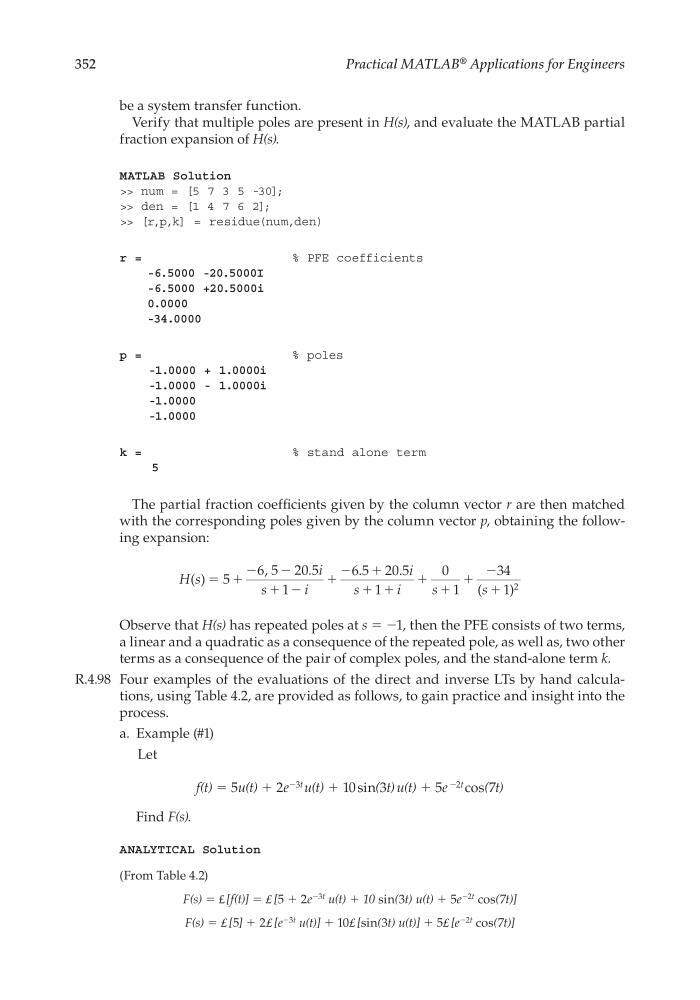
The partial fraction coeffi cients given by the column vector r are then matched
with the corresponding poles given by the column vector p, obtaining the following expansion:
H s
i
s
i
i
s
i
s
s
( )
,
.
.
.
(
)
ϭ ϩ
ϩ
ϩ
ϩ
ϩ ϩ
ϩ ϩ
ϩ ϩ
5
6 5 20 5
1
6 5 20 5
1
0
1
34
1
2
Ϫ
Ϫ
Ϫ
Ϫ
Ϫ
Observe that H(s) has repeated poles at s = −1, then the PFE consists of two terms,
a linear and a quadratic as a consequence of the repeated pole, as well as, two other
terms as a consequence of the pair of complex poles, and the stand-alone term k.
R.4.98 Four examples of the evaluations of the direct and inverse LTs by hand calculations, using Table 4.2, are provided as follows, to gain practice and insight into the
process.
a. Example (#1)
Let
f(t) = 5u(t) + 2e
−3t u(t) + 10 sin(3t) u(t) + 5e
−2t cos(7t)
Find F(s).
ANALYTICAL Solution
(From Table 4.2)
F(s) = £ [f(t)] = £ [5 + 2e
−3t u(t) + 10 sin(3t) u(t) + 5e
−2t cos(7t)]
F(s) = £ [5] + 2£ [e
−3t u(t)] + 10£ [sin(3t) u(t)] + 5£ [e
−2t cos(7t)]
CRC_47760_CH004.indd 352
CRC_47760_CH004.indd 352
7/28/2008 12:25:58 PM
7/28/2008 12:25:58 PM
Practical MATLAB
® Applications for Engineers
be a system transfer function.
Verify that multiple poles are present in H(s), and evaluate the MATLAB partial
fraction expansion of H(s).
MATLAB Solution
>> num = [5 7 3 5 -30];
>> den = [1 4 7 6 2];
>> [r,p,k] = residue(num,den)
r =
% PFE coefficients
-6.5000 -20.5000I
-6.5000 +20.5000i
0.0000
-34.0000
p =
% poles
-1.0000 + 1.0000i
-1.0000 - 1.0000i
-1.0000
-1.0000
k =
% stand alone term
5
The partial fraction coeffi cients given by the column vector r are then matched
with the corresponding poles given by the column vector p, obtaining the following expansion:
H s
i
s
i
i
s
i
s
s
( )
,
.
.
.
(
)
ϭ ϩ
ϩ
ϩ
ϩ
ϩ ϩ
ϩ ϩ
ϩ ϩ
5
6 5 20 5
1
6 5 20 5
1
0
1
34
1
2
Ϫ
Ϫ
Ϫ
Ϫ
Ϫ
Observe that H(s) has repeated poles at s = −1, then the PFE consists of two terms,
a linear and a quadratic as a consequence of the repeated pole, as well as, two other
terms as a consequence of the pair of complex poles, and the stand-alone term k.
R.4.98 Four examples of the evaluations of the direct and inverse LTs by hand calculations, using Table 4.2, are provided as follows, to gain practice and insight into the
process.
a. Example (#1)
Let
f(t) = 5u(t) + 2e
−3t u(t) + 10 sin(3t) u(t) + 5e
−2t cos(7t)
Find F(s).
ANALYTICAL Solution
(From Table 4.2)
F(s) = £ [f(t)] = £ [5 + 2e
−3t u(t) + 10 sin(3t) u(t) + 5e
−2t cos(7t)]
F(s) = £ [5] + 2£ [e
−3t u(t)] + 10£ [sin(3t) u(t)] + 5£ [e
−2t cos(7t)]
CRC_47760_CH004.indd 352
CRC_47760_CH004.indd 352
7/28/2008 12:25:58 PM
7/28/2008 12:25:58 PM