

Fourier and Laplace
337
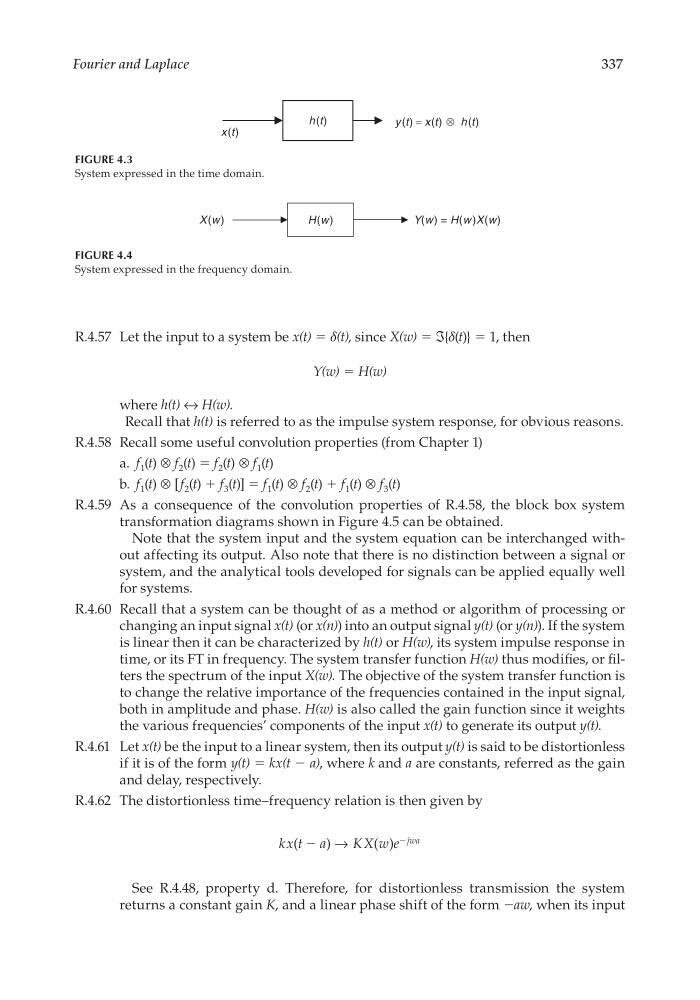
R.4.57 Let the input to a system be x(t) = δ(t), since X(w) = ℑ{δ(t)} = 1, then
Y(w) = H(w)
where h(t) ↔ H(w).
Recall that h(t) is referred to as the impulse system response, for obvious reasons.
R.4.58 Recall some useful convolution properties (from Chapter 1)
a. f 1 (t) ⊗ f 2 (t) = f 2 (t) ⊗ f 1 (t)
b. f 1 (t) ⊗ [f 2 (t) + f 3 (t)] = f 1 (t) ⊗ f 2 (t) + f 1 (t) ⊗ f 3 (t)
R.4.59 As a consequence of the convolution properties of R.4.58, the block box system
transformation diagrams shown in Figure 4.5 can be obtained.
Note that the system input and the system equation can be interchanged without affecting its output. Also note that there is no distinction between a signal or
system, and the analytical tools developed for signals can be applied equally well
for systems.
R.4.60 Recall that a system can be thought of as a method or algorithm of processing or
changing an input signal x(t) (or x(n)) into an output signal y(t) (or y(n)). If the system
is linear then it can be characterized by h(t) or H(w), its system impulse response in
time, or its FT in frequency. The system transfer function H(w) thus modifi es, or fi lters the spectrum of the input X(w). The objective of the system transfer function is
to change the relative importance of the frequencies contained in the input signal,
both in amplitude and phase. H(w) is also called the gain function since it weights
the various frequencies’ components of the input x(t) to generate its output y(t).
R.4.61 Let x(t) be the input to a linear system, then its output y(t) is said to be distortionless
if it is of the form y(t) = kx(t − a), where k and a are constants, referred as the gain
and delay, respectively.
R.4.62 The distortionless time–frequency relation is then given by
kx t a
KX w e
jwa
(
)
( )
Ϫ
Ϫ
→
See R.4.48, property d. Therefore, for distortionless transmission the system
returns a constant gain K, and a linear phase shift of the form −aw, when its input
h (t)
h (t)
x(t)
y (t)
⊗
=
x (t)
FIGURE 4.3
System expressed in the time domain.
H(w )
X(w )
Y(w) = H(w )X(w)
FIGURE 4.4
System expressed in the frequency domain.
CRC_47760_CH004.indd 337
CRC_47760_CH004.indd 337
7/28/2008 12:25:55 PM
7/28/2008 12:25:55 PM
337
R.4.57 Let the input to a system be x(t) = δ(t), since X(w) = ℑ{δ(t)} = 1, then
Y(w) = H(w)
where h(t) ↔ H(w).
Recall that h(t) is referred to as the impulse system response, for obvious reasons.
R.4.58 Recall some useful convolution properties (from Chapter 1)
a. f 1 (t) ⊗ f 2 (t) = f 2 (t) ⊗ f 1 (t)
b. f 1 (t) ⊗ [f 2 (t) + f 3 (t)] = f 1 (t) ⊗ f 2 (t) + f 1 (t) ⊗ f 3 (t)
R.4.59 As a consequence of the convolution properties of R.4.58, the block box system
transformation diagrams shown in Figure 4.5 can be obtained.
Note that the system input and the system equation can be interchanged without affecting its output. Also note that there is no distinction between a signal or
system, and the analytical tools developed for signals can be applied equally well
for systems.
R.4.60 Recall that a system can be thought of as a method or algorithm of processing or
changing an input signal x(t) (or x(n)) into an output signal y(t) (or y(n)). If the system
is linear then it can be characterized by h(t) or H(w), its system impulse response in
time, or its FT in frequency. The system transfer function H(w) thus modifi es, or fi lters the spectrum of the input X(w). The objective of the system transfer function is
to change the relative importance of the frequencies contained in the input signal,
both in amplitude and phase. H(w) is also called the gain function since it weights
the various frequencies’ components of the input x(t) to generate its output y(t).
R.4.61 Let x(t) be the input to a linear system, then its output y(t) is said to be distortionless
if it is of the form y(t) = kx(t − a), where k and a are constants, referred as the gain
and delay, respectively.
R.4.62 The distortionless time–frequency relation is then given by
kx t a
KX w e
jwa
(
)
( )
Ϫ
Ϫ
→
See R.4.48, property d. Therefore, for distortionless transmission the system
returns a constant gain K, and a linear phase shift of the form −aw, when its input
h (t)
h (t)
x(t)
y (t)
⊗
=
x (t)
FIGURE 4.3
System expressed in the time domain.
H(w )
X(w )
Y(w) = H(w )X(w)
FIGURE 4.4
System expressed in the frequency domain.
CRC_47760_CH004.indd 337
CRC_47760_CH004.indd 337
7/28/2008 12:25:55 PM
7/28/2008 12:25:55 PM