

Direct Current and Transient Analysis
191
5. By using MATLAB, verify the solution v C (t) obtained in part 2 by applying KVL
around the active loop for t > 0.
6. Compare the results of part 1 with the results of part 2 and 3.
ANALYTICAL Solution
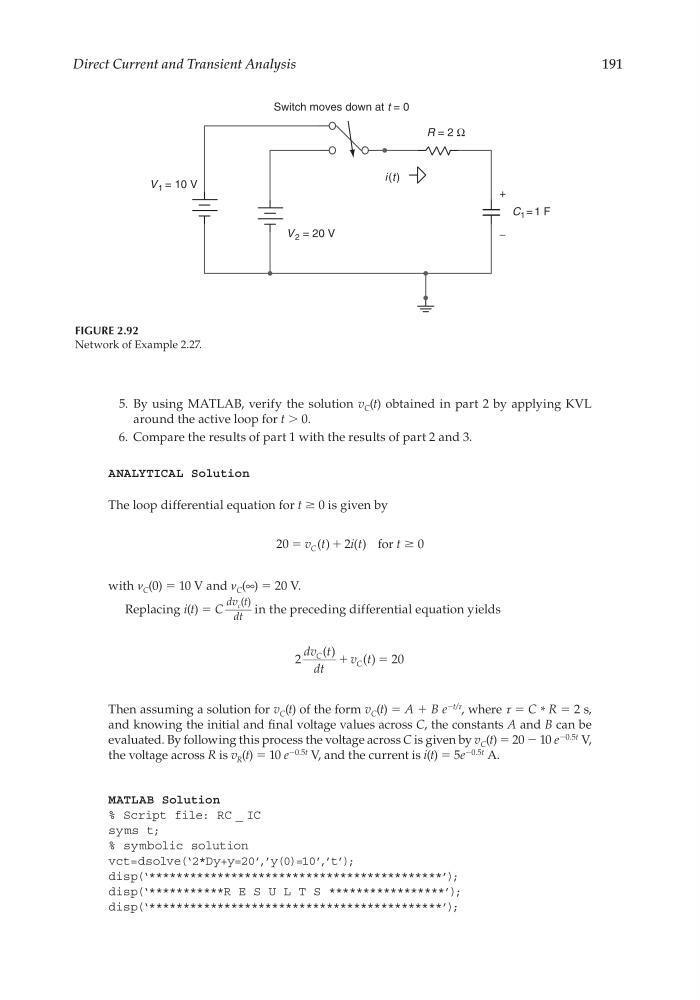
The loop differential equation for t ≥ 0 is given by
20
2
ϭ
ϩ
Ն
v t
i t
C ( )
( ) for
0
t
with ν C (0) = 10 V and ν C (∞) = 20 V.
Replacing i(t) = C
dv c (t)
_____
dt
in the preceding differential equation yields
2
2 0
dv t
dt
v t
C
C
( )
( )
ϩ
ϭ
Then assuming a solution for v C (t) of the form v C (t) = A + B e
−t/τ
, where τ = C * R = 2 s,
and knowing the initial and fi nal voltage values across C, the constants A and B can be
evaluated. By following this process the voltage across C is given by v C (t) = 20 − 10 e
−0.5t V,
the voltage across R is v R (t) = 10 e
−0.5t V, and the current is i(t) = 5e
−0.5t A.
MATLAB Solution
% Script file: RC _ IC
syms t;
% symbolic solution
vct=dsolve(‘2*Dy+y=20’,’y(0)=10’,’t’);
disp(‘*******************************************’);
disp(‘***********R E S U L T S *****************’);
disp(‘*******************************************’);
FIGURE 2.92
Network of Example 2.27.
V 1 = 10 V
Switch moves down at t = 0
+
−
C 1 = 1 F
R = 2 Ω
V 2 = 20 V
i (t )
CRC_47760_CH002.indd 191
CRC_47760_CH002.indd 191
7/23/2008 1:38:58 PM
7/23/2008 1:38:58 PM
191
5. By using MATLAB, verify the solution v C (t) obtained in part 2 by applying KVL
around the active loop for t > 0.
6. Compare the results of part 1 with the results of part 2 and 3.
ANALYTICAL Solution
The loop differential equation for t ≥ 0 is given by
20
2
ϭ
ϩ
Ն
v t
i t
C ( )
( ) for
0
t
with ν C (0) = 10 V and ν C (∞) = 20 V.
Replacing i(t) = C
dv c (t)
_____
dt
in the preceding differential equation yields
2
2 0
dv t
dt
v t
C
C
( )
( )
ϩ
ϭ
Then assuming a solution for v C (t) of the form v C (t) = A + B e
−t/τ
, where τ = C * R = 2 s,
and knowing the initial and fi nal voltage values across C, the constants A and B can be
evaluated. By following this process the voltage across C is given by v C (t) = 20 − 10 e
−0.5t V,
the voltage across R is v R (t) = 10 e
−0.5t V, and the current is i(t) = 5e
−0.5t A.
MATLAB Solution
% Script file: RC _ IC
syms t;
% symbolic solution
vct=dsolve(‘2*Dy+y=20’,’y(0)=10’,’t’);
disp(‘*******************************************’);
disp(‘***********R E S U L T S *****************’);
disp(‘*******************************************’);
FIGURE 2.92
Network of Example 2.27.
V 1 = 10 V
Switch moves down at t = 0
+
−
C 1 = 1 F
R = 2 Ω
V 2 = 20 V
i (t )
CRC_47760_CH002.indd 191
CRC_47760_CH002.indd 191
7/23/2008 1:38:58 PM
7/23/2008 1:38:58 PM