

Direct Current and Transient Analysis
165
Example 2.20
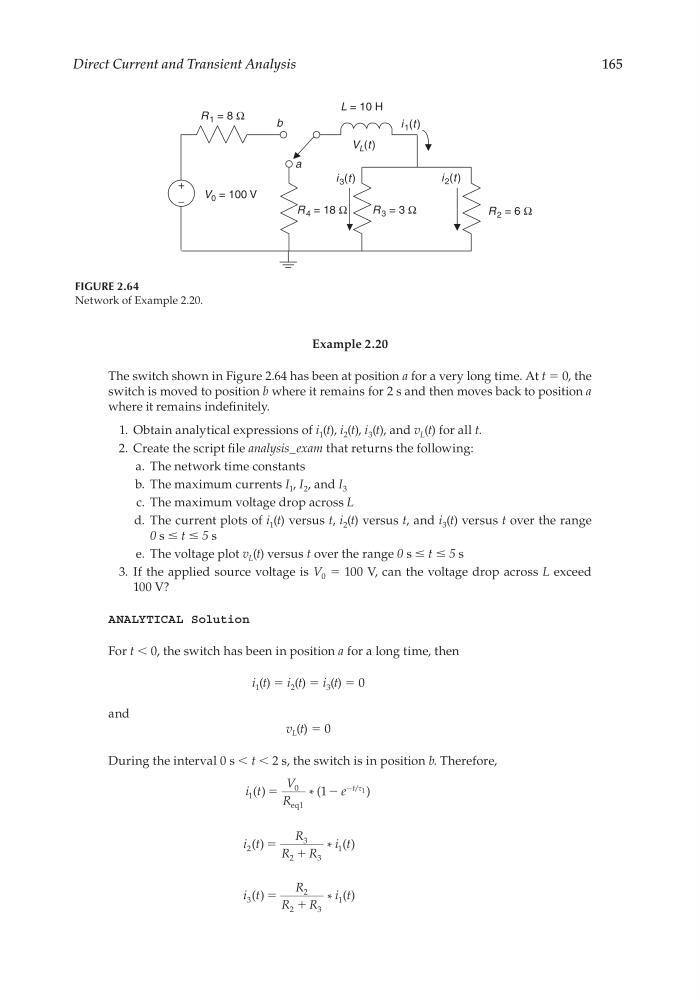
The switch shown in Figure 2.64 has been at position a for a very long time. At t = 0, the
switch is moved to position b where it remains for 2 s and then moves back to position a
where it remains indefi nitely.
1. Obtain analytical expressions of i 1 (t), i 2 (t), i 3 (t), and v L (t) for all t.
2. Create the script fi le analysis_exam that returns the following:
a. The network time constants
b. The maximum currents I 1 , I 2 , and I 3
c. The maximum voltage drop across L
d. The current plots of i 1 (t) versus t, i 2 (t) versus t, and i 3 (t) versus t over the range
0 s ≤ t ≤ 5 s
e. The voltage plot v L (t) versus t over the range 0 s ≤ t ≤ 5 s
3. If the applied source voltage is V 0 = 100 V, can the voltage drop across L exceed
100 V?
ANALYTICAL Solution
For t < 0, the switch has been in position a for a long time, then
i 1 (t) = i 2 (t) = i 3 (t) = 0
and
v L (t) = 0
During the interval 0 s < t < 2 s, the switch is in position b. Therefore,
i t
V
R
e
t
1
1
1
( )
* (
)
/
ϭ
0
eq
1
Ϫ
Ϫ
i t
R
R
R
i t
2
3
2
3
1
( )
* ( )
ϭ
ϩ
i t
R
R
R
i t
3
2
2
3
1
( )
* ( )
ϭ
ϩ
FIGURE 2.64
Network of Example 2.20.
b
a
L = 10 H
i 1 (t )
i 2 (t )
i 3 (t )
V L (t )
R 1 = 8 Ω
R 2 = 6 Ω
R 3 = 3 Ω
R 4 = 18 Ω
V 0 = 100 V
+
−
CRC_47760_CH002.indd 165
CRC_47760_CH002.indd 165
7/23/2008 1:38:52 PM
7/23/2008 1:38:52 PM
165
Example 2.20
The switch shown in Figure 2.64 has been at position a for a very long time. At t = 0, the
switch is moved to position b where it remains for 2 s and then moves back to position a
where it remains indefi nitely.
1. Obtain analytical expressions of i 1 (t), i 2 (t), i 3 (t), and v L (t) for all t.
2. Create the script fi le analysis_exam that returns the following:
a. The network time constants
b. The maximum currents I 1 , I 2 , and I 3
c. The maximum voltage drop across L
d. The current plots of i 1 (t) versus t, i 2 (t) versus t, and i 3 (t) versus t over the range
0 s ≤ t ≤ 5 s
e. The voltage plot v L (t) versus t over the range 0 s ≤ t ≤ 5 s
3. If the applied source voltage is V 0 = 100 V, can the voltage drop across L exceed
100 V?
ANALYTICAL Solution
For t < 0, the switch has been in position a for a long time, then
i 1 (t) = i 2 (t) = i 3 (t) = 0
and
v L (t) = 0
During the interval 0 s < t < 2 s, the switch is in position b. Therefore,
i t
V
R
e
t
1
1
1
( )
* (
)
/
ϭ
0
eq
1
Ϫ
Ϫ
i t
R
R
R
i t
2
3
2
3
1
( )
* ( )
ϭ
ϩ
i t
R
R
R
i t
3
2
2
3
1
( )
* ( )
ϭ
ϩ
FIGURE 2.64
Network of Example 2.20.
b
a
L = 10 H
i 1 (t )
i 2 (t )
i 3 (t )
V L (t )
R 1 = 8 Ω
R 2 = 6 Ω
R 3 = 3 Ω
R 4 = 18 Ω
V 0 = 100 V
+
−
CRC_47760_CH002.indd 165
CRC_47760_CH002.indd 165
7/23/2008 1:38:52 PM
7/23/2008 1:38:52 PM