

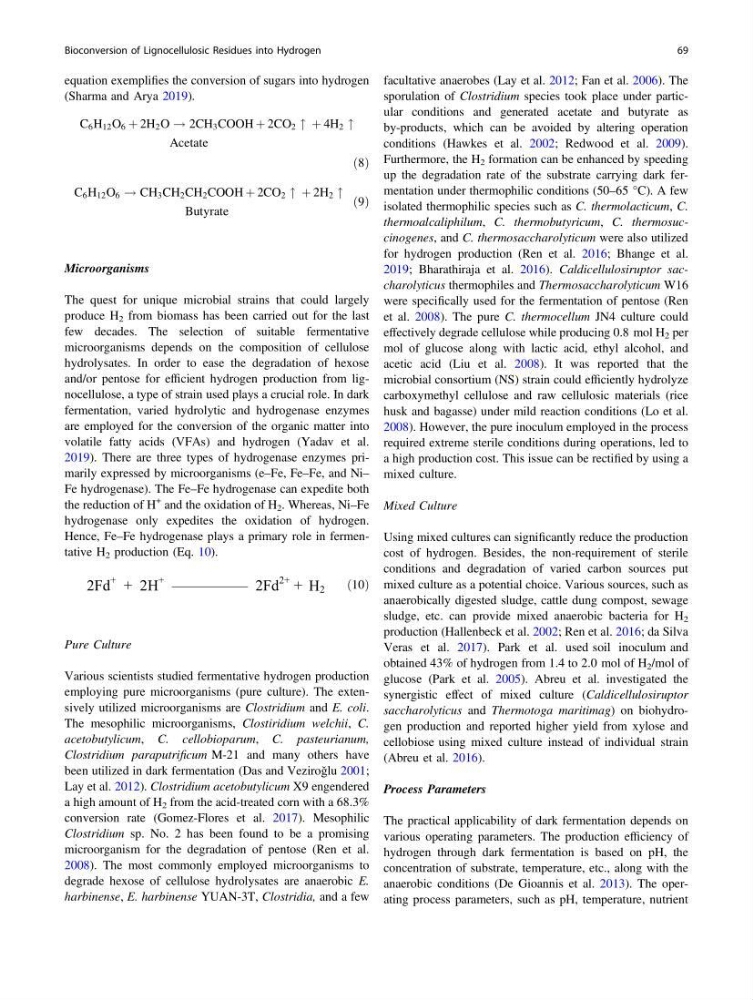
equation exemplifies the conversion of sugars into hydrogen
(Sharma and Arya 2019).
C 6 H 12 O 6 þ 2H 2 O ! 2CH 3 COOH þ 2CO 2 " þ 4H 2 "
Acetate
ð8Þ
C 6 H 12 O 6 ! CH 3 CH 2 CH 2 COOH þ 2CO 2 " þ 2H 2 "
Butyrate
ð9Þ
Microorganisms
The quest for unique microbial strains that could largely
produce H 2 from biomass has been carried out for the last
few decades. The selection of suitable fermentative
microorganisms depends on the composition of cellulose
hydrolysates. In order to ease the degradation of hexose
and/or pentose for efficient hydrogen production from lignocellulose, a type of strain used plays a crucial role. In dark
fermentation, varied hydrolytic and hydrogenase enzymes
are employed for the conversion of the organic matter into
volatile fatty acids (VFAs) and hydrogen (Yadav et al.
2019). There are three types of hydrogenase enzymes primarily expressed by microorganisms (e–Fe, Fe–Fe, and Ni–
Fe hydrogenase). The Fe–Fe hydrogenase can expedite both
the reduction of H
+ and the oxidation of H 2 . Whereas, Ni–Fe
hydrogenase only expedites the oxidation of hydrogen.
Hence, Fe–Fe hydrogenase plays a primary role in fermentative H 2 production (Eq. 10).
2Fd
+
+ 2H
+
————— 2Fd
2+
+ H 2 ð10Þ
Pure Culture
Various scientists studied fermentative hydrogen production
employing pure microorganisms (pure culture). The extensively utilized microorganisms are Clostridium and E. coli.
The mesophilic microorganisms, Clostiridium welchii, C.
acetobutylicum, C. cellobioparum, C. pasteurianum,
Clostridium paraputrificum M-21 and many others have
been utilized in dark fermentation (Das and Veziroǧlu 2001;
Lay et al. 2012). Clostridium acetobutylicum X9 engendered
a high amount of H 2 from the acid-treated corn with a 68.3%
conversion rate (Gomez-Flores et al. 2017). Mesophilic
Clostridium sp. No. 2 has been found to be a promising
microorganism for the degradation of pentose (Ren et al.
2008). The most commonly employed microorganisms to
degrade hexose of cellulose hydrolysates are anaerobic E.
harbinense, E. harbinense YUAN-3T, Clostridia, and a few
facultative anaerobes (Lay et al. 2012; Fan et al. 2006). The
sporulation of Clostridium species took place under particular conditions and generated acetate and butyrate as
by-products, which can be avoided by altering operation
conditions (Hawkes et al. 2002; Redwood et al. 2009).
Furthermore, the H 2 formation can be enhanced by speeding
up the degradation rate of the substrate carrying dark fermentation under thermophilic conditions (50–65 °C). A few
isolated thermophilic species such as C. thermolacticum, C.
thermoalcaliphilum, C. thermobutyricum, C. thermosuccinogenes, and C. thermosaccharolyticum were also utilized
for hydrogen production (Ren et al. 2016; Bhange et al.
2019; Bharathiraja et al. 2016). Caldicellulosiruptor saccharolyticus thermophiles and Thermosaccharolyticum W16
were specifically used for the fermentation of pentose (Ren
et al. 2008). The pure C. thermocellum JN4 culture could
effectively degrade cellulose while producing 0.8 mol H 2 per
mol of glucose along with lactic acid, ethyl alcohol, and
acetic acid (Liu et al. 2008). It was reported that the
microbial consortium (NS) strain could efficiently hydrolyze
carboxymethyl cellulose and raw cellulosic materials (rice
husk and bagasse) under mild reaction conditions (Lo et al.
2008). However, the pure inoculum employed in the process
required extreme sterile conditions during operations, led to
a high production cost. This issue can be rectified by using a
mixed culture.
Mixed Culture
Using mixed cultures can significantly reduce the production
cost of hydrogen. Besides, the non-requirement of sterile
conditions and degradation of varied carbon sources put
mixed culture as a potential choice. Various sources, such as
anaerobically digested sludge, cattle dung compost, sewage
sludge, etc. can provide mixed anaerobic bacteria for H 2
production (Hallenbeck et al. 2002; Ren et al. 2016; da Silva
Veras et al. 2017). Park et al. used soil inoculum and
obtained 43% of hydrogen from 1.4 to 2.0 mol of H 2 /mol of
glucose (Park et al. 2005). Abreu et al. investigated the
synergistic effect of mixed culture (Caldicellulosiruptor
saccharolyticus and Thermotoga maritimag) on biohydrogen production and reported higher yield from xylose and
cellobiose using mixed culture instead of individual strain
(Abreu et al. 2016).
Process Parameters
The practical applicability of dark fermentation depends on
various operating parameters. The production efficiency of
hydrogen through dark fermentation is based on pH, the
concentration of substrate, temperature, etc., along with the
anaerobic conditions (De Gioannis et al. 2013). The operating process parameters, such as pH, temperature, nutrient
Bioconversion of Lignocellulosic Residues into Hydrogen
69
(Sharma and Arya 2019).
C 6 H 12 O 6 þ 2H 2 O ! 2CH 3 COOH þ 2CO 2 " þ 4H 2 "
Acetate
ð8Þ
C 6 H 12 O 6 ! CH 3 CH 2 CH 2 COOH þ 2CO 2 " þ 2H 2 "
Butyrate
ð9Þ
Microorganisms
The quest for unique microbial strains that could largely
produce H 2 from biomass has been carried out for the last
few decades. The selection of suitable fermentative
microorganisms depends on the composition of cellulose
hydrolysates. In order to ease the degradation of hexose
and/or pentose for efficient hydrogen production from lignocellulose, a type of strain used plays a crucial role. In dark
fermentation, varied hydrolytic and hydrogenase enzymes
are employed for the conversion of the organic matter into
volatile fatty acids (VFAs) and hydrogen (Yadav et al.
2019). There are three types of hydrogenase enzymes primarily expressed by microorganisms (e–Fe, Fe–Fe, and Ni–
Fe hydrogenase). The Fe–Fe hydrogenase can expedite both
the reduction of H
+ and the oxidation of H 2 . Whereas, Ni–Fe
hydrogenase only expedites the oxidation of hydrogen.
Hence, Fe–Fe hydrogenase plays a primary role in fermentative H 2 production (Eq. 10).
2Fd
+
+ 2H
+
————— 2Fd
2+
+ H 2 ð10Þ
Pure Culture
Various scientists studied fermentative hydrogen production
employing pure microorganisms (pure culture). The extensively utilized microorganisms are Clostridium and E. coli.
The mesophilic microorganisms, Clostiridium welchii, C.
acetobutylicum, C. cellobioparum, C. pasteurianum,
Clostridium paraputrificum M-21 and many others have
been utilized in dark fermentation (Das and Veziroǧlu 2001;
Lay et al. 2012). Clostridium acetobutylicum X9 engendered
a high amount of H 2 from the acid-treated corn with a 68.3%
conversion rate (Gomez-Flores et al. 2017). Mesophilic
Clostridium sp. No. 2 has been found to be a promising
microorganism for the degradation of pentose (Ren et al.
2008). The most commonly employed microorganisms to
degrade hexose of cellulose hydrolysates are anaerobic E.
harbinense, E. harbinense YUAN-3T, Clostridia, and a few
facultative anaerobes (Lay et al. 2012; Fan et al. 2006). The
sporulation of Clostridium species took place under particular conditions and generated acetate and butyrate as
by-products, which can be avoided by altering operation
conditions (Hawkes et al. 2002; Redwood et al. 2009).
Furthermore, the H 2 formation can be enhanced by speeding
up the degradation rate of the substrate carrying dark fermentation under thermophilic conditions (50–65 °C). A few
isolated thermophilic species such as C. thermolacticum, C.
thermoalcaliphilum, C. thermobutyricum, C. thermosuccinogenes, and C. thermosaccharolyticum were also utilized
for hydrogen production (Ren et al. 2016; Bhange et al.
2019; Bharathiraja et al. 2016). Caldicellulosiruptor saccharolyticus thermophiles and Thermosaccharolyticum W16
were specifically used for the fermentation of pentose (Ren
et al. 2008). The pure C. thermocellum JN4 culture could
effectively degrade cellulose while producing 0.8 mol H 2 per
mol of glucose along with lactic acid, ethyl alcohol, and
acetic acid (Liu et al. 2008). It was reported that the
microbial consortium (NS) strain could efficiently hydrolyze
carboxymethyl cellulose and raw cellulosic materials (rice
husk and bagasse) under mild reaction conditions (Lo et al.
2008). However, the pure inoculum employed in the process
required extreme sterile conditions during operations, led to
a high production cost. This issue can be rectified by using a
mixed culture.
Mixed Culture
Using mixed cultures can significantly reduce the production
cost of hydrogen. Besides, the non-requirement of sterile
conditions and degradation of varied carbon sources put
mixed culture as a potential choice. Various sources, such as
anaerobically digested sludge, cattle dung compost, sewage
sludge, etc. can provide mixed anaerobic bacteria for H 2
production (Hallenbeck et al. 2002; Ren et al. 2016; da Silva
Veras et al. 2017). Park et al. used soil inoculum and
obtained 43% of hydrogen from 1.4 to 2.0 mol of H 2 /mol of
glucose (Park et al. 2005). Abreu et al. investigated the
synergistic effect of mixed culture (Caldicellulosiruptor
saccharolyticus and Thermotoga maritimag) on biohydrogen production and reported higher yield from xylose and
cellobiose using mixed culture instead of individual strain
(Abreu et al. 2016).
Process Parameters
The practical applicability of dark fermentation depends on
various operating parameters. The production efficiency of
hydrogen through dark fermentation is based on pH, the
concentration of substrate, temperature, etc., along with the
anaerobic conditions (De Gioannis et al. 2013). The operating process parameters, such as pH, temperature, nutrient
Bioconversion of Lignocellulosic Residues into Hydrogen
69