

hydrogen has no greenhouse gas (GHG) emissions during
combustion (da Silva Veras et al. 2017).
2 Pretreatment of Lignocellulosic Biomass
The lignocelluloses are complex in structure and cannot be
utilized directly by microorganisms for the production of
useful products. The pretreatment of lignocellulose is
required to overcome these structural resistances, followed
by the hydrolysis to convert the lignocellulosic residues into
simple sugars. The pretreatment improves the efficiency of
the hydrolysis of lignocellulose and thus enhances the overall
production of hydrogen. The pretreatment results in the
breaking of complex structures into simple sugars via lignin
removal from the residue (Patil and Yadav 2018). It also
decreases the lignocellulose crystallinity while reducing the
cellulose’s polymerization degree and ultimately enhances
the available area of lignocellulose residue to microorganisms (Ren et al. 2016; Chundawat et al. 2010). The various
pretreatment methods have been primarily categorized based
on the mode of action, such as biological, chemical, physical,
and physicochemical. An ideal pretreatment should attain a
high yield of sugars, avoid the loss or degradation of carbohydrates, minimize the inhibitor formation, and must be
cost-effective. The following section highlights these methods, along with their advantages and disadvantages.
2.1 Physical Pretreatments
Physical pretreatment involves the breaking of crystalline
structures or reducing particle size, which enhances the
overall availability of lignocellulose’s surface area for the
enzymes. The most widely used physical methods include
chipping, grinding, and milling, along with some modern
techniques such as ultrasonication and microwave
irradiation.
Chipping, Grinding, and Milling Method
A typical application of chipping and grinding is to reduce
the size of lignocellulose materials into chips or in small
pieces. However, the chipping and grinding alone are not
efficient, and it is generally followed by milling to reduce the
residue’s size further. The milling results in a significant
reduction in the structure’s crystallinity and forms very fine
particles, thus increasing the accessible area (Ren et al.
2009). Milling offers several advantages since it obtains
uniform particle size, provides convenient operations,
requires less water, and enhances enzymatic hydrolysis.
However, milling is an energy-intensive technique that limits
its wider adoption (Salakkam et al. 2019). The category of
biomass, duration of the process, and kind of milling
employed determines the final degree of polymerization,
decrease in the cellulose crystallinity, and increment in the
surface area (Kumar and Sharma 2017). Yu and Wu have
reported a significant decrease in cellulose crystallinity after
the ball milling of a-cellulose (2011). Similarly, Liu et al.
reported wet milling of corn stover biomass after dilute-acid
pretreatment. The optimized milling conditions were found
to be as follows; the power of 1.1 kW, current of 2.6 A,
rotation speed of 1800 rpm with varying residence times,
giving enhanced enzyme accessibility to cellulose and pore
volume of biomass (Liu et al. 2016).
Microwave Irradiation and Ultrasonication Method
Microwave irradiation and ultrasonication are alternate
physical methods that result in the structural disintegration
of cellulosic fraction and bulging of the lignocellulosic
biomass (Patil and Yadav 2018). These methods are capable
of altering the chemical and physical properties of lignocellulose while disintegrating the aromatic and carbohydrate
polymer by splitting the ether and ester linkages (Kumar and
Sharma 2017). Microwave irradiation is a direct application
of the electromagnetic field to the molecular structure that
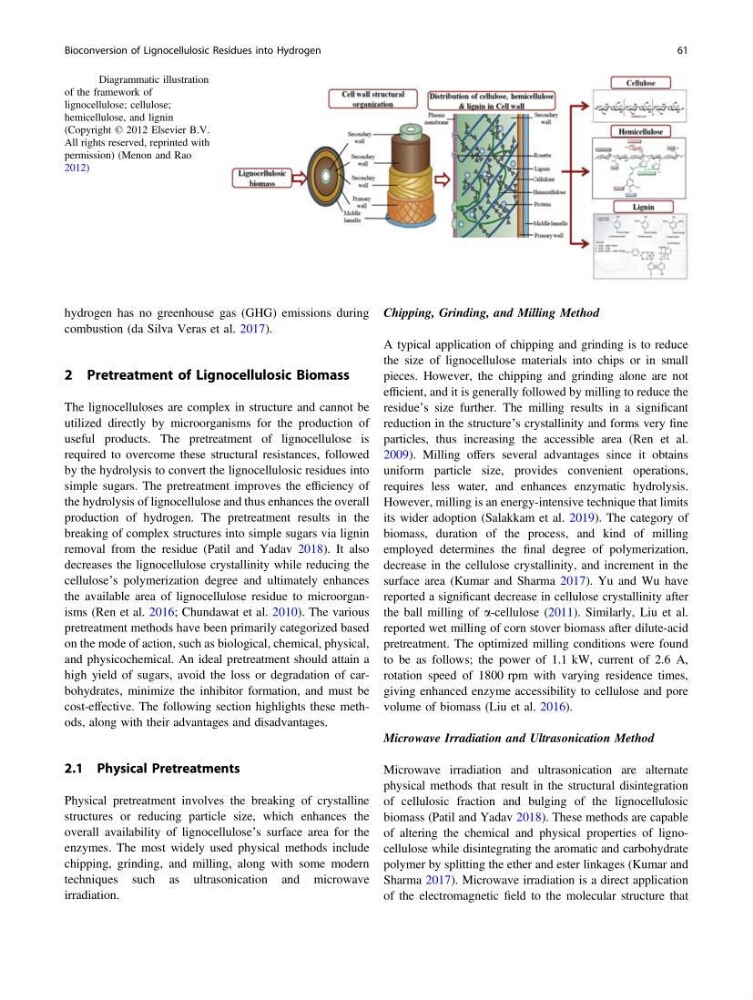
Fig. 2 Diagrammatic illustration
of the framework of
lignocellulose; cellulose;
hemicellulose, and lignin
(Copyright © 2012 Elsevier B.V.
All rights reserved, reprinted with
permission) (Menon and Rao
2012)
Bioconversion of Lignocellulosic Residues into Hydrogen
61
combustion (da Silva Veras et al. 2017).
2 Pretreatment of Lignocellulosic Biomass
The lignocelluloses are complex in structure and cannot be
utilized directly by microorganisms for the production of
useful products. The pretreatment of lignocellulose is
required to overcome these structural resistances, followed
by the hydrolysis to convert the lignocellulosic residues into
simple sugars. The pretreatment improves the efficiency of
the hydrolysis of lignocellulose and thus enhances the overall
production of hydrogen. The pretreatment results in the
breaking of complex structures into simple sugars via lignin
removal from the residue (Patil and Yadav 2018). It also
decreases the lignocellulose crystallinity while reducing the
cellulose’s polymerization degree and ultimately enhances
the available area of lignocellulose residue to microorganisms (Ren et al. 2016; Chundawat et al. 2010). The various
pretreatment methods have been primarily categorized based
on the mode of action, such as biological, chemical, physical,
and physicochemical. An ideal pretreatment should attain a
high yield of sugars, avoid the loss or degradation of carbohydrates, minimize the inhibitor formation, and must be
cost-effective. The following section highlights these methods, along with their advantages and disadvantages.
2.1 Physical Pretreatments
Physical pretreatment involves the breaking of crystalline
structures or reducing particle size, which enhances the
overall availability of lignocellulose’s surface area for the
enzymes. The most widely used physical methods include
chipping, grinding, and milling, along with some modern
techniques such as ultrasonication and microwave
irradiation.
Chipping, Grinding, and Milling Method
A typical application of chipping and grinding is to reduce
the size of lignocellulose materials into chips or in small
pieces. However, the chipping and grinding alone are not
efficient, and it is generally followed by milling to reduce the
residue’s size further. The milling results in a significant
reduction in the structure’s crystallinity and forms very fine
particles, thus increasing the accessible area (Ren et al.
2009). Milling offers several advantages since it obtains
uniform particle size, provides convenient operations,
requires less water, and enhances enzymatic hydrolysis.
However, milling is an energy-intensive technique that limits
its wider adoption (Salakkam et al. 2019). The category of
biomass, duration of the process, and kind of milling
employed determines the final degree of polymerization,
decrease in the cellulose crystallinity, and increment in the
surface area (Kumar and Sharma 2017). Yu and Wu have
reported a significant decrease in cellulose crystallinity after
the ball milling of a-cellulose (2011). Similarly, Liu et al.
reported wet milling of corn stover biomass after dilute-acid
pretreatment. The optimized milling conditions were found
to be as follows; the power of 1.1 kW, current of 2.6 A,
rotation speed of 1800 rpm with varying residence times,
giving enhanced enzyme accessibility to cellulose and pore
volume of biomass (Liu et al. 2016).
Microwave Irradiation and Ultrasonication Method
Microwave irradiation and ultrasonication are alternate
physical methods that result in the structural disintegration
of cellulosic fraction and bulging of the lignocellulosic
biomass (Patil and Yadav 2018). These methods are capable
of altering the chemical and physical properties of lignocellulose while disintegrating the aromatic and carbohydrate
polymer by splitting the ether and ester linkages (Kumar and
Sharma 2017). Microwave irradiation is a direct application
of the electromagnetic field to the molecular structure that
Fig. 2 Diagrammatic illustration
of the framework of
lignocellulose; cellulose;
hemicellulose, and lignin
(Copyright © 2012 Elsevier B.V.
All rights reserved, reprinted with
permission) (Menon and Rao
2012)
Bioconversion of Lignocellulosic Residues into Hydrogen
61