

investigated the catalytic effect of acetic acid at subcritical
conditions for two microalgae species with different amount
of lipid content (Ross et al. 2010). It was found that acetic
acid was comparatively more favorable than alkali catalyst
to enhance bio-crude yield. In biomass liquefaction, the
decomposition of organic acids form in-situ carbon
monoxide and hydrogen; subsequently, the in situ hydrogen
could work as a hydrogen (H) donor to boost the bio-crude
quantity and quality. Hu et al. further validated this finding
by reporting maximum energy recovery up to 65% via
recycling one-time aqueous phase with formic acid as catalyst (Hu et al. 2017). However, the HHV of resulting
bio-crude also slightly improved from 33.87 to 34.95 mJ/kg.
Li et al. liquefied desert shrubs (Salix psammophila) with
acetic acid and found the same increment in bio-crude yield
as it was in the second cycle (Li et al. 2013).
4.2 Chemical Composition and Applications
The composition of residual water is highly dependent on
the chemical components of the feedstocks. The most significant indicators of assessing the quality of aqueous phase
are total nitrogen, total organic carbon, and the composition
of organic and inorganic elements. The comprehensive
characterization of the aqueous phase is very complex,
because of the presence of a variety of light-weight organic
compounds, which require specific columns for the detection
through gas chromatography-mass spectrometry (GCMS).
However, there are few studies in which characterization of
aqueous phase has been specifically investigated (Gai et al.
2015; Maddi et al. 2016, 2017; Villadsen et al. 2012).
Hu et al. characterized aqueous phase from Chlorella
vulgaris, and observed that with the successive recycling, the
dark color was developed in residual water, which indicates
saturation of organic matter in aqueous phase (Hu et al.
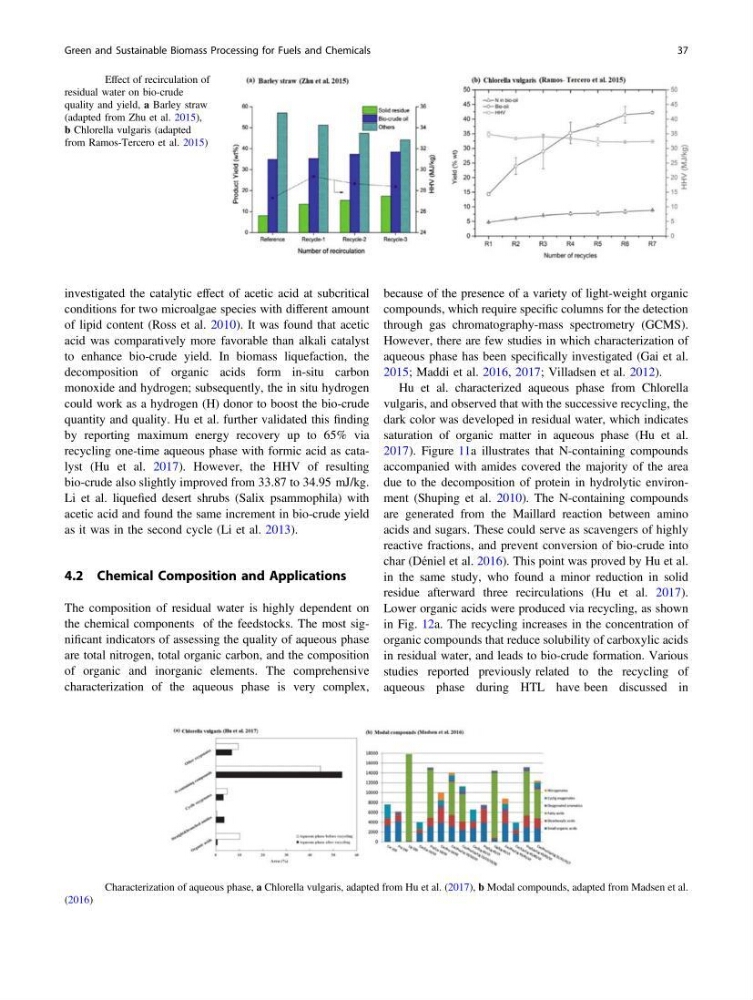
2017). Figure 11a illustrates that N-containing compounds
accompanied with amides covered the majority of the area
due to the decomposition of protein in hydrolytic environment (Shuping et al. 2010). The N-containing compounds
are generated from the Maillard reaction between amino
acids and sugars. These could serve as scavengers of highly
reactive fractions, and prevent conversion of bio-crude into
char (Déniel et al. 2016). This point was proved by Hu et al.
in the same study, who found a minor reduction in solid
residue afterward three recirculations (Hu et al. 2017).
Lower organic acids were produced via recycling, as shown
in Fig. 12a. The recycling increases in the concentration of
organic compounds that reduce solubility of carboxylic acids
in residual water, and leads to bio-crude formation. Various
studies reported previously related to the recycling of
aqueous phase during HTL have been discussed in
Fig. 11 Effect of recirculation of
residual water on bio-crude
quality and yield, a Barley straw
(adapted from Zhu et al. 2015),
b Chlorella vulgaris (adapted
from Ramos-Tercero et al. 2015)
Fig. 12 Characterization of aqueous phase, a Chlorella vulgaris, adapted from Hu et al. (2017), b Modal compounds, adapted from Madsen et al.
(2016)
Green and Sustainable Biomass Processing for Fuels and Chemicals
37
conditions for two microalgae species with different amount
of lipid content (Ross et al. 2010). It was found that acetic
acid was comparatively more favorable than alkali catalyst
to enhance bio-crude yield. In biomass liquefaction, the
decomposition of organic acids form in-situ carbon
monoxide and hydrogen; subsequently, the in situ hydrogen
could work as a hydrogen (H) donor to boost the bio-crude
quantity and quality. Hu et al. further validated this finding
by reporting maximum energy recovery up to 65% via
recycling one-time aqueous phase with formic acid as catalyst (Hu et al. 2017). However, the HHV of resulting
bio-crude also slightly improved from 33.87 to 34.95 mJ/kg.
Li et al. liquefied desert shrubs (Salix psammophila) with
acetic acid and found the same increment in bio-crude yield
as it was in the second cycle (Li et al. 2013).
4.2 Chemical Composition and Applications
The composition of residual water is highly dependent on
the chemical components of the feedstocks. The most significant indicators of assessing the quality of aqueous phase
are total nitrogen, total organic carbon, and the composition
of organic and inorganic elements. The comprehensive
characterization of the aqueous phase is very complex,
because of the presence of a variety of light-weight organic
compounds, which require specific columns for the detection
through gas chromatography-mass spectrometry (GCMS).
However, there are few studies in which characterization of
aqueous phase has been specifically investigated (Gai et al.
2015; Maddi et al. 2016, 2017; Villadsen et al. 2012).
Hu et al. characterized aqueous phase from Chlorella
vulgaris, and observed that with the successive recycling, the
dark color was developed in residual water, which indicates
saturation of organic matter in aqueous phase (Hu et al.
2017). Figure 11a illustrates that N-containing compounds
accompanied with amides covered the majority of the area
due to the decomposition of protein in hydrolytic environment (Shuping et al. 2010). The N-containing compounds
are generated from the Maillard reaction between amino
acids and sugars. These could serve as scavengers of highly
reactive fractions, and prevent conversion of bio-crude into
char (Déniel et al. 2016). This point was proved by Hu et al.
in the same study, who found a minor reduction in solid
residue afterward three recirculations (Hu et al. 2017).
Lower organic acids were produced via recycling, as shown
in Fig. 12a. The recycling increases in the concentration of
organic compounds that reduce solubility of carboxylic acids
in residual water, and leads to bio-crude formation. Various
studies reported previously related to the recycling of
aqueous phase during HTL have been discussed in
Fig. 11 Effect of recirculation of
residual water on bio-crude
quality and yield, a Barley straw
(adapted from Zhu et al. 2015),
b Chlorella vulgaris (adapted
from Ramos-Tercero et al. 2015)
Fig. 12 Characterization of aqueous phase, a Chlorella vulgaris, adapted from Hu et al. (2017), b Modal compounds, adapted from Madsen et al.
(2016)
Green and Sustainable Biomass Processing for Fuels and Chemicals
37