

Similarly, Tommaso et al. had used the HTL aqueous phase
for anaerobic digestion to produce methane gas with 61% of
removal of COD and 84% of an anaerobic biodegradability
(Tommaso et al. 2015).
Among all these ways, the recirculation of residual water
from the HTL system has received much attention recently.
In the literature almost all the studies reported enhanced
bio-crude quantity according to the number of recirculation
(Déniel et al. 2016; Biller et al. 2016; Li et al. 2013;
Ramos-Tercero et al. 2015; Zhu et al. 2015). Pedersen et al.
could not notice a trend in the yield of bio-crude because of
complicated extraction procedure from the continuous plant,
while H/C was observed to increase slightly with three
recirculations. Pacific Northwest National Laboratory
(PNNL, USA) also noticed enhanced bio-crude quality and
quantity with recycling residual water produced from the
HTL of corn stover and pine (Elliott et al. 2015). From the
available literature, the major studies found related to recycling of aqueous phase from different biomasses are
described in Table 1.
Zhu et al. studied the effect of residual water recycling
from lignocellulosic feedstock straw at 300 °C with a catalyst
(K 2 CO 3 ) (Zhu et al. 2015). It was reported that after three
successive cycles, bio-crude production yield was raised
from 34.9 to 38.4 wt% (db) as demonstrated in Fig. 11a.
The presence of organic components in residual water
accelerated the decomposition reaction rate of barley straw
and portioned into bio-crude. Secondly, solid residue
increased due to repolymerization of reactive compounds
present in bio-crude. From the quality point of view, a
smaller gain in HHV (from 27.29 to 29.4 MJ/kg) unwraps
the new possibility of usage of residual water in liquefaction
of straw at subcritical condition. Recirculation of Chlorella
vulgaris was performed at 240 °C for 30 min residence time.
The bio-oil yield raised up to (42.2 wt%, daf) after six
cycles, almost three times more as compared to the reference
run (14.3 wt%, daf) as shown in Fig. 11b (Ramos-Tercero
et al. 2015). This increase in bio-crude was due to saturation
of light polar organic in the aqueous phase. The interesting
point to be noticed here is that HHVs bio-crude slightly
decreased. This decrease in HHV is related to increasing
concentration of nitrogen due to repolymerization of
nitrogen-rich organic molecules of aqueous phase, which
ended up in bio-crude. Biller et al. also found increased
concentration of nitrogen from 5 to 8.3% after nine recirculations (Biller et al. 2016).
Previous studies observed that the acetic acid is the most
essential and responsible compound in aqueous phase for
increasing the bio-crude yield (Li et al. 2013;
Ramos-Tercero et al. 2015; Zhu et al. 2015). Ross et al.
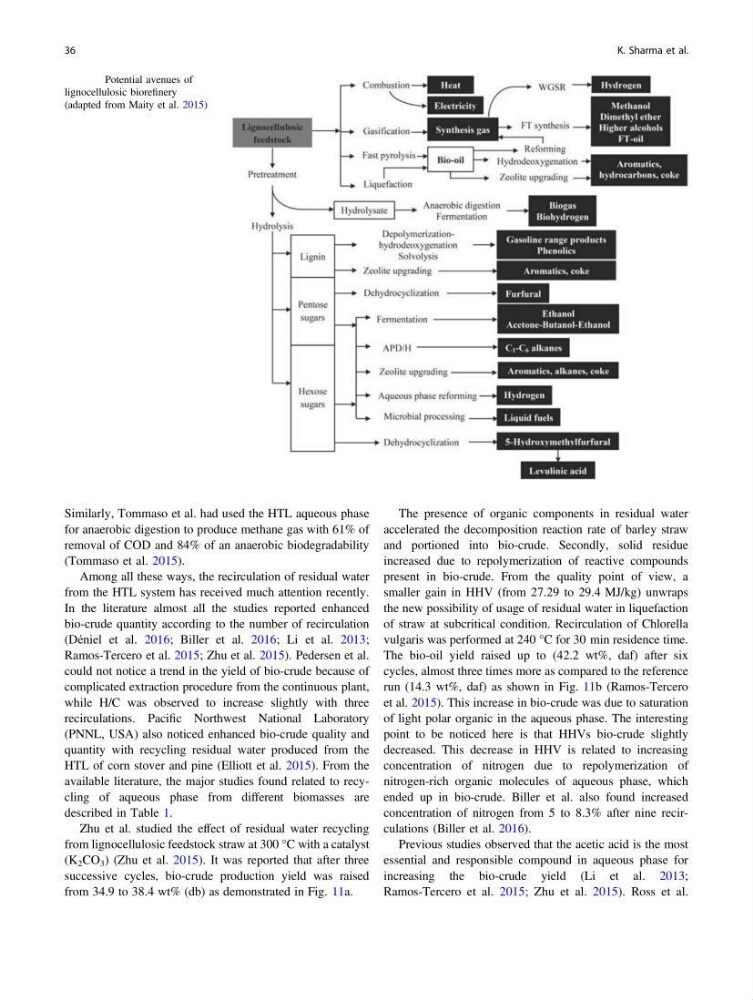
Fig. 10 Potential avenues of
lignocellulosic biorefinery
(adapted from Maity et al. 2015)
36
K. Sharma et al.
for anaerobic digestion to produce methane gas with 61% of
removal of COD and 84% of an anaerobic biodegradability
(Tommaso et al. 2015).
Among all these ways, the recirculation of residual water
from the HTL system has received much attention recently.
In the literature almost all the studies reported enhanced
bio-crude quantity according to the number of recirculation
(Déniel et al. 2016; Biller et al. 2016; Li et al. 2013;
Ramos-Tercero et al. 2015; Zhu et al. 2015). Pedersen et al.
could not notice a trend in the yield of bio-crude because of
complicated extraction procedure from the continuous plant,
while H/C was observed to increase slightly with three
recirculations. Pacific Northwest National Laboratory
(PNNL, USA) also noticed enhanced bio-crude quality and
quantity with recycling residual water produced from the
HTL of corn stover and pine (Elliott et al. 2015). From the
available literature, the major studies found related to recycling of aqueous phase from different biomasses are
described in Table 1.
Zhu et al. studied the effect of residual water recycling
from lignocellulosic feedstock straw at 300 °C with a catalyst
(K 2 CO 3 ) (Zhu et al. 2015). It was reported that after three
successive cycles, bio-crude production yield was raised
from 34.9 to 38.4 wt% (db) as demonstrated in Fig. 11a.
The presence of organic components in residual water
accelerated the decomposition reaction rate of barley straw
and portioned into bio-crude. Secondly, solid residue
increased due to repolymerization of reactive compounds
present in bio-crude. From the quality point of view, a
smaller gain in HHV (from 27.29 to 29.4 MJ/kg) unwraps
the new possibility of usage of residual water in liquefaction
of straw at subcritical condition. Recirculation of Chlorella
vulgaris was performed at 240 °C for 30 min residence time.
The bio-oil yield raised up to (42.2 wt%, daf) after six
cycles, almost three times more as compared to the reference
run (14.3 wt%, daf) as shown in Fig. 11b (Ramos-Tercero
et al. 2015). This increase in bio-crude was due to saturation
of light polar organic in the aqueous phase. The interesting
point to be noticed here is that HHVs bio-crude slightly
decreased. This decrease in HHV is related to increasing
concentration of nitrogen due to repolymerization of
nitrogen-rich organic molecules of aqueous phase, which
ended up in bio-crude. Biller et al. also found increased
concentration of nitrogen from 5 to 8.3% after nine recirculations (Biller et al. 2016).
Previous studies observed that the acetic acid is the most
essential and responsible compound in aqueous phase for
increasing the bio-crude yield (Li et al. 2013;
Ramos-Tercero et al. 2015; Zhu et al. 2015). Ross et al.
Fig. 10 Potential avenues of
lignocellulosic biorefinery
(adapted from Maity et al. 2015)
36
K. Sharma et al.