

3 Types and Properties of Organic Wastes
Organic waste prevails in every step of development of
biomass. In general, the constituents of waste are dependent
on the origination of the biomass. Here, we discuss different
categories of organic wastes and their characteristics (Yang
et al. 2015).
3.1 Organic Waste Generated Out of Residue
of Agriculture
Traditionally, organic waste originates from agricultural
residue. This type of waste economically and strategically
proves beneficial for producing a variety of products.
Majority of forest and crop waste can be utilized as raw
material which is lignocellulosic in nature. In comparison to
other categories, organic waste originating from the agricultural residue possess more stability in composition.
Around 2/3rd of this organic waste is converted to bioenergy. Owing to wide-scale utilization of lignocellulosic in
biorefinery industries, development and improvement of the
pre-treatment procedure is a topic of concern for the
researcher. The primary target is to lower the cost of processing and to find a better pre-treatment procedure capable
of eliminating lignin. Depending on the composition of raw
material, the procedure of pre-treatment process is developed
to more complex techniques from single biological,
chemical and physical methods. Pre-treatment complex
processes are capable of obtaining better amounts of cellulose by more removal of lignin but there is still a requirement
of reducing the cost by simplifying the procedure (Kim et al.
2013a, b, c, 2011; Limayem and Ricke 2012; Kemppainen
et al. 2012; Nakayama and Imai 2013; Karthika et al. 2012;
Chaudhary et al. 2012; Zavrel et al. 2009; Monavari et al.
2009; Wang et al. 2013). According to some reports, protein
beam or electron beam are feasibly utilized for pre-treatment
of lignocellulose, which were found to be saving the time
during the process (Kim et al. 2011, 2013). Due to the stable
constituents of forest and crop products and advanced
pre-treatment procedure this category of organic waste has
got maximum attention for industrial-scale application (Kim
et al. 2013a, b; Kemppainen et al. 2012; Nakayama and Imai
2013; Karthika et al. 2012; Chaudhary et al. 2012; Zavrel
et al. 2009; Monavari et al. 2009; Wang et al. 2013;
Dashtban et al. 2009; Brown and Chang 2014). In countries
like the U. S. and South America, technologies for utilization
of organic wastes coming from agricultural residue are
designed already and utilized for biorefinery industries
(Viikari et al. 2012). In recent decades, hydrophyte has been
identified due to its extraordinary performance in both
biorefineries as well as environmental bioremediation (Kim
et al. 2012). In comparison to the agricultural residue, there
is no need to cultivate hydrophyte and hence land is saved
both for animal feed and for food production by humans.
Micro and macroalgae are in the category of recent targets of
research in the field of biorefinery. Bioconversion
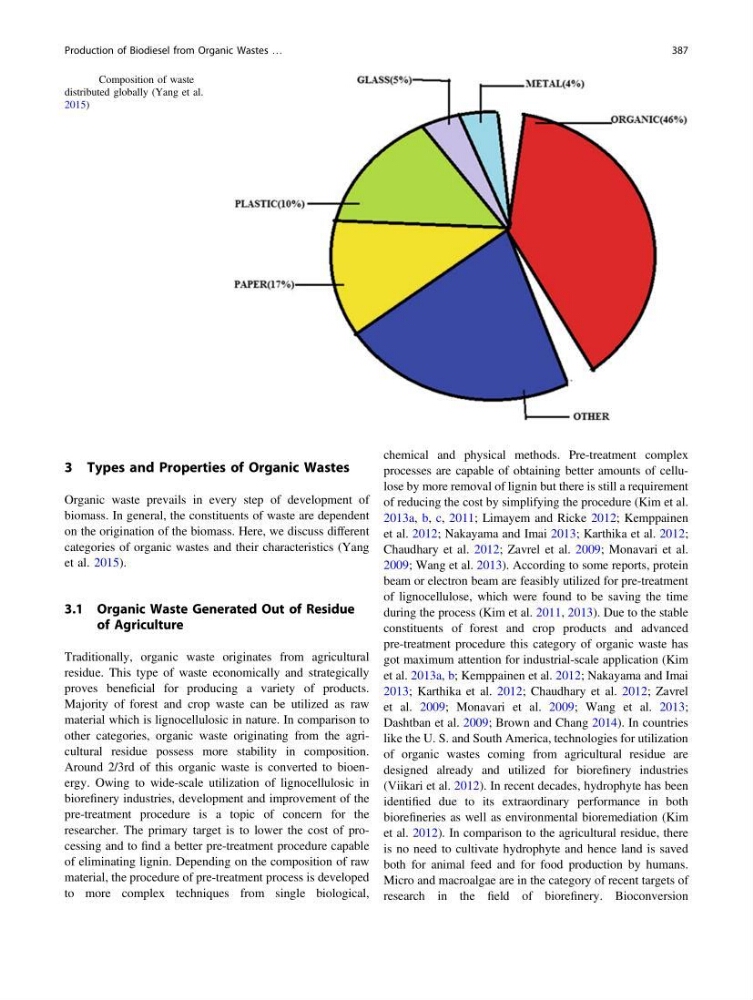
Fig. 1 Composition of waste
distributed globally (Yang et al.
2015)
Production of Biodiesel from Organic Wastes …
387
Organic waste prevails in every step of development of
biomass. In general, the constituents of waste are dependent
on the origination of the biomass. Here, we discuss different
categories of organic wastes and their characteristics (Yang
et al. 2015).
3.1 Organic Waste Generated Out of Residue
of Agriculture
Traditionally, organic waste originates from agricultural
residue. This type of waste economically and strategically
proves beneficial for producing a variety of products.
Majority of forest and crop waste can be utilized as raw
material which is lignocellulosic in nature. In comparison to
other categories, organic waste originating from the agricultural residue possess more stability in composition.
Around 2/3rd of this organic waste is converted to bioenergy. Owing to wide-scale utilization of lignocellulosic in
biorefinery industries, development and improvement of the
pre-treatment procedure is a topic of concern for the
researcher. The primary target is to lower the cost of processing and to find a better pre-treatment procedure capable
of eliminating lignin. Depending on the composition of raw
material, the procedure of pre-treatment process is developed
to more complex techniques from single biological,
chemical and physical methods. Pre-treatment complex
processes are capable of obtaining better amounts of cellulose by more removal of lignin but there is still a requirement
of reducing the cost by simplifying the procedure (Kim et al.
2013a, b, c, 2011; Limayem and Ricke 2012; Kemppainen
et al. 2012; Nakayama and Imai 2013; Karthika et al. 2012;
Chaudhary et al. 2012; Zavrel et al. 2009; Monavari et al.
2009; Wang et al. 2013). According to some reports, protein
beam or electron beam are feasibly utilized for pre-treatment
of lignocellulose, which were found to be saving the time
during the process (Kim et al. 2011, 2013). Due to the stable
constituents of forest and crop products and advanced
pre-treatment procedure this category of organic waste has
got maximum attention for industrial-scale application (Kim
et al. 2013a, b; Kemppainen et al. 2012; Nakayama and Imai
2013; Karthika et al. 2012; Chaudhary et al. 2012; Zavrel
et al. 2009; Monavari et al. 2009; Wang et al. 2013;
Dashtban et al. 2009; Brown and Chang 2014). In countries
like the U. S. and South America, technologies for utilization
of organic wastes coming from agricultural residue are
designed already and utilized for biorefinery industries
(Viikari et al. 2012). In recent decades, hydrophyte has been
identified due to its extraordinary performance in both
biorefineries as well as environmental bioremediation (Kim
et al. 2012). In comparison to the agricultural residue, there
is no need to cultivate hydrophyte and hence land is saved
both for animal feed and for food production by humans.
Micro and macroalgae are in the category of recent targets of
research in the field of biorefinery. Bioconversion
Fig. 1 Composition of waste
distributed globally (Yang et al.
2015)
Production of Biodiesel from Organic Wastes …
387