

(as shown in Fig. 4) (Den and Sharma 2018), and to carry
out fermentation or anaerobic digestion using microbes to
obtain different products.
As shown in Fig. 5, cellulose is not easily accessible due
to the presence of hemicellulose and lignin, (Tian et al.
2018), suggesting that the combined pretreatments based on
mechanical, chemical, and biological means, should be
practically considered to reach the reaction sites (Tian et al.
2018). Depending on the composition of the lignocellulosic
materials, pretreatments may involve high energy consumption for the conversion into fuels or biochemicals. The
methane production based on rice straw varies from 92–280
L/kg of volatile solids, depending upon the digestion constraints and pretreatment protocols (Mussoline et al. 2013).
The synthesis of fuels, chemicals, and products of industrial
interests based on the bioconversion processes is the way
forward to meet the Global Sustainable Development goals
(Kennes 2018). The optimization and enhancement of bioconversion routes and the bio-refineries are being implemented in combination with the existing conventional
processing plants (Cho et al. 2020; Arellano-Garcia et al.
2017). The feedstock is the biomass, solid waste, sewage
sludge, wastewater and biogases, agricultural waste
residues/husk and straw wastes, and by-products such as
glycerol from different bio-refineries (Rulkens 2008;
Kirchmann et al. 2017; Pancha et al. 2019; Santos et al.
2017; Nda-Umar et al. 2019; Crosse et al. 2019). For economics reason, most bioconversion protocols are employed
without pre-treating the primary feedstocks, but some
require specific pretreatments before undergoing the microbial fermentation or conversion. Some feedstocks comprise
complex polymeric constituents, which necessitate the first
step of breaking down the polymers into smaller or monomeric molecules, to allow easy access to the microorganisms
(Tian et al. 2018; Xiu et al. 2017; Ren et al. 2016). Diverse
strains of microorganisms (pure or mixed cultures of
anaerobic and aerobic bacteria, algae, fungi, and yeast) taken
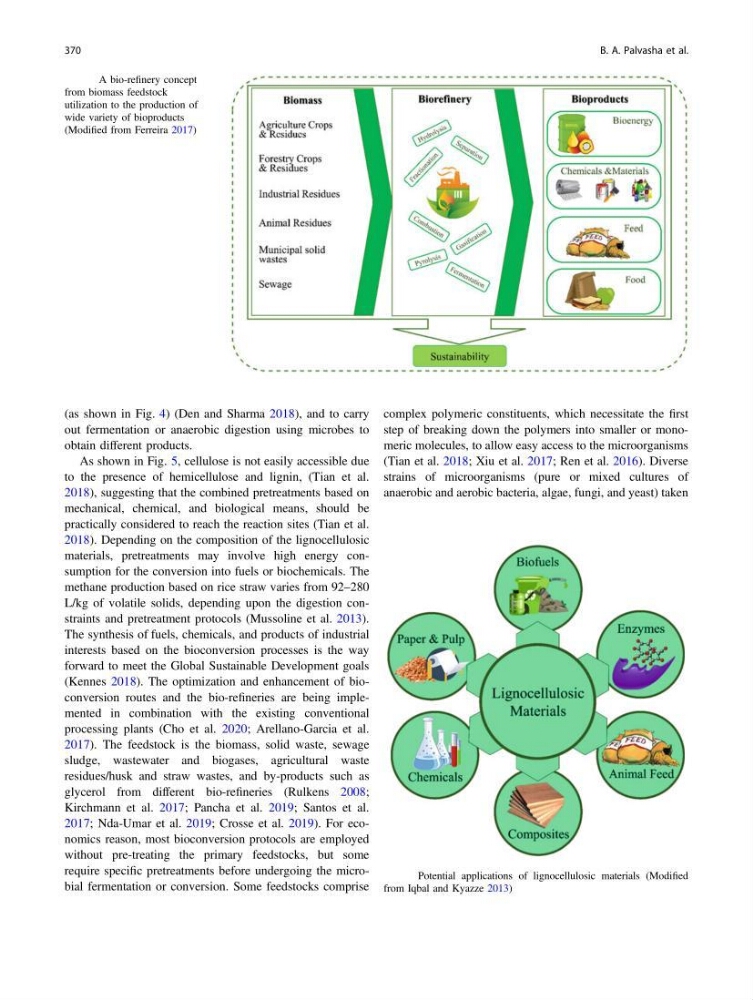
Fig. 1 A bio-refinery concept
from biomass feedstock
utilization to the production of
wide variety of bioproducts
(Modified from Ferreira 2017)
Fig. 2 Potential applications of lignocellulosic materials (Modified
from Iqbal and Kyazze 2013)
370
B. A. Palvasha et al.
out fermentation or anaerobic digestion using microbes to
obtain different products.
As shown in Fig. 5, cellulose is not easily accessible due
to the presence of hemicellulose and lignin, (Tian et al.
2018), suggesting that the combined pretreatments based on
mechanical, chemical, and biological means, should be
practically considered to reach the reaction sites (Tian et al.
2018). Depending on the composition of the lignocellulosic
materials, pretreatments may involve high energy consumption for the conversion into fuels or biochemicals. The
methane production based on rice straw varies from 92–280
L/kg of volatile solids, depending upon the digestion constraints and pretreatment protocols (Mussoline et al. 2013).
The synthesis of fuels, chemicals, and products of industrial
interests based on the bioconversion processes is the way
forward to meet the Global Sustainable Development goals
(Kennes 2018). The optimization and enhancement of bioconversion routes and the bio-refineries are being implemented in combination with the existing conventional
processing plants (Cho et al. 2020; Arellano-Garcia et al.
2017). The feedstock is the biomass, solid waste, sewage
sludge, wastewater and biogases, agricultural waste
residues/husk and straw wastes, and by-products such as
glycerol from different bio-refineries (Rulkens 2008;
Kirchmann et al. 2017; Pancha et al. 2019; Santos et al.
2017; Nda-Umar et al. 2019; Crosse et al. 2019). For economics reason, most bioconversion protocols are employed
without pre-treating the primary feedstocks, but some
require specific pretreatments before undergoing the microbial fermentation or conversion. Some feedstocks comprise
complex polymeric constituents, which necessitate the first
step of breaking down the polymers into smaller or monomeric molecules, to allow easy access to the microorganisms
(Tian et al. 2018; Xiu et al. 2017; Ren et al. 2016). Diverse
strains of microorganisms (pure or mixed cultures of
anaerobic and aerobic bacteria, algae, fungi, and yeast) taken
Fig. 1 A bio-refinery concept
from biomass feedstock
utilization to the production of
wide variety of bioproducts
(Modified from Ferreira 2017)
Fig. 2 Potential applications of lignocellulosic materials (Modified
from Iqbal and Kyazze 2013)
370
B. A. Palvasha et al.