

Ojha et al. (2020) revealed that there has been a significant progress in the expansion of waste development in
poultry industry into commercial valuable products. The
amount of waste product generated from poultry meat
management like offal, quills, blood, visceral organs, dead
winged animals and litter is very huge, thereby creating an
opportunity to apply various technologies such as anaerobic
treatment, microbial enzymes, incineration or burning,
thermal decomposition, recycling, and vermicomposting in
the bioconversion and utilization. Consequently, hydrolysates have displayed an immense potential as a bioactive
substance with tremendous physiological impact. Hence, we
will outline various microbes and microbial proteins like
proteases, lipases, keratinases plus consolidated catalyst
arrangements that have been utilized in the bioconversion of
poultry waste into various biostimulants. Studies have
shown that poultry waste is rich in fat, dry matter, ash
content, and protein (Tesfaye et al. 2017).
Verma et al. (2017) described how organic waste can be
recycled into useful and valuable products such as biostimulants with positive impact on the environment. The authors
went further to recycle bovine manure and poultry litter
waste into humic acid, evaluating its biological effects on
corn plants with or without chemical biostimulants. The
experiment lasted for 30 days and various parameters were
measured. They revealed that the corn plant treated with the
combination showed more increase in yield and development. They, therefore, suggested that the combination of
biostimulants from organics poultry farm could be complementary effort in agricultural sector with huge economic
benefits.
Barik et al. (1991) suggested that increase in the output of
poultry waste could generate serious environmental concerns. The bioconversion of these waste into valuable
products is becoming possible due to advances in technology. The authors revealed that large form of methane gas,
propionic acids plus acetic acid could be generated via
microbial inoculation. Also, studies have revealed that
greater amount of poultry waste could be bioconverted into
nitrogen-rich biostimulants with potential soil health benefits. The poultry industries can generate huge commercial
value from waste if proper investment and market are in
place to utilize the large-scale production of products generated. In the past, poultry waste is largely used as fertilizer
due to small size but today large volume of poultry waste
generation can induce small, environmental outbreak of
infection and pathogenic attack on crops if left untreated
basically because of huge ammonia content.
Jones and Ogden (1984) studied the energy potential
present in poultry and livestock waste in the United States
for future generation. They discovered that through anaerobic metabolism, laying hen manures, dairy cow, and hog
have the potential to generate about 16.9 billion cubic feet of
methane gas, and the entire farm value was estimated to be
about $458 million in 1990 of biomass energy. Zhenghou
et al. (1987) investigated the biogas energy generated from
the North Carolina State University poultry waste through
in situ utilization method. They discovered that the efficiency and production value increased tremendously with
the capacity to be used as fertilizers or biostimulants. In
addition, reduction in the cost of natural gas in raising young
chicks could be considerably reduced when the biogas
produced from the poultry waste is significantly harnessed.
Forgács et al. (2011) showed that anaerobic metabolism
of poultry waste is the most proficient and sustainable
eco-friendly way of reducing dependency on fossil fuel
energy. The authors investigated the metabolism and energy
generation of chicken feather and citrus wastes, and
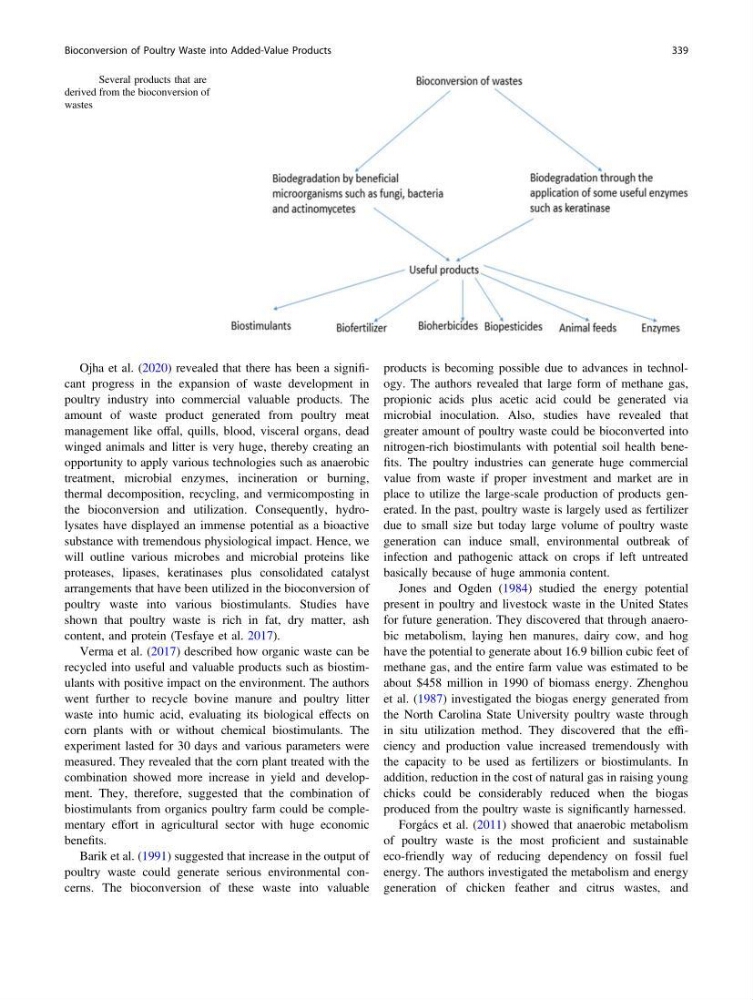
Fig. 1 Several products that are
derived from the bioconversion of
wastes
Bioconversion of Poultry Waste into Added-Value Products
339
poultry industry into commercial valuable products. The
amount of waste product generated from poultry meat
management like offal, quills, blood, visceral organs, dead
winged animals and litter is very huge, thereby creating an
opportunity to apply various technologies such as anaerobic
treatment, microbial enzymes, incineration or burning,
thermal decomposition, recycling, and vermicomposting in
the bioconversion and utilization. Consequently, hydrolysates have displayed an immense potential as a bioactive
substance with tremendous physiological impact. Hence, we
will outline various microbes and microbial proteins like
proteases, lipases, keratinases plus consolidated catalyst
arrangements that have been utilized in the bioconversion of
poultry waste into various biostimulants. Studies have
shown that poultry waste is rich in fat, dry matter, ash
content, and protein (Tesfaye et al. 2017).
Verma et al. (2017) described how organic waste can be
recycled into useful and valuable products such as biostimulants with positive impact on the environment. The authors
went further to recycle bovine manure and poultry litter
waste into humic acid, evaluating its biological effects on
corn plants with or without chemical biostimulants. The
experiment lasted for 30 days and various parameters were
measured. They revealed that the corn plant treated with the
combination showed more increase in yield and development. They, therefore, suggested that the combination of
biostimulants from organics poultry farm could be complementary effort in agricultural sector with huge economic
benefits.
Barik et al. (1991) suggested that increase in the output of
poultry waste could generate serious environmental concerns. The bioconversion of these waste into valuable
products is becoming possible due to advances in technology. The authors revealed that large form of methane gas,
propionic acids plus acetic acid could be generated via
microbial inoculation. Also, studies have revealed that
greater amount of poultry waste could be bioconverted into
nitrogen-rich biostimulants with potential soil health benefits. The poultry industries can generate huge commercial
value from waste if proper investment and market are in
place to utilize the large-scale production of products generated. In the past, poultry waste is largely used as fertilizer
due to small size but today large volume of poultry waste
generation can induce small, environmental outbreak of
infection and pathogenic attack on crops if left untreated
basically because of huge ammonia content.
Jones and Ogden (1984) studied the energy potential
present in poultry and livestock waste in the United States
for future generation. They discovered that through anaerobic metabolism, laying hen manures, dairy cow, and hog
have the potential to generate about 16.9 billion cubic feet of
methane gas, and the entire farm value was estimated to be
about $458 million in 1990 of biomass energy. Zhenghou
et al. (1987) investigated the biogas energy generated from
the North Carolina State University poultry waste through
in situ utilization method. They discovered that the efficiency and production value increased tremendously with
the capacity to be used as fertilizers or biostimulants. In
addition, reduction in the cost of natural gas in raising young
chicks could be considerably reduced when the biogas
produced from the poultry waste is significantly harnessed.
Forgács et al. (2011) showed that anaerobic metabolism
of poultry waste is the most proficient and sustainable
eco-friendly way of reducing dependency on fossil fuel
energy. The authors investigated the metabolism and energy
generation of chicken feather and citrus wastes, and
Fig. 1 Several products that are
derived from the bioconversion of
wastes
Bioconversion of Poultry Waste into Added-Value Products
339