

completed through the following stages: drying, pyrolysis,
char, and tar gasification. Different types of biomass materials such as waste wood, sawdust, and agricultural waste
can be used to produce hydrogen via gasification (Basu
2013).
C 6 H 12 O 6 + O 2 + H 2 O ! CO + CO 2 + H 2 + other
ð2Þ
5.1.3 Liquefaction
Liquefaction (hydrothermal liquefaction) is a process of
conversion of lignocellulosic biomass into bio-liquid at a
temperature of 280–370 °C and pressure of 10–25 MPa in
the absence of oxygen (Gollakota et al. 2018). The major
goal of this process is to break down the solid biopolymeric
structure into liquid components (Elliott et al. 2015). During
the conversion process many complex reactions take place
and convert biomass into crude oil-like products (Behrendt
et al. 2008). There are major two types of process mechanism based on the nature of feedstock namely dry feedstock
(lignocellulose biomass) and wet feedstock (algal biomass)
(Elliott et al. 2015). Lower hydrogen yield is the major
limitation of this method.
5.2 Biological Routes for Hydrogen Production
There has been growing interest in bioconversion of waste
products and biomass to produce biofuels and biohydrogen.
Biohydrogen production is considered as an eco-friendly and
inexhaustible process than electrolysis, thermochemical, and
electrochemical processes (Kırtay 2011). In biological processes the feedstocks are catalyzed by microorganisms under
atmospheric pressure and at an ambient temperature. Biohydrogen production methods are broadly categorized as
light-dependent and light-independent processes (Ding et al.
2016). Light-dependent processes can be further classified
into direct biophotolysis, indirect biophotolysis, and
photo-fermentation. Light-independent processes are also
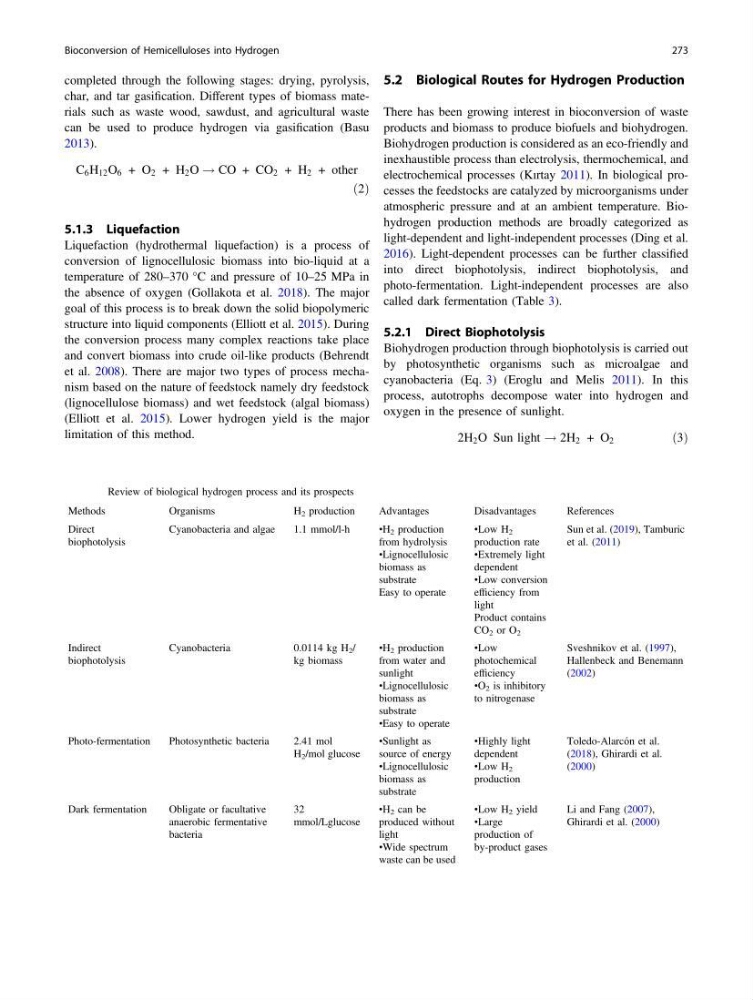
called dark fermentation (Table 3).
5.2.1 Direct Biophotolysis
Biohydrogen production through biophotolysis is carried out
by photosynthetic organisms such as microalgae and
cyanobacteria (Eq. 3) (Eroglu and Melis 2011). In this
process, autotrophs decompose water into hydrogen and
oxygen in the presence of sunlight.
2H 2 O Sun light ! 2H 2 + O 2
ð3Þ
Table 3 Review of biological hydrogen process and its prospects
Methods
Organisms
H 2 production
Advantages
Disadvantages
References
Direct
biophotolysis
Cyanobacteria and algae
1.1 mmol/l-h
•H 2 production
from hydrolysis
•Lignocellulosic
biomass as
substrate
Easy to operate
•Low H 2
production rate
•Extremely light
dependent
•Low conversion
efficiency from
light
Product contains
CO 2 or O 2
Sun et al. (2019), Tamburic
et al. (2011)
Indirect
biophotolysis
Cyanobacteria
0.0114 kg H 2 /
kg biomass
•H 2 production
from water and
sunlight
•Lignocellulosic
biomass as
substrate
•Easy to operate
•Low
photochemical
efficiency
•O 2 is inhibitory
to nitrogenase
Sveshnikov et al. (1997),
Hallenbeck and Benemann
(2002)
Photo-fermentation
Photosynthetic bacteria
2.41 mol
H 2 /mol glucose
•Sunlight as
source of energy
•Lignocellulosic
biomass as
substrate
•Highly light
dependent
•Low H 2
production
Toledo-Alarcón et al.
(2018), Ghirardi et al.
(2000)
Dark fermentation
Obligate or facultative
anaerobic fermentative
bacteria
32
mmol/Lglucose
•H 2 can be
produced without
light
•Wide spectrum
waste can be used
•Low H 2 yield
•Large
production of
by-product gases
Li and Fang (2007),
Ghirardi et al. (2000)
Bioconversion of Hemicelluloses into Hydrogen
273
char, and tar gasification. Different types of biomass materials such as waste wood, sawdust, and agricultural waste
can be used to produce hydrogen via gasification (Basu
2013).
C 6 H 12 O 6 + O 2 + H 2 O ! CO + CO 2 + H 2 + other
ð2Þ
5.1.3 Liquefaction
Liquefaction (hydrothermal liquefaction) is a process of
conversion of lignocellulosic biomass into bio-liquid at a
temperature of 280–370 °C and pressure of 10–25 MPa in
the absence of oxygen (Gollakota et al. 2018). The major
goal of this process is to break down the solid biopolymeric
structure into liquid components (Elliott et al. 2015). During
the conversion process many complex reactions take place
and convert biomass into crude oil-like products (Behrendt
et al. 2008). There are major two types of process mechanism based on the nature of feedstock namely dry feedstock
(lignocellulose biomass) and wet feedstock (algal biomass)
(Elliott et al. 2015). Lower hydrogen yield is the major
limitation of this method.
5.2 Biological Routes for Hydrogen Production
There has been growing interest in bioconversion of waste
products and biomass to produce biofuels and biohydrogen.
Biohydrogen production is considered as an eco-friendly and
inexhaustible process than electrolysis, thermochemical, and
electrochemical processes (Kırtay 2011). In biological processes the feedstocks are catalyzed by microorganisms under
atmospheric pressure and at an ambient temperature. Biohydrogen production methods are broadly categorized as
light-dependent and light-independent processes (Ding et al.
2016). Light-dependent processes can be further classified
into direct biophotolysis, indirect biophotolysis, and
photo-fermentation. Light-independent processes are also
called dark fermentation (Table 3).
5.2.1 Direct Biophotolysis
Biohydrogen production through biophotolysis is carried out
by photosynthetic organisms such as microalgae and
cyanobacteria (Eq. 3) (Eroglu and Melis 2011). In this
process, autotrophs decompose water into hydrogen and
oxygen in the presence of sunlight.
2H 2 O Sun light ! 2H 2 + O 2
ð3Þ
Table 3 Review of biological hydrogen process and its prospects
Methods
Organisms
H 2 production
Advantages
Disadvantages
References
Direct
biophotolysis
Cyanobacteria and algae
1.1 mmol/l-h
•H 2 production
from hydrolysis
•Lignocellulosic
biomass as
substrate
Easy to operate
•Low H 2
production rate
•Extremely light
dependent
•Low conversion
efficiency from
light
Product contains
CO 2 or O 2
Sun et al. (2019), Tamburic
et al. (2011)
Indirect
biophotolysis
Cyanobacteria
0.0114 kg H 2 /
kg biomass
•H 2 production
from water and
sunlight
•Lignocellulosic
biomass as
substrate
•Easy to operate
•Low
photochemical
efficiency
•O 2 is inhibitory
to nitrogenase
Sveshnikov et al. (1997),
Hallenbeck and Benemann
(2002)
Photo-fermentation
Photosynthetic bacteria
2.41 mol
H 2 /mol glucose
•Sunlight as
source of energy
•Lignocellulosic
biomass as
substrate
•Highly light
dependent
•Low H 2
production
Toledo-Alarcón et al.
(2018), Ghirardi et al.
(2000)
Dark fermentation
Obligate or facultative
anaerobic fermentative
bacteria
32
mmol/Lglucose
•H 2 can be
produced without
light
•Wide spectrum
waste can be used
•Low H 2 yield
•Large
production of
by-product gases
Li and Fang (2007),
Ghirardi et al. (2000)
Bioconversion of Hemicelluloses into Hydrogen
273