

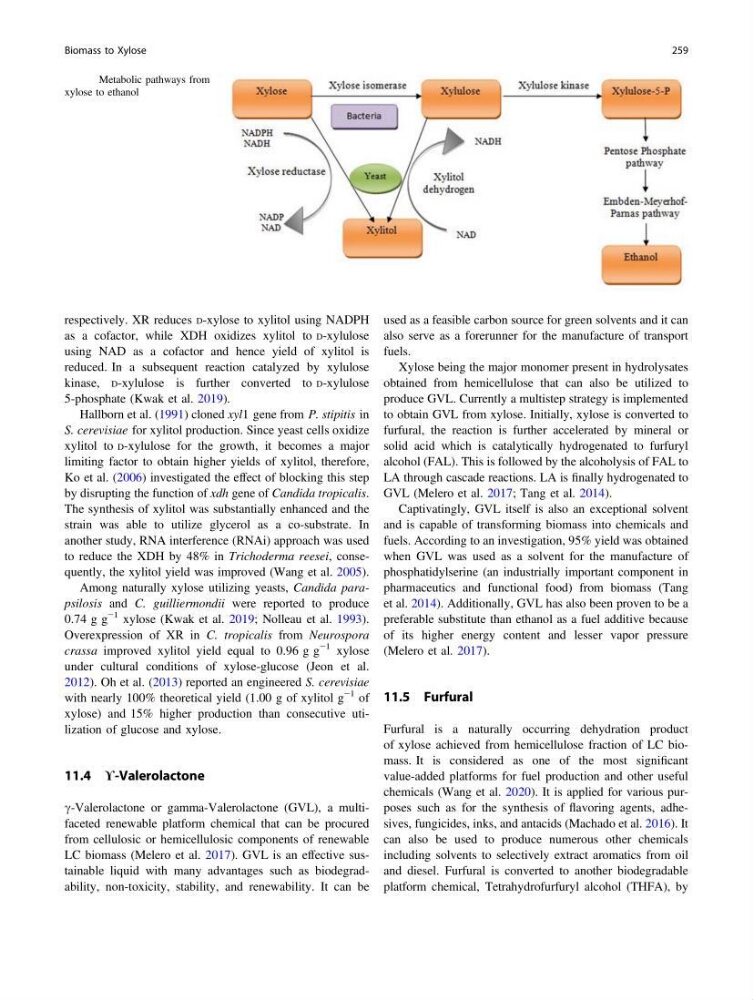
respectively. XR reduces D-xylose to xylitol using NADPH
as a cofactor, while XDH oxidizes xylitol to D-xylulose
using NAD as a cofactor and hence yield of xylitol is
reduced. In a subsequent reaction catalyzed by xylulose
kinase, D-xylulose is further converted to D-xylulose
5-phosphate (Kwak et al. 2019).
Hallborn et al. (1991) cloned xyl1 gene from P. stipitis in
S. cerevisiae for xylitol production. Since yeast cells oxidize
xylitol to D-xylulose for the growth, it becomes a major
limiting factor to obtain higher yields of xylitol, therefore,
Ko et al. (2006) investigated the effect of blocking this step
by disrupting the function of xdh gene of Candida tropicalis.
The synthesis of xylitol was substantially enhanced and the
strain was able to utilize glycerol as a co-substrate. In
another study, RNA interference (RNAi) approach was used
to reduce the XDH by 48% in Trichoderma reesei, consequently, the xylitol yield was improved (Wang et al. 2005).
Among naturally xylose utilizing yeasts, Candida parapsilosis and C. guilliermondii were reported to produce
0.74 g g
−1 xylose (Kwak et al. 2019; Nolleau et al. 1993).
Overexpression of XR in C. tropicalis from Neurospora
crassa improved xylitol yield equal to 0.96 g g
−1 xylose
under cultural conditions of xylose-glucose (Jeon et al.
2012). Oh et al. (2013) reported an engineered S. cerevisiae
with nearly 100% theoretical yield (1.00 g of xylitol g
−1 of
xylose) and 15% higher production than consecutive utilization of glucose and xylose.
11.4 ϒ-Valerolactone
c-Valerolactone or gamma-Valerolactone (GVL), a multifaceted renewable platform chemical that can be procured
from cellulosic or hemicellulosic components of renewable
LC biomass (Melero et al. 2017). GVL is an effective sustainable liquid with many advantages such as biodegradability, non-toxicity, stability, and renewability. It can be
used as a feasible carbon source for green solvents and it can
also serve as a forerunner for the manufacture of transport
fuels.
Xylose being the major monomer present in hydrolysates
obtained from hemicellulose that can also be utilized to
produce GVL. Currently a multistep strategy is implemented
to obtain GVL from xylose. Initially, xylose is converted to
furfural, the reaction is further accelerated by mineral or
solid acid which is catalytically hydrogenated to furfuryl
alcohol (FAL). This is followed by the alcoholysis of FAL to
LA through cascade reactions. LA is finally hydrogenated to
GVL (Melero et al. 2017; Tang et al. 2014).
Captivatingly, GVL itself is also an exceptional solvent
and is capable of transforming biomass into chemicals and
fuels. According to an investigation, 95% yield was obtained
when GVL was used as a solvent for the manufacture of
phosphatidylserine (an industrially important component in
pharmaceutics and functional food) from biomass (Tang
et al. 2014). Additionally, GVL has also been proven to be a
preferable substitute than ethanol as a fuel additive because
of its higher energy content and lesser vapor pressure
(Melero et al. 2017).
11.5 Furfural
Furfural is a naturally occurring dehydration product
of xylose achieved from hemicellulose fraction of LC biomass. It is considered as one of the most significant
value-added platforms for fuel production and other useful
chemicals (Wang et al. 2020). It is applied for various purposes such as for the synthesis of flavoring agents, adhesives, fungicides, inks, and antacids (Machado et al. 2016). It
can also be used to produce numerous other chemicals
including solvents to selectively extract aromatics from oil
and diesel. Furfural is converted to another biodegradable
platform chemical, Tetrahydrofurfuryl alcohol (THFA), by
Fig. 2 Metabolic pathways from
xylose to ethanol
Biomass to Xylose
259
as a cofactor, while XDH oxidizes xylitol to D-xylulose
using NAD as a cofactor and hence yield of xylitol is
reduced. In a subsequent reaction catalyzed by xylulose
kinase, D-xylulose is further converted to D-xylulose
5-phosphate (Kwak et al. 2019).
Hallborn et al. (1991) cloned xyl1 gene from P. stipitis in
S. cerevisiae for xylitol production. Since yeast cells oxidize
xylitol to D-xylulose for the growth, it becomes a major
limiting factor to obtain higher yields of xylitol, therefore,
Ko et al. (2006) investigated the effect of blocking this step
by disrupting the function of xdh gene of Candida tropicalis.
The synthesis of xylitol was substantially enhanced and the
strain was able to utilize glycerol as a co-substrate. In
another study, RNA interference (RNAi) approach was used
to reduce the XDH by 48% in Trichoderma reesei, consequently, the xylitol yield was improved (Wang et al. 2005).
Among naturally xylose utilizing yeasts, Candida parapsilosis and C. guilliermondii were reported to produce
0.74 g g
−1 xylose (Kwak et al. 2019; Nolleau et al. 1993).
Overexpression of XR in C. tropicalis from Neurospora
crassa improved xylitol yield equal to 0.96 g g
−1 xylose
under cultural conditions of xylose-glucose (Jeon et al.
2012). Oh et al. (2013) reported an engineered S. cerevisiae
with nearly 100% theoretical yield (1.00 g of xylitol g
−1 of
xylose) and 15% higher production than consecutive utilization of glucose and xylose.
11.4 ϒ-Valerolactone
c-Valerolactone or gamma-Valerolactone (GVL), a multifaceted renewable platform chemical that can be procured
from cellulosic or hemicellulosic components of renewable
LC biomass (Melero et al. 2017). GVL is an effective sustainable liquid with many advantages such as biodegradability, non-toxicity, stability, and renewability. It can be
used as a feasible carbon source for green solvents and it can
also serve as a forerunner for the manufacture of transport
fuels.
Xylose being the major monomer present in hydrolysates
obtained from hemicellulose that can also be utilized to
produce GVL. Currently a multistep strategy is implemented
to obtain GVL from xylose. Initially, xylose is converted to
furfural, the reaction is further accelerated by mineral or
solid acid which is catalytically hydrogenated to furfuryl
alcohol (FAL). This is followed by the alcoholysis of FAL to
LA through cascade reactions. LA is finally hydrogenated to
GVL (Melero et al. 2017; Tang et al. 2014).
Captivatingly, GVL itself is also an exceptional solvent
and is capable of transforming biomass into chemicals and
fuels. According to an investigation, 95% yield was obtained
when GVL was used as a solvent for the manufacture of
phosphatidylserine (an industrially important component in
pharmaceutics and functional food) from biomass (Tang
et al. 2014). Additionally, GVL has also been proven to be a
preferable substitute than ethanol as a fuel additive because
of its higher energy content and lesser vapor pressure
(Melero et al. 2017).
11.5 Furfural
Furfural is a naturally occurring dehydration product
of xylose achieved from hemicellulose fraction of LC biomass. It is considered as one of the most significant
value-added platforms for fuel production and other useful
chemicals (Wang et al. 2020). It is applied for various purposes such as for the synthesis of flavoring agents, adhesives, fungicides, inks, and antacids (Machado et al. 2016). It
can also be used to produce numerous other chemicals
including solvents to selectively extract aromatics from oil
and diesel. Furfural is converted to another biodegradable
platform chemical, Tetrahydrofurfuryl alcohol (THFA), by
Fig. 2 Metabolic pathways from
xylose to ethanol
Biomass to Xylose
259