

to some issues like lack of proper technical and farming
facilities, these countries show this discrepancy.
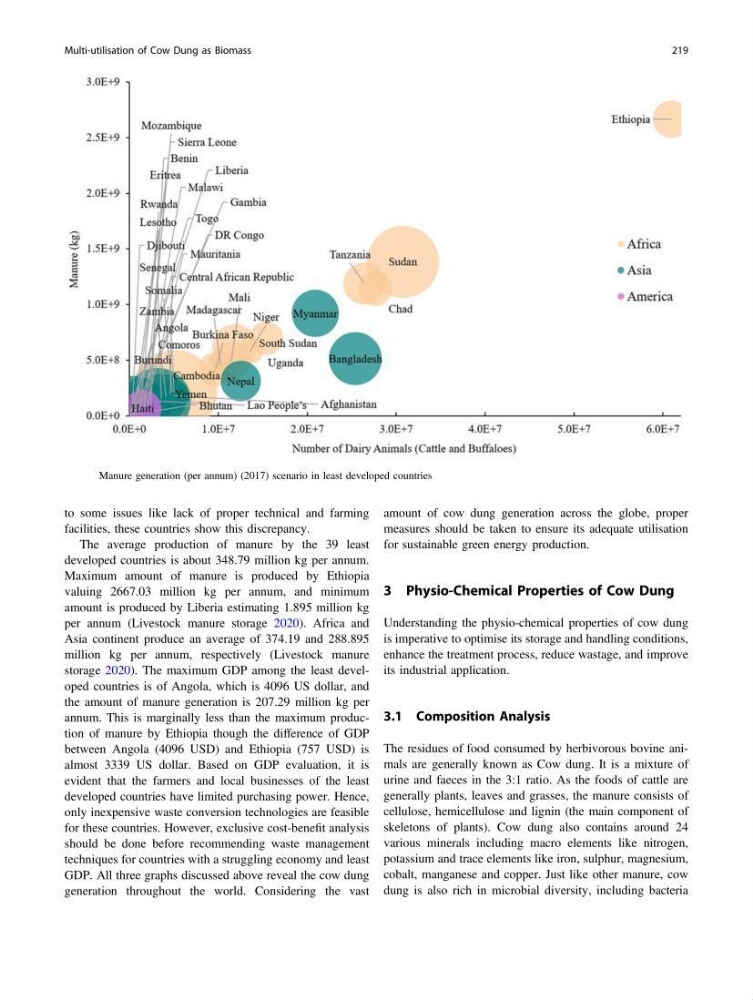
The average production of manure by the 39 least
developed countries is about 348.79 million kg per annum.
Maximum amount of manure is produced by Ethiopia
valuing 2667.03 million kg per annum, and minimum
amount is produced by Liberia estimating 1.895 million kg
per annum (Livestock manure storage 2020). Africa and
Asia continent produce an average of 374.19 and 288.895
million kg per annum, respectively (Livestock manure
storage 2020). The maximum GDP among the least developed countries is of Angola, which is 4096 US dollar, and
the amount of manure generation is 207.29 million kg per
annum. This is marginally less than the maximum production of manure by Ethiopia though the difference of GDP
between Angola (4096 USD) and Ethiopia (757 USD) is
almost 3339 US dollar. Based on GDP evaluation, it is
evident that the farmers and local businesses of the least
developed countries have limited purchasing power. Hence,
only inexpensive waste conversion technologies are feasible
for these countries. However, exclusive cost-benefit analysis
should be done before recommending waste management
techniques for countries with a struggling economy and least
GDP. All three graphs discussed above reveal the cow dung
generation throughout the world. Considering the vast
amount of cow dung generation across the globe, proper
measures should be taken to ensure its adequate utilisation
for sustainable green energy production.
3 Physio-Chemical Properties of Cow Dung
Understanding the physio-chemical properties of cow dung
is imperative to optimise its storage and handling conditions,
enhance the treatment process, reduce wastage, and improve
its industrial application.
3.1 Composition Analysis
The residues of food consumed by herbivorous bovine animals are generally known as Cow dung. It is a mixture of
urine and faeces in the 3:1 ratio. As the foods of cattle are
generally plants, leaves and grasses, the manure consists of
cellulose, hemicellulose and lignin (the main component of
skeletons of plants). Cow dung also contains around 24
various minerals including macro elements like nitrogen,
potassium and trace elements like iron, sulphur, magnesium,
cobalt, manganese and copper. Just like other manure, cow
dung is also rich in microbial diversity, including bacteria
Fig. 3 Manure generation (per annum) (2017) scenario in least developed countries
Multi-utilisation of Cow Dung as Biomass
219
facilities, these countries show this discrepancy.
The average production of manure by the 39 least
developed countries is about 348.79 million kg per annum.
Maximum amount of manure is produced by Ethiopia
valuing 2667.03 million kg per annum, and minimum
amount is produced by Liberia estimating 1.895 million kg
per annum (Livestock manure storage 2020). Africa and
Asia continent produce an average of 374.19 and 288.895
million kg per annum, respectively (Livestock manure
storage 2020). The maximum GDP among the least developed countries is of Angola, which is 4096 US dollar, and
the amount of manure generation is 207.29 million kg per
annum. This is marginally less than the maximum production of manure by Ethiopia though the difference of GDP
between Angola (4096 USD) and Ethiopia (757 USD) is
almost 3339 US dollar. Based on GDP evaluation, it is
evident that the farmers and local businesses of the least
developed countries have limited purchasing power. Hence,
only inexpensive waste conversion technologies are feasible
for these countries. However, exclusive cost-benefit analysis
should be done before recommending waste management
techniques for countries with a struggling economy and least
GDP. All three graphs discussed above reveal the cow dung
generation throughout the world. Considering the vast
amount of cow dung generation across the globe, proper
measures should be taken to ensure its adequate utilisation
for sustainable green energy production.
3 Physio-Chemical Properties of Cow Dung
Understanding the physio-chemical properties of cow dung
is imperative to optimise its storage and handling conditions,
enhance the treatment process, reduce wastage, and improve
its industrial application.
3.1 Composition Analysis
The residues of food consumed by herbivorous bovine animals are generally known as Cow dung. It is a mixture of
urine and faeces in the 3:1 ratio. As the foods of cattle are
generally plants, leaves and grasses, the manure consists of
cellulose, hemicellulose and lignin (the main component of
skeletons of plants). Cow dung also contains around 24
various minerals including macro elements like nitrogen,
potassium and trace elements like iron, sulphur, magnesium,
cobalt, manganese and copper. Just like other manure, cow
dung is also rich in microbial diversity, including bacteria
Fig. 3 Manure generation (per annum) (2017) scenario in least developed countries
Multi-utilisation of Cow Dung as Biomass
219