

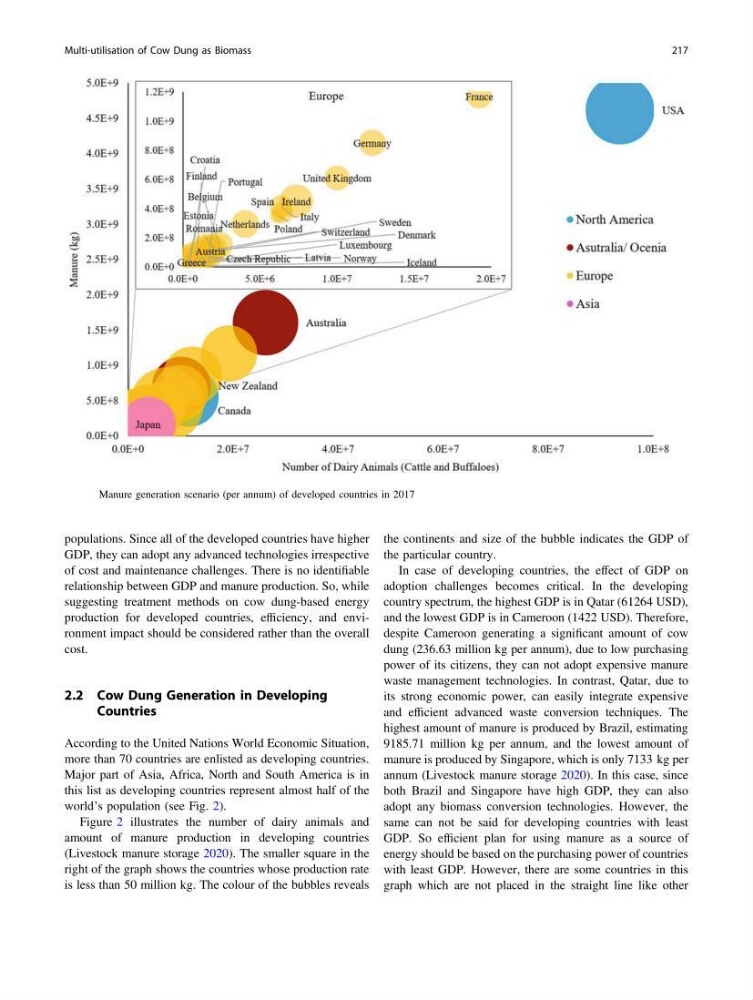
populations. Since all of the developed countries have higher
GDP, they can adopt any advanced technologies irrespective
of cost and maintenance challenges. There is no identifiable
relationship between GDP and manure production. So, while
suggesting treatment methods on cow dung-based energy
production for developed countries, efficiency, and environment impact should be considered rather than the overall
cost.
2.2 Cow Dung Generation in Developing
Countries
According to the United Nations World Economic Situation,
more than 70 countries are enlisted as developing countries.
Major part of Asia, Africa, North and South America is in
this list as developing countries represent almost half of the
world’s population (see Fig. 2).
Figure 2 illustrates the number of dairy animals and
amount of manure production in developing countries
(Livestock manure storage 2020). The smaller square in the
right of the graph shows the countries whose production rate
is less than 50 million kg. The colour of the bubbles reveals
the continents and size of the bubble indicates the GDP of
the particular country.
In case of developing countries, the effect of GDP on
adoption challenges becomes critical. In the developing
country spectrum, the highest GDP is in Qatar (61264 USD),
and the lowest GDP is in Cameroon (1422 USD). Therefore,
despite Cameroon generating a significant amount of cow
dung (236.63 million kg per annum), due to low purchasing
power of its citizens, they can not adopt expensive manure
waste management technologies. In contrast, Qatar, due to
its strong economic power, can easily integrate expensive
and efficient advanced waste conversion techniques. The
highest amount of manure is produced by Brazil, estimating
9185.71 million kg per annum, and the lowest amount of
manure is produced by Singapore, which is only 7133 kg per
annum (Livestock manure storage 2020). In this case, since
both Brazil and Singapore have high GDP, they can also
adopt any biomass conversion technologies. However, the
same can not be said for developing countries with least
GDP. So efficient plan for using manure as a source of
energy should be based on the purchasing power of countries
with least GDP. However, there are some countries in this
graph which are not placed in the straight line like other
Fig. 1 Manure generation scenario (per annum) of developed countries in 2017
Multi-utilisation of Cow Dung as Biomass
217
GDP, they can adopt any advanced technologies irrespective
of cost and maintenance challenges. There is no identifiable
relationship between GDP and manure production. So, while
suggesting treatment methods on cow dung-based energy
production for developed countries, efficiency, and environment impact should be considered rather than the overall
cost.
2.2 Cow Dung Generation in Developing
Countries
According to the United Nations World Economic Situation,
more than 70 countries are enlisted as developing countries.
Major part of Asia, Africa, North and South America is in
this list as developing countries represent almost half of the
world’s population (see Fig. 2).
Figure 2 illustrates the number of dairy animals and
amount of manure production in developing countries
(Livestock manure storage 2020). The smaller square in the
right of the graph shows the countries whose production rate
is less than 50 million kg. The colour of the bubbles reveals
the continents and size of the bubble indicates the GDP of
the particular country.
In case of developing countries, the effect of GDP on
adoption challenges becomes critical. In the developing
country spectrum, the highest GDP is in Qatar (61264 USD),
and the lowest GDP is in Cameroon (1422 USD). Therefore,
despite Cameroon generating a significant amount of cow
dung (236.63 million kg per annum), due to low purchasing
power of its citizens, they can not adopt expensive manure
waste management technologies. In contrast, Qatar, due to
its strong economic power, can easily integrate expensive
and efficient advanced waste conversion techniques. The
highest amount of manure is produced by Brazil, estimating
9185.71 million kg per annum, and the lowest amount of
manure is produced by Singapore, which is only 7133 kg per
annum (Livestock manure storage 2020). In this case, since
both Brazil and Singapore have high GDP, they can also
adopt any biomass conversion technologies. However, the
same can not be said for developing countries with least
GDP. So efficient plan for using manure as a source of
energy should be based on the purchasing power of countries
with least GDP. However, there are some countries in this
graph which are not placed in the straight line like other
Fig. 1 Manure generation scenario (per annum) of developed countries in 2017
Multi-utilisation of Cow Dung as Biomass
217