

activity of the prepared Ag nanoparticles. Interestingly, no
bacterial inactivation was observed in the case of aggregated
Ag nanoparticles, while nanoparticle prepared in the presence of low- and high-methoxyl pectin presented inhibition
zones against Escherichia coli, Bacillus pumilus, and
Bacillus subtilis. Also, enhancing the amount of pectin had a
positive effect on the bacterial growth inhibitory. Indeed,
when pectin:Ag mass ratio was 10:1, no antibacterial activity
was observed, but enhancing this ratio to 25:1, satisfactory
results were observed. They illustrated the role of pectin in
the reduction of Ag particle size, which directly affects its
antibacterial performance. Meanwhile, pectin is capable to
adhere to the bacterial membrane and promote antibacterial
agent delivery.
5.3.4 Wound Dressing
During daily activities, different injuries may be caused in
skin and it needs care by using proper wound dressings until
healing. An ideal wound dressing should be able to keep the
wound zone humid, gaseous permeable, absorb exudates,
and have antibacterial property to prevent infection (Xu et al.
2019). Some polysaccharides meet these requirements and
are proper candidates to be used in the fabrication of wound
dressing. For example, it has been pointed out to the capability of chitin to promote movement of keratinocytes to
wound, and consequently accelerates healing (Mehrabani
et al. 2018).
Deng et al. (2020) designed a nanocomposite hydrogel
based on agarose containing Fe
3+ nanoparticles to use for
wound infection treatments. The nanocomposite prepared at
the optimum conditions showed satisfactory mechanical
performance as well as proper wound disinfection and
healing of the wound in the animal model. The prepared
hydrogel also demonstrated antibacterial behavior and it
showed inhibition zone for Staphylococcus aureus (diameter = 1.5 cm) during the Oxford cup method. Also in the
agar plate assays, 99% reduction in the number of Staphylococcus aureus colonies compared to the control sample
was observed. Taking into account their biocompatibility
and photothermal sterilization capability, the prepared
nanocomposite hydrogels could be proper for antibacterial
wound dressing applications.
A wound dressing composed of chitosan, PVA, and
acacia gum embedded with ZnO nanoparticles was prepared
using electrospraying by Güldiken et al. (2020). The effects
of concentration of chitosan, acacia gum, and ZnO
nanoparticles on the nanocomposite’s features were studied.
Best cell viability was observed when weight percentages of
chitosan and acacia gum were 8 wt% and 2 wt%, respectively. This composition was selected for further studies and
maximum cell viability was attained when 0.6 of ZnO
nanoparticles were inserted within the blended polymer
matrix.
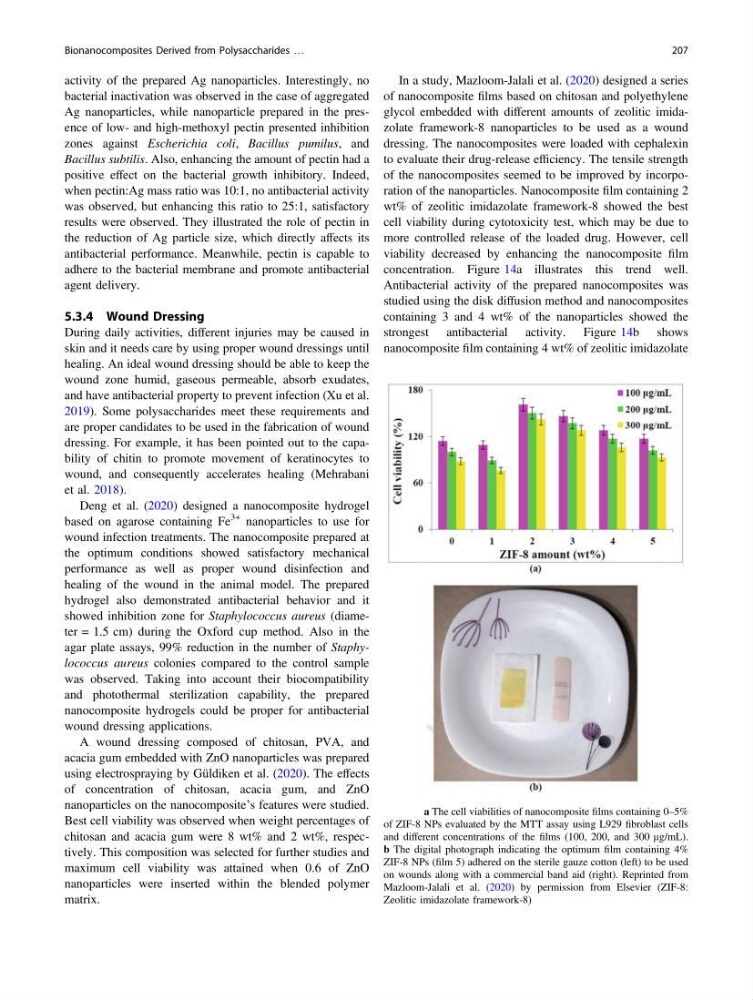
In a study, Mazloom-Jalali et al. (2020) designed a series
of nanocomposite films based on chitosan and polyethylene
glycol embedded with different amounts of zeolitic imidazolate framework-8 nanoparticles to be used as a wound
dressing. The nanocomposites were loaded with cephalexin
to evaluate their drug-release efficiency. The tensile strength
of the nanocomposites seemed to be improved by incorporation of the nanoparticles. Nanocomposite film containing 2
wt% of zeolitic imidazolate framework-8 showed the best
cell viability during cytotoxicity test, which may be due to
more controlled release of the loaded drug. However, cell
viability decreased by enhancing the nanocomposite film
concentration. Figure 14a illustrates this trend well.
Antibacterial activity of the prepared nanocomposites was
studied using the disk diffusion method and nanocomposites
containing 3 and 4 wt% of the nanoparticles showed the
strongest antibacterial activity. Figure 14b shows
nanocomposite film containing 4 wt% of zeolitic imidazolate
Fig. 14 a The cell viabilities of nanocomposite films containing 0–5%
of ZIF-8 NPs evaluated by the MTT assay using L929 fibroblast cells
and different concentrations of the films (100, 200, and 300 lg/mL).
b The digital photograph indicating the optimum film containing 4%
ZIF-8 NPs (film 5) adhered on the sterile gauze cotton (left) to be used
on wounds along with a commercial band aid (right). Reprinted from
Mazloom-Jalali et al. (2020) by permission from Elsevier (ZIF-8:
Zeolitic imidazolate framework-8)
Bionanocomposites Derived from Polysaccharides …
207
bacterial inactivation was observed in the case of aggregated
Ag nanoparticles, while nanoparticle prepared in the presence of low- and high-methoxyl pectin presented inhibition
zones against Escherichia coli, Bacillus pumilus, and
Bacillus subtilis. Also, enhancing the amount of pectin had a
positive effect on the bacterial growth inhibitory. Indeed,
when pectin:Ag mass ratio was 10:1, no antibacterial activity
was observed, but enhancing this ratio to 25:1, satisfactory
results were observed. They illustrated the role of pectin in
the reduction of Ag particle size, which directly affects its
antibacterial performance. Meanwhile, pectin is capable to
adhere to the bacterial membrane and promote antibacterial
agent delivery.
5.3.4 Wound Dressing
During daily activities, different injuries may be caused in
skin and it needs care by using proper wound dressings until
healing. An ideal wound dressing should be able to keep the
wound zone humid, gaseous permeable, absorb exudates,
and have antibacterial property to prevent infection (Xu et al.
2019). Some polysaccharides meet these requirements and
are proper candidates to be used in the fabrication of wound
dressing. For example, it has been pointed out to the capability of chitin to promote movement of keratinocytes to
wound, and consequently accelerates healing (Mehrabani
et al. 2018).
Deng et al. (2020) designed a nanocomposite hydrogel
based on agarose containing Fe
3+ nanoparticles to use for
wound infection treatments. The nanocomposite prepared at
the optimum conditions showed satisfactory mechanical
performance as well as proper wound disinfection and
healing of the wound in the animal model. The prepared
hydrogel also demonstrated antibacterial behavior and it
showed inhibition zone for Staphylococcus aureus (diameter = 1.5 cm) during the Oxford cup method. Also in the
agar plate assays, 99% reduction in the number of Staphylococcus aureus colonies compared to the control sample
was observed. Taking into account their biocompatibility
and photothermal sterilization capability, the prepared
nanocomposite hydrogels could be proper for antibacterial
wound dressing applications.
A wound dressing composed of chitosan, PVA, and
acacia gum embedded with ZnO nanoparticles was prepared
using electrospraying by Güldiken et al. (2020). The effects
of concentration of chitosan, acacia gum, and ZnO
nanoparticles on the nanocomposite’s features were studied.
Best cell viability was observed when weight percentages of
chitosan and acacia gum were 8 wt% and 2 wt%, respectively. This composition was selected for further studies and
maximum cell viability was attained when 0.6 of ZnO
nanoparticles were inserted within the blended polymer
matrix.
In a study, Mazloom-Jalali et al. (2020) designed a series
of nanocomposite films based on chitosan and polyethylene
glycol embedded with different amounts of zeolitic imidazolate framework-8 nanoparticles to be used as a wound
dressing. The nanocomposites were loaded with cephalexin
to evaluate their drug-release efficiency. The tensile strength
of the nanocomposites seemed to be improved by incorporation of the nanoparticles. Nanocomposite film containing 2
wt% of zeolitic imidazolate framework-8 showed the best
cell viability during cytotoxicity test, which may be due to
more controlled release of the loaded drug. However, cell
viability decreased by enhancing the nanocomposite film
concentration. Figure 14a illustrates this trend well.
Antibacterial activity of the prepared nanocomposites was
studied using the disk diffusion method and nanocomposites
containing 3 and 4 wt% of the nanoparticles showed the
strongest antibacterial activity. Figure 14b shows
nanocomposite film containing 4 wt% of zeolitic imidazolate
Fig. 14 a The cell viabilities of nanocomposite films containing 0–5%
of ZIF-8 NPs evaluated by the MTT assay using L929 fibroblast cells
and different concentrations of the films (100, 200, and 300 lg/mL).
b The digital photograph indicating the optimum film containing 4%
ZIF-8 NPs (film 5) adhered on the sterile gauze cotton (left) to be used
on wounds along with a commercial band aid (right). Reprinted from
Mazloom-Jalali et al. (2020) by permission from Elsevier (ZIF-8:
Zeolitic imidazolate framework-8)
Bionanocomposites Derived from Polysaccharides …
207