

supplements and food fortification for health benefits and
prefer natural sources that are not able to synthesize chemically and need to be extracted from original plant material
(Schieber et al. 2001).
4.1.2 Enzymes
Enzymes are biological catalysts, proteinaceous, and catalyze a number of metabolic processes. Enzymes are applied
in different industries for the production of a wide variety of
products. For instance, pectinases and amylases are used in
food industries, cellulases in biofuel industries, and tannases
in reducing the tannic acid amount in effluents. However,
raw materials used for the production of different enzymes
account for about 30% of the operation cost (Ravindran and
Jaiswal 2016). Plant-related food wastes mainly contain
cellulose, hemicellulose, lignin, starch, xylan, pectin, glucan,
etc., depending upon the nature of waste products. Most
commonly applied enzymes are amylases, cellulases, hemicellulases, ligninases, pectinases, tannases, proteases, lipases. Microorganisms can be utilized for the production of
different enzymes and the rate of enzyme production varies
with the organisms growing on dissimilar substrates and
different methods of fermentation.
Enzymes Acting on Polysaccharides
i. Amylases: This group of enzymes composed of glucoamylase, b-amylase, and a‐amylase which hydrolyze
starch, oligosaccharide, and polysaccharides into glucose,
fructose, maltose sugars. Amylases are classified in
exo-amylase and endo-amylase based on the hydrolysis of
starch (Panda et al. 2016). Many FVWs such as banana
waste (Unakal et al. 2012), date waste (Said et al. 2014),
apple pomace (Nigam and Singh 1994), and potato peel
(Mushtaq et al. 2017) have been used in amylase production.
Microorganisms like Candida guilliermondii, Aspergillus
niger, A. tamarii, A. oryzae, Bacillus licheniformis, B. subtilis, Thermomyces lanuginosus, and Rhizopus oryzaeare
exploited for amylase production (Unakal et al. 2012; Said
et al. 2014; Nigam and Singh 1994; Mushtaq et al. 2017;
Metha and Satyanarayana 2016). Amylases are widely used
in baking, brewing, and preparation of digestive aids such as
for the production of sugar, paper, moist cakes, fruit juices,
chocolate cakes, starch syrup, and more (Metha and Satyanarayana 2016).
ii. Cellulases: This group of enzymes is comprised of
exoglucanase (cellobiohydrolase), endo-b-glucanase, and
b-glucosidase which hydrolyze cellulose into glucose, cellobiose, and other oligosaccharides. The three main cellulases act synergistically to cleave the glycosidic linkage of
cellulose and completely hydrolyze the cellulose present in
plant wastes. Exoglucanase cleaves the long chain from
endings (reducing or non-reducing), endoglucanase cleaves
the long oligosaccharides into short oligosaccharide chain,
and b-glucosidase further hydrolyze to glucose (Kuhad and
Gupta 2011; Juturu and Wu 2014). Vegetable waste like
bottle gourd peel can be the substrate for producing cellulase
by Neurospora crassa and Trichoderma reesei (Verma and
Kumar 2020), potato peel by Aspergillus niger (dos Santos
et al. 2012). Cellulases are applied in animal feed, food, and
brewery production, textile processing, detergent production,
and pulp paper manufacture. Recently, the increasing
demand for biofuels and chemicals recovered from
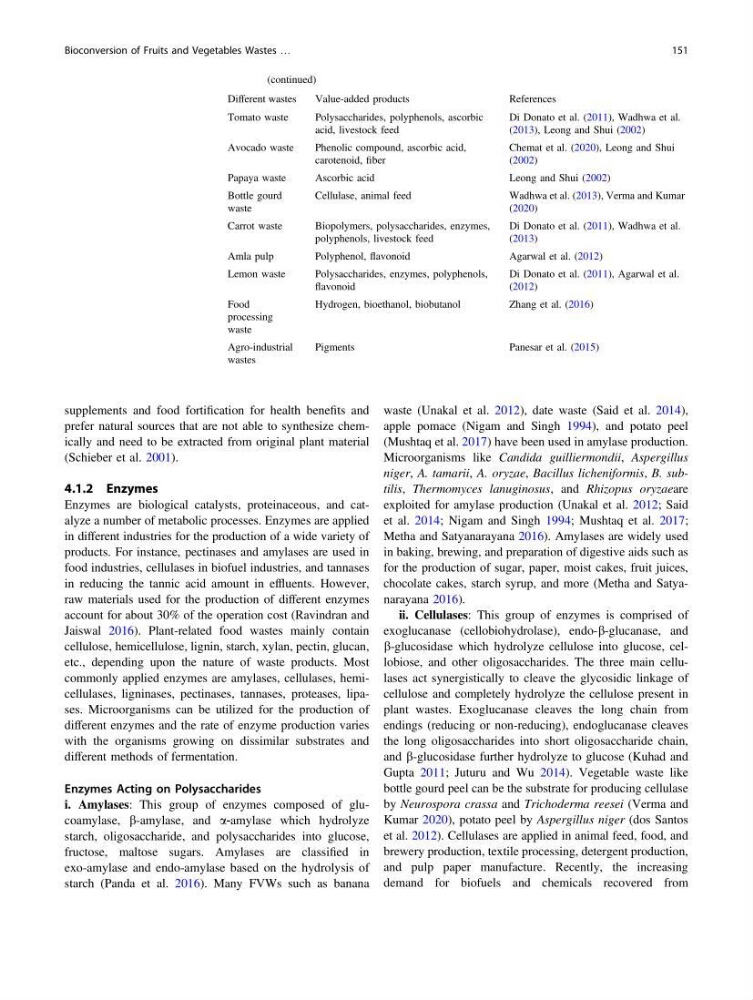
Table 2 (continued)
Different wastes
Value-added products
References
Tomato waste
Polysaccharides, polyphenols, ascorbic
acid, livestock feed
Di Donato et al. (2011), Wadhwa et al.
(2013), Leong and Shui (2002)
Avocado waste
Phenolic compound, ascorbic acid,
carotenoid, fiber
Chemat et al. (2020), Leong and Shui
(2002)
Papaya waste
Ascorbic acid
Leong and Shui (2002)
Bottle gourd
waste
Cellulase, animal feed
Wadhwa et al. (2013), Verma and Kumar
(2020)
Carrot waste
Biopolymers, polysaccharides, enzymes,
polyphenols, livestock feed
Di Donato et al. (2011), Wadhwa et al.
(2013)
Amla pulp
Polyphenol, flavonoid
Agarwal et al. (2012)
Lemon waste
Polysaccharides, enzymes, polyphenols,
flavonoid
Di Donato et al. (2011), Agarwal et al.
(2012)
Food
processing
waste
Hydrogen, bioethanol, biobutanol
Zhang et al. (2016)
Agro-industrial
wastes
Pigments
Panesar et al. (2015)
Bioconversion of Fruits and Vegetables Wastes …
151
prefer natural sources that are not able to synthesize chemically and need to be extracted from original plant material
(Schieber et al. 2001).
4.1.2 Enzymes
Enzymes are biological catalysts, proteinaceous, and catalyze a number of metabolic processes. Enzymes are applied
in different industries for the production of a wide variety of
products. For instance, pectinases and amylases are used in
food industries, cellulases in biofuel industries, and tannases
in reducing the tannic acid amount in effluents. However,
raw materials used for the production of different enzymes
account for about 30% of the operation cost (Ravindran and
Jaiswal 2016). Plant-related food wastes mainly contain
cellulose, hemicellulose, lignin, starch, xylan, pectin, glucan,
etc., depending upon the nature of waste products. Most
commonly applied enzymes are amylases, cellulases, hemicellulases, ligninases, pectinases, tannases, proteases, lipases. Microorganisms can be utilized for the production of
different enzymes and the rate of enzyme production varies
with the organisms growing on dissimilar substrates and
different methods of fermentation.
Enzymes Acting on Polysaccharides
i. Amylases: This group of enzymes composed of glucoamylase, b-amylase, and a‐amylase which hydrolyze
starch, oligosaccharide, and polysaccharides into glucose,
fructose, maltose sugars. Amylases are classified in
exo-amylase and endo-amylase based on the hydrolysis of
starch (Panda et al. 2016). Many FVWs such as banana
waste (Unakal et al. 2012), date waste (Said et al. 2014),
apple pomace (Nigam and Singh 1994), and potato peel
(Mushtaq et al. 2017) have been used in amylase production.
Microorganisms like Candida guilliermondii, Aspergillus
niger, A. tamarii, A. oryzae, Bacillus licheniformis, B. subtilis, Thermomyces lanuginosus, and Rhizopus oryzaeare
exploited for amylase production (Unakal et al. 2012; Said
et al. 2014; Nigam and Singh 1994; Mushtaq et al. 2017;
Metha and Satyanarayana 2016). Amylases are widely used
in baking, brewing, and preparation of digestive aids such as
for the production of sugar, paper, moist cakes, fruit juices,
chocolate cakes, starch syrup, and more (Metha and Satyanarayana 2016).
ii. Cellulases: This group of enzymes is comprised of
exoglucanase (cellobiohydrolase), endo-b-glucanase, and
b-glucosidase which hydrolyze cellulose into glucose, cellobiose, and other oligosaccharides. The three main cellulases act synergistically to cleave the glycosidic linkage of
cellulose and completely hydrolyze the cellulose present in
plant wastes. Exoglucanase cleaves the long chain from
endings (reducing or non-reducing), endoglucanase cleaves
the long oligosaccharides into short oligosaccharide chain,
and b-glucosidase further hydrolyze to glucose (Kuhad and
Gupta 2011; Juturu and Wu 2014). Vegetable waste like
bottle gourd peel can be the substrate for producing cellulase
by Neurospora crassa and Trichoderma reesei (Verma and
Kumar 2020), potato peel by Aspergillus niger (dos Santos
et al. 2012). Cellulases are applied in animal feed, food, and
brewery production, textile processing, detergent production,
and pulp paper manufacture. Recently, the increasing
demand for biofuels and chemicals recovered from
Table 2 (continued)
Different wastes
Value-added products
References
Tomato waste
Polysaccharides, polyphenols, ascorbic
acid, livestock feed
Di Donato et al. (2011), Wadhwa et al.
(2013), Leong and Shui (2002)
Avocado waste
Phenolic compound, ascorbic acid,
carotenoid, fiber
Chemat et al. (2020), Leong and Shui
(2002)
Papaya waste
Ascorbic acid
Leong and Shui (2002)
Bottle gourd
waste
Cellulase, animal feed
Wadhwa et al. (2013), Verma and Kumar
(2020)
Carrot waste
Biopolymers, polysaccharides, enzymes,
polyphenols, livestock feed
Di Donato et al. (2011), Wadhwa et al.
(2013)
Amla pulp
Polyphenol, flavonoid
Agarwal et al. (2012)
Lemon waste
Polysaccharides, enzymes, polyphenols,
flavonoid
Di Donato et al. (2011), Agarwal et al.
(2012)
Food
processing
waste
Hydrogen, bioethanol, biobutanol
Zhang et al. (2016)
Agro-industrial
wastes
Pigments
Panesar et al. (2015)
Bioconversion of Fruits and Vegetables Wastes …
151