

Before the introduction of the regulation in 1977, the CPO
processing industry was the biggest contributor to water
pollution in the country without any control (Ahmed et al.
2015). The regulations that help to control the effluent discharged from the palm oil industry are stated in the Environmental Quality Regulations 1977 (Prescribed Premises—
Crude Palm Oil) under Section 51 of the Environmental
Quality Act (EQA) 1974, the principal governing regulation
for discharge standards of industrial effluent (Rupani et al.
2010; Ahmed et al. 2015). The general characteristics of raw
POME and its allowable discharge limits into water bodies
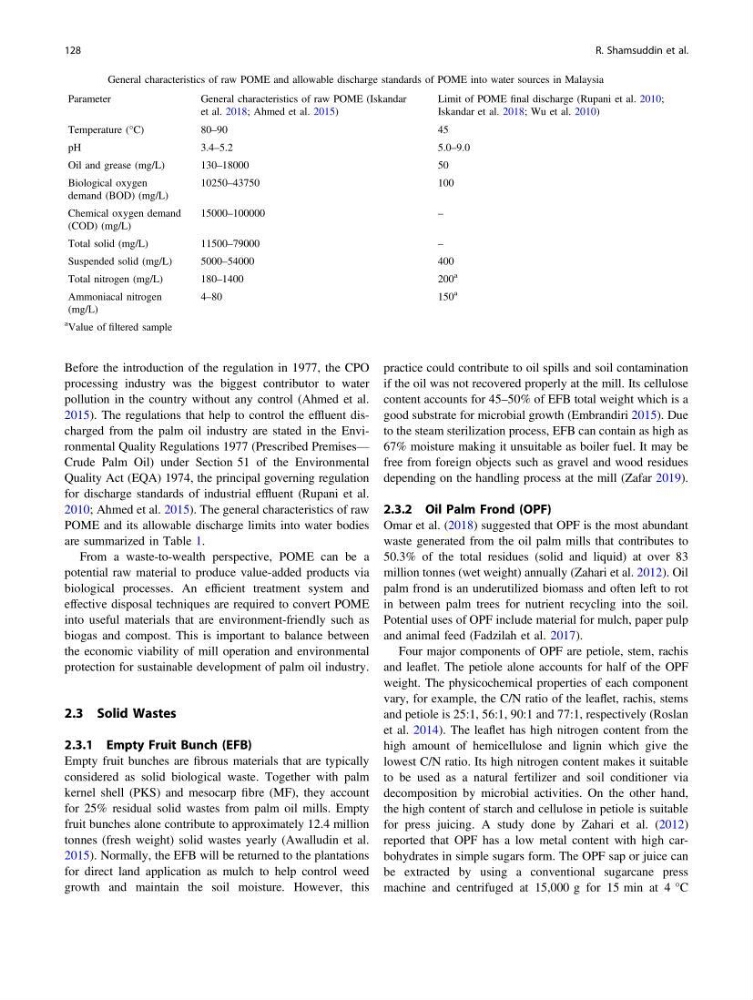
are summarized in Table 1.
From a waste-to-wealth perspective, POME can be a
potential raw material to produce value-added products via
biological processes. An efficient treatment system and
effective disposal techniques are required to convert POME
into useful materials that are environment-friendly such as
biogas and compost. This is important to balance between
the economic viability of mill operation and environmental
protection for sustainable development of palm oil industry.
2.3 Solid Wastes
2.3.1 Empty Fruit Bunch (EFB)
Empty fruit bunches are fibrous materials that are typically
considered as solid biological waste. Together with palm
kernel shell (PKS) and mesocarp fibre (MF), they account
for 25% residual solid wastes from palm oil mills. Empty
fruit bunches alone contribute to approximately 12.4 million
tonnes (fresh weight) solid wastes yearly (Awalludin et al.
2015). Normally, the EFB will be returned to the plantations
for direct land application as mulch to help control weed
growth and maintain the soil moisture. However, this
practice could contribute to oil spills and soil contamination
if the oil was not recovered properly at the mill. Its cellulose
content accounts for 45–50% of EFB total weight which is a
good substrate for microbial growth (Embrandiri 2015). Due
to the steam sterilization process, EFB can contain as high as
67% moisture making it unsuitable as boiler fuel. It may be
free from foreign objects such as gravel and wood residues
depending on the handling process at the mill (Zafar 2019).
2.3.2 Oil Palm Frond (OPF)
Omar et al. (2018) suggested that OPF is the most abundant
waste generated from the oil palm mills that contributes to
50.3% of the total residues (solid and liquid) at over 83
million tonnes (wet weight) annually (Zahari et al. 2012). Oil
palm frond is an underutilized biomass and often left to rot
in between palm trees for nutrient recycling into the soil.
Potential uses of OPF include material for mulch, paper pulp
and animal feed (Fadzilah et al. 2017).
Four major components of OPF are petiole, stem, rachis
and leaflet. The petiole alone accounts for half of the OPF
weight. The physicochemical properties of each component
vary, for example, the C/N ratio of the leaflet, rachis, stems
and petiole is 25:1, 56:1, 90:1 and 77:1, respectively (Roslan
et al. 2014). The leaflet has high nitrogen content from the
high amount of hemicellulose and lignin which give the
lowest C/N ratio. Its high nitrogen content makes it suitable
to be used as a natural fertilizer and soil conditioner via
decomposition by microbial activities. On the other hand,
the high content of starch and cellulose in petiole is suitable
for press juicing. A study done by Zahari et al. (2012)
reported that OPF has a low metal content with high carbohydrates in simple sugars form. The OPF sap or juice can
be extracted by using a conventional sugarcane press
machine and centrifuged at 15,000 g for 15 min at 4 °C
Table 1 General characteristics of raw POME and allowable discharge standards of POME into water sources in Malaysia
Parameter
General characteristics of raw POME (Iskandar
et al. 2018; Ahmed et al. 2015)
Limit of POME final discharge (Rupani et al. 2010;
Iskandar et al. 2018; Wu et al. 2010)
Temperature (°C)
80–90
45
pH
3.4–5.2
5.0–9.0
Oil and grease (mg/L)
130–18000
50
Biological oxygen
demand (BOD) (mg/L)
10250–43750
100
Chemical oxygen demand
(COD) (mg/L)
15000–100000
–
Total solid (mg/L)
11500–79000
–
Suspended solid (mg/L)
5000–54000
400
Total nitrogen (mg/L)
180–1400
200
a
Ammoniacal nitrogen
(mg/L)
4–80
150
a
a Value of filtered sample
128
R. Shamsuddin et al.
processing industry was the biggest contributor to water
pollution in the country without any control (Ahmed et al.
2015). The regulations that help to control the effluent discharged from the palm oil industry are stated in the Environmental Quality Regulations 1977 (Prescribed Premises—
Crude Palm Oil) under Section 51 of the Environmental
Quality Act (EQA) 1974, the principal governing regulation
for discharge standards of industrial effluent (Rupani et al.
2010; Ahmed et al. 2015). The general characteristics of raw
POME and its allowable discharge limits into water bodies
are summarized in Table 1.
From a waste-to-wealth perspective, POME can be a
potential raw material to produce value-added products via
biological processes. An efficient treatment system and
effective disposal techniques are required to convert POME
into useful materials that are environment-friendly such as
biogas and compost. This is important to balance between
the economic viability of mill operation and environmental
protection for sustainable development of palm oil industry.
2.3 Solid Wastes
2.3.1 Empty Fruit Bunch (EFB)
Empty fruit bunches are fibrous materials that are typically
considered as solid biological waste. Together with palm
kernel shell (PKS) and mesocarp fibre (MF), they account
for 25% residual solid wastes from palm oil mills. Empty
fruit bunches alone contribute to approximately 12.4 million
tonnes (fresh weight) solid wastes yearly (Awalludin et al.
2015). Normally, the EFB will be returned to the plantations
for direct land application as mulch to help control weed
growth and maintain the soil moisture. However, this
practice could contribute to oil spills and soil contamination
if the oil was not recovered properly at the mill. Its cellulose
content accounts for 45–50% of EFB total weight which is a
good substrate for microbial growth (Embrandiri 2015). Due
to the steam sterilization process, EFB can contain as high as
67% moisture making it unsuitable as boiler fuel. It may be
free from foreign objects such as gravel and wood residues
depending on the handling process at the mill (Zafar 2019).
2.3.2 Oil Palm Frond (OPF)
Omar et al. (2018) suggested that OPF is the most abundant
waste generated from the oil palm mills that contributes to
50.3% of the total residues (solid and liquid) at over 83
million tonnes (wet weight) annually (Zahari et al. 2012). Oil
palm frond is an underutilized biomass and often left to rot
in between palm trees for nutrient recycling into the soil.
Potential uses of OPF include material for mulch, paper pulp
and animal feed (Fadzilah et al. 2017).
Four major components of OPF are petiole, stem, rachis
and leaflet. The petiole alone accounts for half of the OPF
weight. The physicochemical properties of each component
vary, for example, the C/N ratio of the leaflet, rachis, stems
and petiole is 25:1, 56:1, 90:1 and 77:1, respectively (Roslan
et al. 2014). The leaflet has high nitrogen content from the
high amount of hemicellulose and lignin which give the
lowest C/N ratio. Its high nitrogen content makes it suitable
to be used as a natural fertilizer and soil conditioner via
decomposition by microbial activities. On the other hand,
the high content of starch and cellulose in petiole is suitable
for press juicing. A study done by Zahari et al. (2012)
reported that OPF has a low metal content with high carbohydrates in simple sugars form. The OPF sap or juice can
be extracted by using a conventional sugarcane press
machine and centrifuged at 15,000 g for 15 min at 4 °C
Table 1 General characteristics of raw POME and allowable discharge standards of POME into water sources in Malaysia
Parameter
General characteristics of raw POME (Iskandar
et al. 2018; Ahmed et al. 2015)
Limit of POME final discharge (Rupani et al. 2010;
Iskandar et al. 2018; Wu et al. 2010)
Temperature (°C)
80–90
45
pH
3.4–5.2
5.0–9.0
Oil and grease (mg/L)
130–18000
50
Biological oxygen
demand (BOD) (mg/L)
10250–43750
100
Chemical oxygen demand
(COD) (mg/L)
15000–100000
–
Total solid (mg/L)
11500–79000
–
Suspended solid (mg/L)
5000–54000
400
Total nitrogen (mg/L)
180–1400
200
a
Ammoniacal nitrogen
(mg/L)
4–80
150
a
a Value of filtered sample
128
R. Shamsuddin et al.