

2.2 Palm Oil Mill Effluent (POME)
In the CPO extraction process, approximately 5–7.5 tonnes
of water are needed to produce 1 tonne of CPO with more
than 50% of the processing water could finally become
POME. In addition, 0.5–0.75 tonnes of POME are produced
for every tonne of FFB processed (Yacob et al. 2005).
Simple mass balance in a processing mill suggests that 36%
and 60% of POME is contributed by the sterilization of FFB
and clarification of extracted CPO, respectively (Sethupathi
2004). According to Lorestani (Lorestani 2006), Malaysian
palm oil industry generates about 53 million cubic meters of
POME annually.
POME contains 95–96% water, 0.6–0.7% oil and 4–5%
total solids (of which 2–4% are suspended solids). Freshly
produced POME has a pH value of 4–5, chemical oxygen
demand of 51,000 mg/L, biological oxygen demand of
25,000 mg/L, suspended solids of 18,000 mg/L, oil and
grease of 4000 mg/L and nitrogen content of 750 mg/L
(Iskandar et al. 2018). POME is a chemical-free effluent and
is considered non-toxic. It is often treated in aeration ponds
which is a very slow process, contributing to environmental
problems such as leaching of contaminants into groundwater
or soil and methane gas released into the atmosphere. In
addition, the naturally present microorganisms in POME
will compete for oxygen uptake with aquatic species,
resulting in the depletion of dissolved oxygen and slowly
inhibit their growth, eventually causing the death of the
aquatic species over time (Iskandar et al. 2018).
The Malaysian government has enforced well-designed
regulatory standards and policies specifically for palm oil
mill discharges to control the industrial pollution effectively.
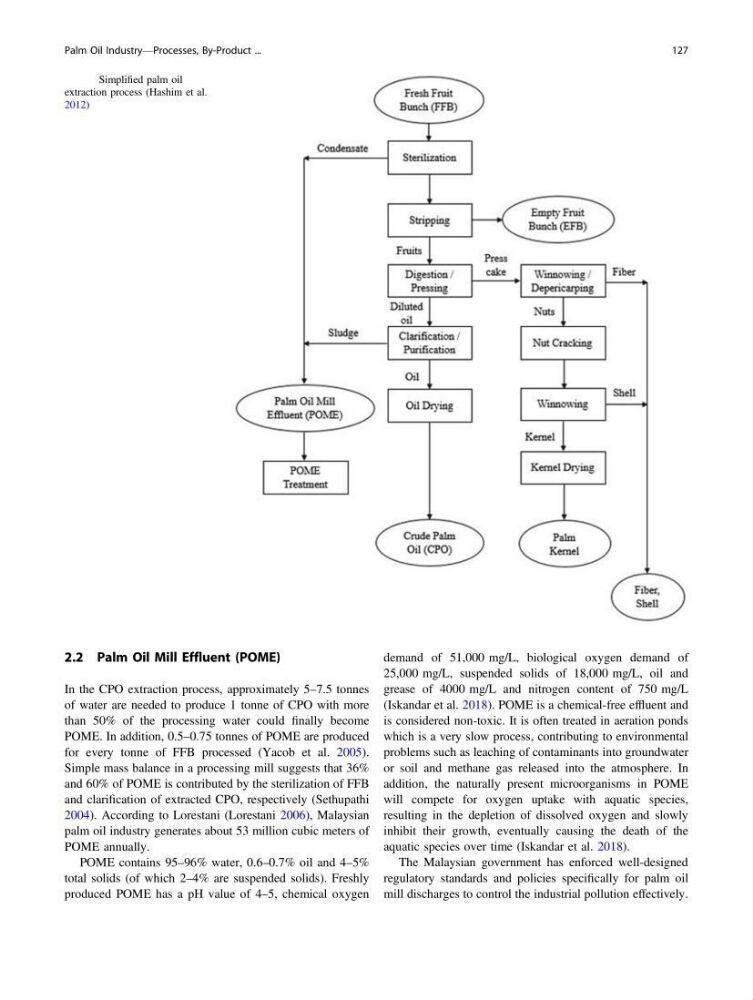
Fig. 8 Simplified palm oil
extraction process (Hashim et al.
2012)
Palm Oil Industry—Processes, By-Product ...
127
In the CPO extraction process, approximately 5–7.5 tonnes
of water are needed to produce 1 tonne of CPO with more
than 50% of the processing water could finally become
POME. In addition, 0.5–0.75 tonnes of POME are produced
for every tonne of FFB processed (Yacob et al. 2005).
Simple mass balance in a processing mill suggests that 36%
and 60% of POME is contributed by the sterilization of FFB
and clarification of extracted CPO, respectively (Sethupathi
2004). According to Lorestani (Lorestani 2006), Malaysian
palm oil industry generates about 53 million cubic meters of
POME annually.
POME contains 95–96% water, 0.6–0.7% oil and 4–5%
total solids (of which 2–4% are suspended solids). Freshly
produced POME has a pH value of 4–5, chemical oxygen
demand of 51,000 mg/L, biological oxygen demand of
25,000 mg/L, suspended solids of 18,000 mg/L, oil and
grease of 4000 mg/L and nitrogen content of 750 mg/L
(Iskandar et al. 2018). POME is a chemical-free effluent and
is considered non-toxic. It is often treated in aeration ponds
which is a very slow process, contributing to environmental
problems such as leaching of contaminants into groundwater
or soil and methane gas released into the atmosphere. In
addition, the naturally present microorganisms in POME
will compete for oxygen uptake with aquatic species,
resulting in the depletion of dissolved oxygen and slowly
inhibit their growth, eventually causing the death of the
aquatic species over time (Iskandar et al. 2018).
The Malaysian government has enforced well-designed
regulatory standards and policies specifically for palm oil
mill discharges to control the industrial pollution effectively.
Fig. 8 Simplified palm oil
extraction process (Hashim et al.
2012)
Palm Oil Industry—Processes, By-Product ...
127