

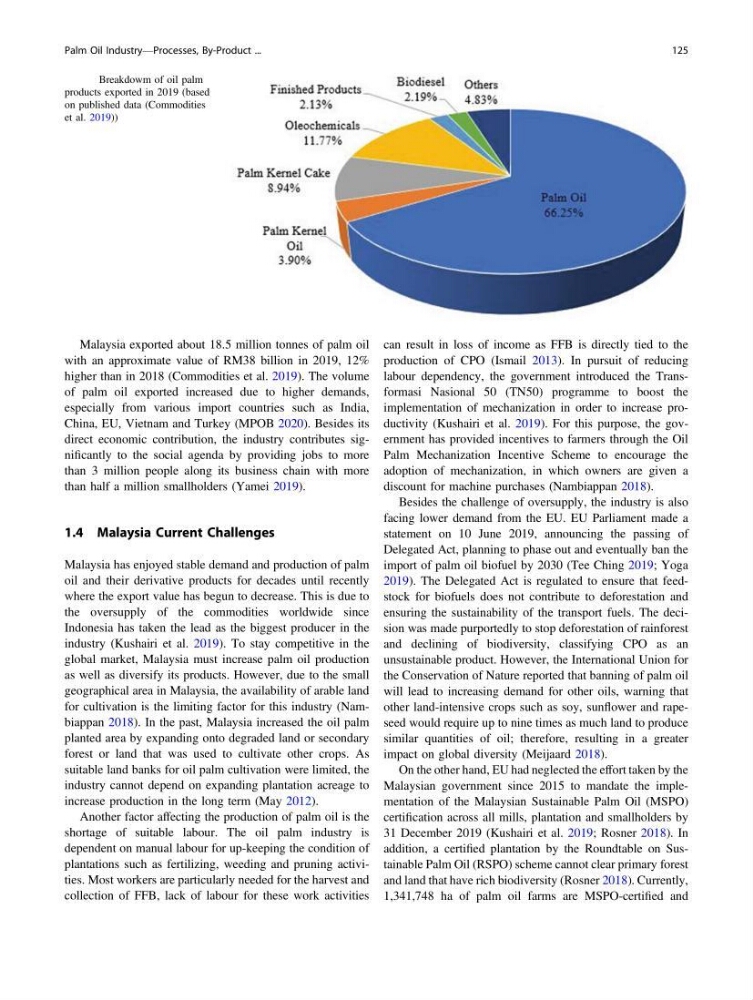
Malaysia exported about 18.5 million tonnes of palm oil
with an approximate value of RM38 billion in 2019, 12%
higher than in 2018 (Commodities et al. 2019). The volume
of palm oil exported increased due to higher demands,
especially from various import countries such as India,
China, EU, Vietnam and Turkey (MPOB 2020). Besides its
direct economic contribution, the industry contributes significantly to the social agenda by providing jobs to more
than 3 million people along its business chain with more
than half a million smallholders (Yamei 2019).
1.4 Malaysia Current Challenges
Malaysia has enjoyed stable demand and production of palm
oil and their derivative products for decades until recently
where the export value has begun to decrease. This is due to
the oversupply of the commodities worldwide since
Indonesia has taken the lead as the biggest producer in the
industry (Kushairi et al. 2019). To stay competitive in the
global market, Malaysia must increase palm oil production
as well as diversify its products. However, due to the small
geographical area in Malaysia, the availability of arable land
for cultivation is the limiting factor for this industry (Nambiappan 2018). In the past, Malaysia increased the oil palm
planted area by expanding onto degraded land or secondary
forest or land that was used to cultivate other crops. As
suitable land banks for oil palm cultivation were limited, the
industry cannot depend on expanding plantation acreage to
increase production in the long term (May 2012).
Another factor affecting the production of palm oil is the
shortage of suitable labour. The oil palm industry is
dependent on manual labour for up-keeping the condition of
plantations such as fertilizing, weeding and pruning activities. Most workers are particularly needed for the harvest and
collection of FFB, lack of labour for these work activities
can result in loss of income as FFB is directly tied to the
production of CPO (Ismail 2013). In pursuit of reducing
labour dependency, the government introduced the Transformasi Nasional 50 (TN50) programme to boost the
implementation of mechanization in order to increase productivity (Kushairi et al. 2019). For this purpose, the government has provided incentives to farmers through the Oil
Palm Mechanization Incentive Scheme to encourage the
adoption of mechanization, in which owners are given a
discount for machine purchases (Nambiappan 2018).
Besides the challenge of oversupply, the industry is also
facing lower demand from the EU. EU Parliament made a
statement on 10 June 2019, announcing the passing of
Delegated Act, planning to phase out and eventually ban the
import of palm oil biofuel by 2030 (Tee Ching 2019; Yoga
2019). The Delegated Act is regulated to ensure that feedstock for biofuels does not contribute to deforestation and
ensuring the sustainability of the transport fuels. The decision was made purportedly to stop deforestation of rainforest
and declining of biodiversity, classifying CPO as an
unsustainable product. However, the International Union for
the Conservation of Nature reported that banning of palm oil
will lead to increasing demand for other oils, warning that
other land-intensive crops such as soy, sunflower and rapeseed would require up to nine times as much land to produce
similar quantities of oil; therefore, resulting in a greater
impact on global diversity (Meijaard 2018).
On the other hand, EU had neglected the effort taken by the
Malaysian government since 2015 to mandate the implementation of the Malaysian Sustainable Palm Oil (MSPO)
certification across all mills, plantation and smallholders by
31 December 2019 (Kushairi et al. 2019; Rosner 2018). In
addition, a certified plantation by the Roundtable on Sustainable Palm Oil (RSPO) scheme cannot clear primary forest
and land that have rich biodiversity (Rosner 2018). Currently,
1,341,748 ha of palm oil farms are MSPO-certified and
Fig. 7 Breakdowm of oil palm
products exported in 2019 (based
on published data (Commodities
et al. 2019))
Palm Oil Industry—Processes, By-Product ...
125
with an approximate value of RM38 billion in 2019, 12%
higher than in 2018 (Commodities et al. 2019). The volume
of palm oil exported increased due to higher demands,
especially from various import countries such as India,
China, EU, Vietnam and Turkey (MPOB 2020). Besides its
direct economic contribution, the industry contributes significantly to the social agenda by providing jobs to more
than 3 million people along its business chain with more
than half a million smallholders (Yamei 2019).
1.4 Malaysia Current Challenges
Malaysia has enjoyed stable demand and production of palm
oil and their derivative products for decades until recently
where the export value has begun to decrease. This is due to
the oversupply of the commodities worldwide since
Indonesia has taken the lead as the biggest producer in the
industry (Kushairi et al. 2019). To stay competitive in the
global market, Malaysia must increase palm oil production
as well as diversify its products. However, due to the small
geographical area in Malaysia, the availability of arable land
for cultivation is the limiting factor for this industry (Nambiappan 2018). In the past, Malaysia increased the oil palm
planted area by expanding onto degraded land or secondary
forest or land that was used to cultivate other crops. As
suitable land banks for oil palm cultivation were limited, the
industry cannot depend on expanding plantation acreage to
increase production in the long term (May 2012).
Another factor affecting the production of palm oil is the
shortage of suitable labour. The oil palm industry is
dependent on manual labour for up-keeping the condition of
plantations such as fertilizing, weeding and pruning activities. Most workers are particularly needed for the harvest and
collection of FFB, lack of labour for these work activities
can result in loss of income as FFB is directly tied to the
production of CPO (Ismail 2013). In pursuit of reducing
labour dependency, the government introduced the Transformasi Nasional 50 (TN50) programme to boost the
implementation of mechanization in order to increase productivity (Kushairi et al. 2019). For this purpose, the government has provided incentives to farmers through the Oil
Palm Mechanization Incentive Scheme to encourage the
adoption of mechanization, in which owners are given a
discount for machine purchases (Nambiappan 2018).
Besides the challenge of oversupply, the industry is also
facing lower demand from the EU. EU Parliament made a
statement on 10 June 2019, announcing the passing of
Delegated Act, planning to phase out and eventually ban the
import of palm oil biofuel by 2030 (Tee Ching 2019; Yoga
2019). The Delegated Act is regulated to ensure that feedstock for biofuels does not contribute to deforestation and
ensuring the sustainability of the transport fuels. The decision was made purportedly to stop deforestation of rainforest
and declining of biodiversity, classifying CPO as an
unsustainable product. However, the International Union for
the Conservation of Nature reported that banning of palm oil
will lead to increasing demand for other oils, warning that
other land-intensive crops such as soy, sunflower and rapeseed would require up to nine times as much land to produce
similar quantities of oil; therefore, resulting in a greater
impact on global diversity (Meijaard 2018).
On the other hand, EU had neglected the effort taken by the
Malaysian government since 2015 to mandate the implementation of the Malaysian Sustainable Palm Oil (MSPO)
certification across all mills, plantation and smallholders by
31 December 2019 (Kushairi et al. 2019; Rosner 2018). In
addition, a certified plantation by the Roundtable on Sustainable Palm Oil (RSPO) scheme cannot clear primary forest
and land that have rich biodiversity (Rosner 2018). Currently,
1,341,748 ha of palm oil farms are MSPO-certified and
Fig. 7 Breakdowm of oil palm
products exported in 2019 (based
on published data (Commodities
et al. 2019))
Palm Oil Industry—Processes, By-Product ...
125