

America, Voice of the People, and SW Radio
Africa.
9
Internet in Zimbabwe
The number of Internet users in 2005 was reportedly 1,000,000, or approximately 8 percent of
Zimbabwe’s population. 10 The number of Internet
service providers (ISPs) has risen from six in 2003
to twenty-seven in 2004, due to growing
demand. 11 The Business Mirror in 2005 performed a survey showing that Harare has over
thirty Internet cafés, up from about twenty, two
years prior. 12 The Internet is a less expensive
means of communication than the telephone
service in Zimbabwe, fueling its growth. In 2004,
electronic messaging cost between ZIM $200
(USD0.04 by 2004 exchange rate) and ZIM $250
(USD0.05 by 2004 exchange rate) per minute,
while international telephone calls cost between
ZIM $3,800 (USD0.72 by 2004 exchange rate)
and ZIM $5,800 (USD1.10 by 2004 exchange
rate) per minute. 13 However, because of limited
awareness of its capabilities, Internet use is
mostly limited to e-mail. 14 The low level of Internet
penetration overall is likely the result of the
increasingly rapid decline of the economy and
quality of life in the country over the past seven
years. In January 2007, inflation rates reached a
staggering 1,593.6 percent. 15 The government is
bankrupt, eight in ten Zimbabweans are destitute, and workers in Harare see their bus fares to
and from work take up their entire salaries. 16 In
such an environment, demand for luxury goods
such as computers and Internet use is low. In
September 2006, a large majority of the Internet
went offline when the international satellite communications provider, Intelsat, cut service to the
country, following the failure of governmentowned telecommunications company, TelOne, to
pay its debts to the company. Service was
restored after the reserve bank paid the outstanding debt. 17
Legal and regulatory frameworks
Zimbabwe’s government mainly focuses its regulation of Internet use on e-mail.
18
The Post and
Telecommunications Act of 2000 allows the government to monitor e-mail usage and requires
ISPs to supply information to government officials
when requested. 19 The Supreme Court, however,
ruled in 2004 that the sections of the law that permit monitoring Internet users violated the constitution. 20
430
Country Summaries
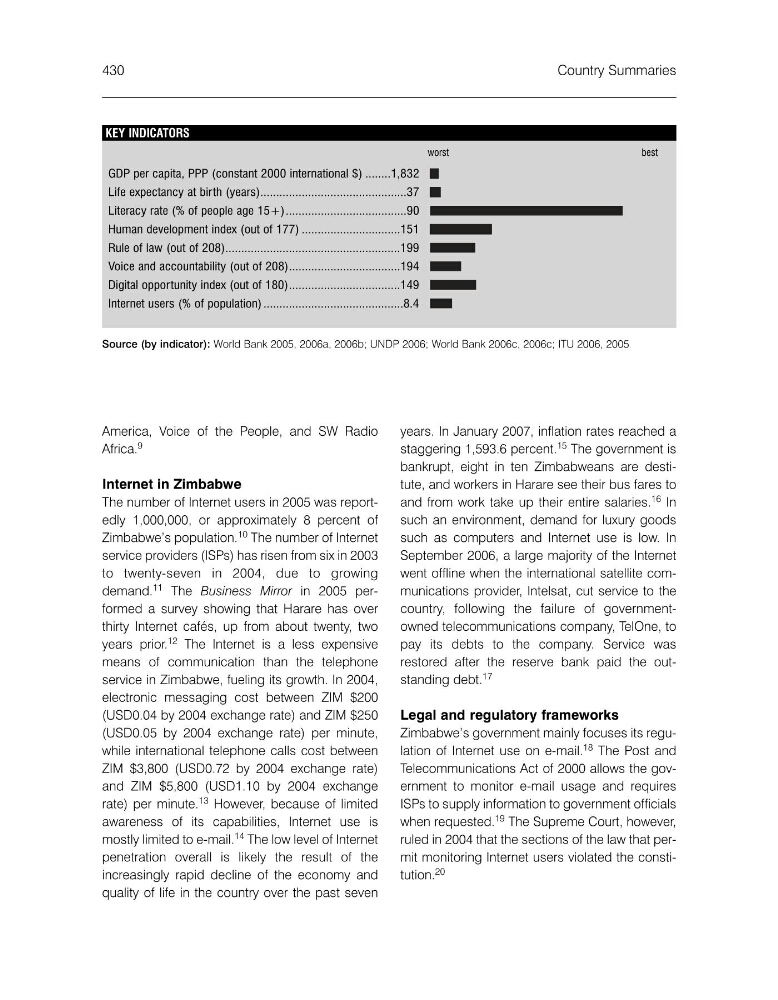
KEY INDICATORS
worst
best
GDP per capita, PPP (constant 2000 international $) ........1,832 3.57
Life expectancy at birth (years)..............................................37 0.33
Literacy rate (% of people age 15+)......................................90 6.00
Human development index (out of 177) ...............................151 2.51
Rule of law (out of 208).......................................................199 2.07
Voice and accountability (out of 208)...................................194 1.69
Digital opportunity index (out of 180)...................................149 2.80
Internet users (% of population) ............................................8.4 3.85
Source (by indicator): World Bank 2005, 2006a, 2006b; UNDP 2006; World Bank 2006c, 2006c; ITU 2006, 2005
Africa.
9
Internet in Zimbabwe
The number of Internet users in 2005 was reportedly 1,000,000, or approximately 8 percent of
Zimbabwe’s population. 10 The number of Internet
service providers (ISPs) has risen from six in 2003
to twenty-seven in 2004, due to growing
demand. 11 The Business Mirror in 2005 performed a survey showing that Harare has over
thirty Internet cafés, up from about twenty, two
years prior. 12 The Internet is a less expensive
means of communication than the telephone
service in Zimbabwe, fueling its growth. In 2004,
electronic messaging cost between ZIM $200
(USD0.04 by 2004 exchange rate) and ZIM $250
(USD0.05 by 2004 exchange rate) per minute,
while international telephone calls cost between
ZIM $3,800 (USD0.72 by 2004 exchange rate)
and ZIM $5,800 (USD1.10 by 2004 exchange
rate) per minute. 13 However, because of limited
awareness of its capabilities, Internet use is
mostly limited to e-mail. 14 The low level of Internet
penetration overall is likely the result of the
increasingly rapid decline of the economy and
quality of life in the country over the past seven
years. In January 2007, inflation rates reached a
staggering 1,593.6 percent. 15 The government is
bankrupt, eight in ten Zimbabweans are destitute, and workers in Harare see their bus fares to
and from work take up their entire salaries. 16 In
such an environment, demand for luxury goods
such as computers and Internet use is low. In
September 2006, a large majority of the Internet
went offline when the international satellite communications provider, Intelsat, cut service to the
country, following the failure of governmentowned telecommunications company, TelOne, to
pay its debts to the company. Service was
restored after the reserve bank paid the outstanding debt. 17
Legal and regulatory frameworks
Zimbabwe’s government mainly focuses its regulation of Internet use on e-mail.
18
The Post and
Telecommunications Act of 2000 allows the government to monitor e-mail usage and requires
ISPs to supply information to government officials
when requested. 19 The Supreme Court, however,
ruled in 2004 that the sections of the law that permit monitoring Internet users violated the constitution. 20
430
Country Summaries
KEY INDICATORS
worst
best
GDP per capita, PPP (constant 2000 international $) ........1,832 3.57
Life expectancy at birth (years)..............................................37 0.33
Literacy rate (% of people age 15+)......................................90 6.00
Human development index (out of 177) ...............................151 2.51
Rule of law (out of 208).......................................................199 2.07
Voice and accountability (out of 208)...................................194 1.69
Digital opportunity index (out of 180)...................................149 2.80
Internet users (% of population) ............................................8.4 3.85
Source (by indicator): World Bank 2005, 2006a, 2006b; UNDP 2006; World Bank 2006c, 2006c; ITU 2006, 2005