

Yemen is serviced by two ISPs: YemenNet,
which is a service of the government’s Public
Telecommunication Corporation (PTC),
6
and
TeleYemen’s Y.Net, which is part of the government’s PTC but is managed by FranceTelecom.
7
Businesses own 60 percent of Internet
subscriber accounts, while government and educational institutions own only 3 percent of subscriber accounts. 8 Far fewer women than men
access the Internet, which may be because the
primary Internet access locations are Internet
cafés (61 percent) and work (24 percent), with
home Internet availability considerably less frequent (13 percent). Only 2 percent access the
Internet from schools. 9 By mid-2005, the number
of Internet cafés in Yemen reached 736.
10
Legal and regulatory frameworks
The Ministry of Telecommunication and Information Technology (MTIT) grants ISP licenses;
11
PTC, a branch under the MTIT, is responsible for
the management and growth of telecommunications in Yemen. 12
ISPs impose restrictions on the use of
Internet services, preventing subscribers from
accessing or transmitting certain content. The
terms and conditions set by TeleYemen (aka
Y.Net) state: “Access to applications which transmit or receive live video or audio, or make similar
demands on the capacity of the network, constitutes an unreasonable usage which may affect
the performance of the network, and is not
permitted.” 13 Also covered are customer responsibilities, including prohibitions on “sending
any message which is offensive on moral, religious, communal, or political grounds” (6.1.1). 14
Additionally, TeleYemen reserves the right to control access “and data stored in the Y.Net system
in any manner deemed appropriate by
TeleYemen” (7.1). 15 Finally, section 6.3.3 admonishes subscribers that TeleYemen will “report to
the competent authorities, any use or attempted
use of the Y.Net service which contravenes any
applicable Law of the Republic of Yemen.” 16
Yemen’s Press and Publications Law,
passed in 1990, subjects publications and
broadcast media to broad prohibitions and harsh
penalties. 17 This law theoretically establishes a
press that “shall be independent and shall have
full freedom to practice its vocation,” but that
must operate “within the context of Islamic creed,
within the basic principles of the Constitution,
goals of the Yemeni Revolution, and the aim of
solidifying national unity.” 18
426
Country Summaries
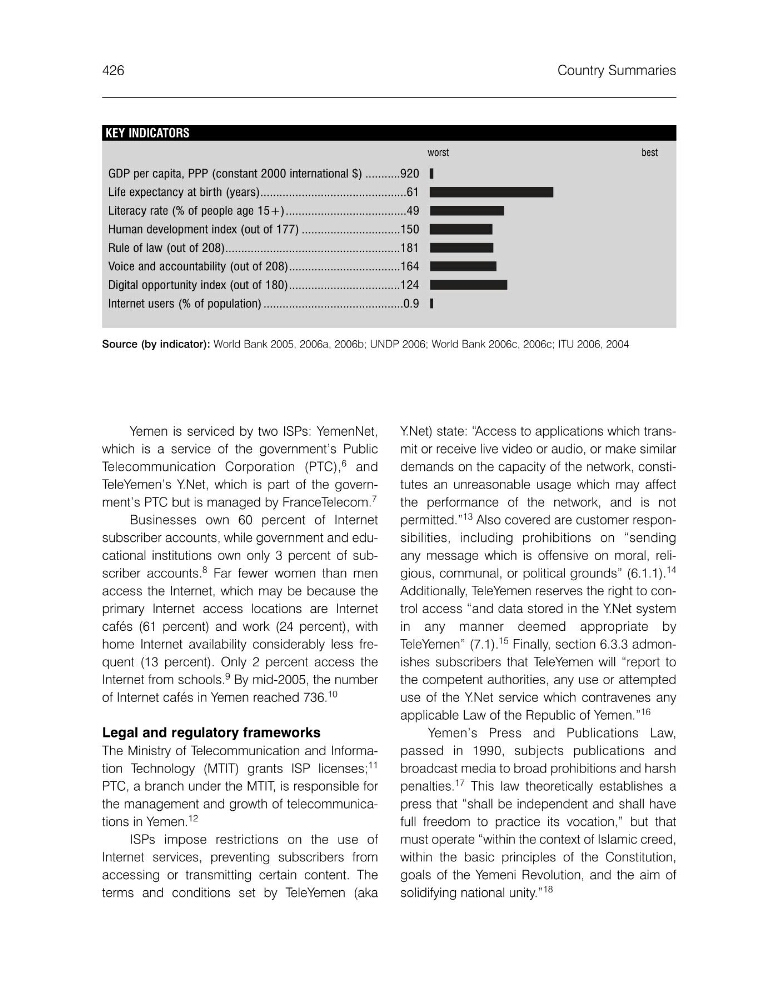
KEY INDICATORS
worst
best
GDP per capita, PPP (constant 2000 international $) ...........920 3.40
Life expectancy at birth (years)..............................................61 4.19
Literacy rate (% of people age 15+)......................................49 2.00
Human development index (out of 177) ...............................150 2.52
Rule of law (out of 208).......................................................181 2.81
Voice and accountability (out of 208)...................................164 2.86
Digital opportunity index (out of 180)...................................124 4.01
Internet users (% of population) ............................................0.9 3.14
Source (by indicator): World Bank 2005, 2006a, 2006b; UNDP 2006; World Bank 2006c, 2006c; ITU 2006, 2004
which is a service of the government’s Public
Telecommunication Corporation (PTC),
6
and
TeleYemen’s Y.Net, which is part of the government’s PTC but is managed by FranceTelecom.
7
Businesses own 60 percent of Internet
subscriber accounts, while government and educational institutions own only 3 percent of subscriber accounts. 8 Far fewer women than men
access the Internet, which may be because the
primary Internet access locations are Internet
cafés (61 percent) and work (24 percent), with
home Internet availability considerably less frequent (13 percent). Only 2 percent access the
Internet from schools. 9 By mid-2005, the number
of Internet cafés in Yemen reached 736.
10
Legal and regulatory frameworks
The Ministry of Telecommunication and Information Technology (MTIT) grants ISP licenses;
11
PTC, a branch under the MTIT, is responsible for
the management and growth of telecommunications in Yemen. 12
ISPs impose restrictions on the use of
Internet services, preventing subscribers from
accessing or transmitting certain content. The
terms and conditions set by TeleYemen (aka
Y.Net) state: “Access to applications which transmit or receive live video or audio, or make similar
demands on the capacity of the network, constitutes an unreasonable usage which may affect
the performance of the network, and is not
permitted.” 13 Also covered are customer responsibilities, including prohibitions on “sending
any message which is offensive on moral, religious, communal, or political grounds” (6.1.1). 14
Additionally, TeleYemen reserves the right to control access “and data stored in the Y.Net system
in any manner deemed appropriate by
TeleYemen” (7.1). 15 Finally, section 6.3.3 admonishes subscribers that TeleYemen will “report to
the competent authorities, any use or attempted
use of the Y.Net service which contravenes any
applicable Law of the Republic of Yemen.” 16
Yemen’s Press and Publications Law,
passed in 1990, subjects publications and
broadcast media to broad prohibitions and harsh
penalties. 17 This law theoretically establishes a
press that “shall be independent and shall have
full freedom to practice its vocation,” but that
must operate “within the context of Islamic creed,
within the basic principles of the Constitution,
goals of the Yemeni Revolution, and the aim of
solidifying national unity.” 18
426
Country Summaries
KEY INDICATORS
worst
best
GDP per capita, PPP (constant 2000 international $) ...........920 3.40
Life expectancy at birth (years)..............................................61 4.19
Literacy rate (% of people age 15+)......................................49 2.00
Human development index (out of 177) ...............................150 2.52
Rule of law (out of 208).......................................................181 2.81
Voice and accountability (out of 208)...................................164 2.86
Digital opportunity index (out of 180)...................................124 4.01
Internet users (% of population) ............................................0.9 3.14
Source (by indicator): World Bank 2005, 2006a, 2006b; UNDP 2006; World Bank 2006c, 2006c; ITU 2006, 2004