

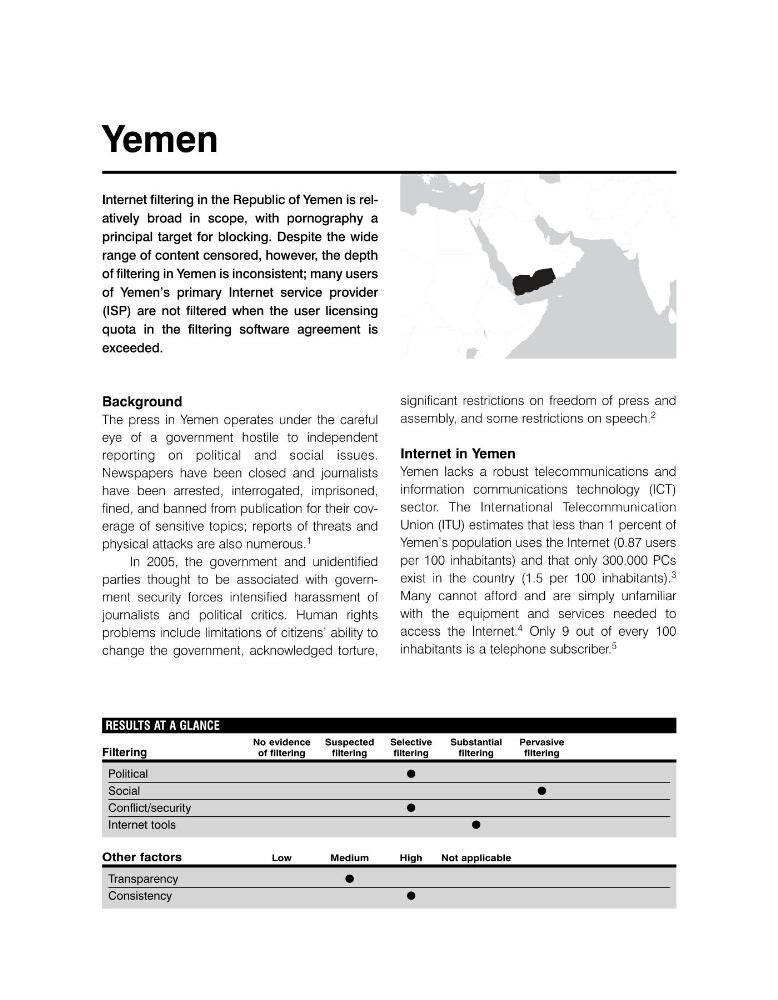
Internet filtering in the Republic of Yemen is relatively broad in scope, with pornography a
principal target for blocking. Despite the wide
range of content censored, however, the depth
of filtering in Yemen is inconsistent; many users
of Yemen’s primary Internet service provider
(ISP) are not filtered when the user licensing
quota in the filtering software agreement is
exceeded.
Background
The press in Yemen operates under the careful
eye of a government hostile to independent
reporting on political and social issues.
Newspapers have been closed and journalists
have been arrested, interrogated, imprisoned,
fined, and banned from publication for their coverage of sensitive topics; reports of threats and
physical attacks are also numerous. 1
In 2005, the government and unidentified
parties thought to be associated with government security forces intensified harassment of
journalists and political critics. Human rights
problems include limitations of citizens’ ability to
change the government, acknowledged torture,
significant restrictions on freedom of press and
assembly, and some restrictions on speech. 2
Internet in Yemen
Yemen lacks a robust telecommunications and
information communications technology (ICT)
sector. The International Telecommunication
Union (ITU) estimates that less than 1 percent of
Yemen’s population uses the Internet (0.87 users
per 100 inhabitants) and that only 300,000 PCs
exist in the country (1.5 per 100 inhabitants). 3
Many cannot afford and are simply unfamiliar
with the equipment and services needed to
access the Internet. 4 Only 9 out of every 100
inhabitants is a telephone subscriber.
5
RESULTS AT A GLANCE
No evidence
Suspected
Selective
Substantial
Pervasive
Filtering
of filtering
filtering
filtering
filtering
filtering
Political
●
Social
●
Conflict/security
●
Internet tools
●
Other factors
Low
Medium
High
Not applicable
Transparency
●
Consistency
●
Yemen
principal target for blocking. Despite the wide
range of content censored, however, the depth
of filtering in Yemen is inconsistent; many users
of Yemen’s primary Internet service provider
(ISP) are not filtered when the user licensing
quota in the filtering software agreement is
exceeded.
Background
The press in Yemen operates under the careful
eye of a government hostile to independent
reporting on political and social issues.
Newspapers have been closed and journalists
have been arrested, interrogated, imprisoned,
fined, and banned from publication for their coverage of sensitive topics; reports of threats and
physical attacks are also numerous. 1
In 2005, the government and unidentified
parties thought to be associated with government security forces intensified harassment of
journalists and political critics. Human rights
problems include limitations of citizens’ ability to
change the government, acknowledged torture,
significant restrictions on freedom of press and
assembly, and some restrictions on speech. 2
Internet in Yemen
Yemen lacks a robust telecommunications and
information communications technology (ICT)
sector. The International Telecommunication
Union (ITU) estimates that less than 1 percent of
Yemen’s population uses the Internet (0.87 users
per 100 inhabitants) and that only 300,000 PCs
exist in the country (1.5 per 100 inhabitants). 3
Many cannot afford and are simply unfamiliar
with the equipment and services needed to
access the Internet. 4 Only 9 out of every 100
inhabitants is a telephone subscriber.
5
RESULTS AT A GLANCE
No evidence
Suspected
Selective
Substantial
Pervasive
Filtering
of filtering
filtering
filtering
filtering
filtering
Political
●
Social
●
Conflict/security
●
Internet tools
●
Other factors
Low
Medium
High
Not applicable
Transparency
●
Consistency
●
Yemen