

elections that were thought to be unfair—highlighted the latent political power resulting from
the “convergence” of information infrastructures
(cell phones, Internet, and independent media)
and political mobilizaton. The opposition made
full use of these technologies to mobilize and
direct supporters in acts of civil disobedience, sitins, and general strikes. Although the Internet did
not play a determining role in the success of the
“orange revolution,” its use by the opposition
helped to foster the perception that these technologies served an important strategic role in
organizing political opposition (which observers
have termed “hyper-democracy”). This perception, in turn, prompted neighboring authoritarian
governments such as that of Belarus to crack
down on Internet openness.
Internet in Ukraine
The partly liberalized Ukrainian telecommunications market is relatively undeveloped. Fixed-line
penetration remains low and the telephone system requires modernization. The demand for
mobile services has expanded rapidly, to reach a
penetration of nearly 50 percent. The largest telecom and top-tier Internet service provider (ISP),
Ukrtelecom, has 92.9 percent state ownership.
The parliament has legalized its privatization, 2
but this has been delayed in anticipation of the
company increasing in market value.
3
The state
monopolies Ukrtelecom and Utel, which is controlled by Ukrtelecom, together own 95 percent of
the long-distance and international calls market. 4
State-owned Ukrtelecom is the largest ISP in
the country, but does not decisively control the
countries other major ISPs. As of June 2006
some sixty ISPs connected to six Internet traffic
exchange points. 5 Recently the number of ISPs
offering broadband access services has rapidly
increased.
6
The government, recognizing the
need for attracting foreign investment and stimulating favorable Internet environment, has also
announced plans to introduce Wi-Fi and WiMAX
technologies. 7
The Ukrainian national country code toplevel domain (“.ua”) is administered by the
Hostmaster Company, a specialized nonprofit
organization.
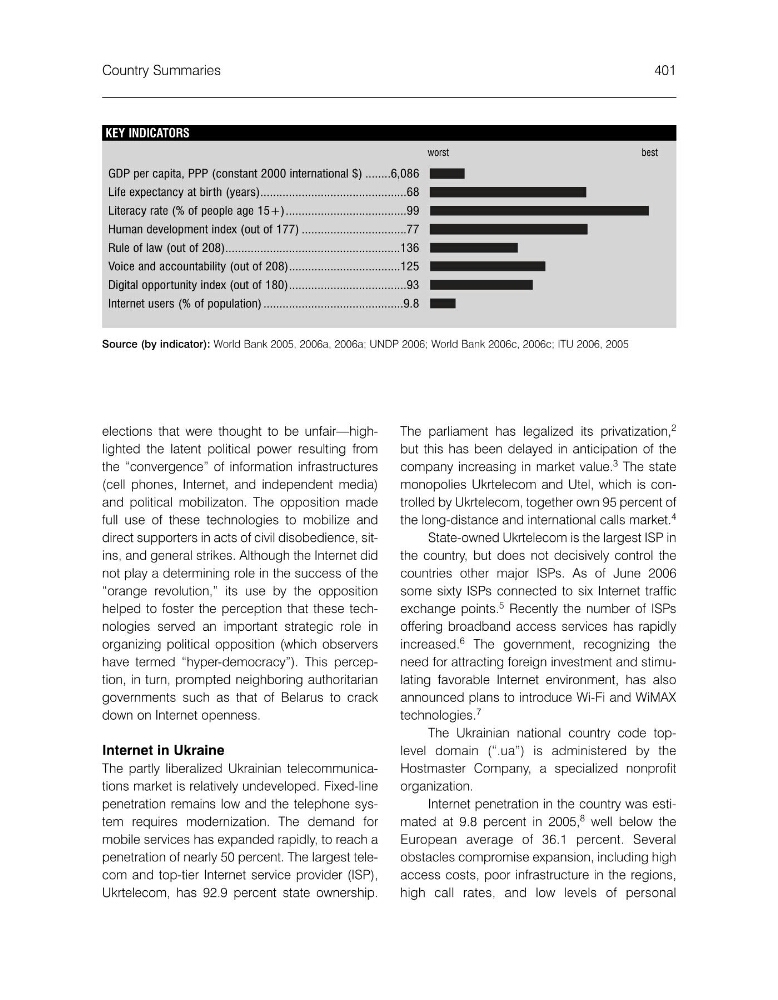
Internet penetration in the country was estimated at 9.8 percent in 2005, 8 well below the
European average of 36.1 percent. Several
obstacles compromise expansion, including high
access costs, poor infrastructure in the regions,
high call rates, and low levels of personal
Country Summaries
401
KEY INDICATORS
worst
best
GDP per capita, PPP (constant 2000 international $) ........6,086 4.39
Life expectancy at birth (years)..............................................68 5.32
Literacy rate (% of people age 15+)......................................99 6.87
Human development index (out of 177) .................................77 5.70
Rule of law (out of 208).......................................................136 3.80
Voice and accountability (out of 208)...................................125 4.49
Digital opportunity index (out of 180).....................................93 5.00
Internet users (% of population) ............................................9.8 3.98
Source (by indicator): World Bank 2005, 2006a, 2006a; UNDP 2006; World Bank 2006c, 2006c; ITU 2006, 2005
the “convergence” of information infrastructures
(cell phones, Internet, and independent media)
and political mobilizaton. The opposition made
full use of these technologies to mobilize and
direct supporters in acts of civil disobedience, sitins, and general strikes. Although the Internet did
not play a determining role in the success of the
“orange revolution,” its use by the opposition
helped to foster the perception that these technologies served an important strategic role in
organizing political opposition (which observers
have termed “hyper-democracy”). This perception, in turn, prompted neighboring authoritarian
governments such as that of Belarus to crack
down on Internet openness.
Internet in Ukraine
The partly liberalized Ukrainian telecommunications market is relatively undeveloped. Fixed-line
penetration remains low and the telephone system requires modernization. The demand for
mobile services has expanded rapidly, to reach a
penetration of nearly 50 percent. The largest telecom and top-tier Internet service provider (ISP),
Ukrtelecom, has 92.9 percent state ownership.
The parliament has legalized its privatization, 2
but this has been delayed in anticipation of the
company increasing in market value.
3
The state
monopolies Ukrtelecom and Utel, which is controlled by Ukrtelecom, together own 95 percent of
the long-distance and international calls market. 4
State-owned Ukrtelecom is the largest ISP in
the country, but does not decisively control the
countries other major ISPs. As of June 2006
some sixty ISPs connected to six Internet traffic
exchange points. 5 Recently the number of ISPs
offering broadband access services has rapidly
increased.
6
The government, recognizing the
need for attracting foreign investment and stimulating favorable Internet environment, has also
announced plans to introduce Wi-Fi and WiMAX
technologies. 7
The Ukrainian national country code toplevel domain (“.ua”) is administered by the
Hostmaster Company, a specialized nonprofit
organization.
Internet penetration in the country was estimated at 9.8 percent in 2005, 8 well below the
European average of 36.1 percent. Several
obstacles compromise expansion, including high
access costs, poor infrastructure in the regions,
high call rates, and low levels of personal
Country Summaries
401
KEY INDICATORS
worst
best
GDP per capita, PPP (constant 2000 international $) ........6,086 4.39
Life expectancy at birth (years)..............................................68 5.32
Literacy rate (% of people age 15+)......................................99 6.87
Human development index (out of 177) .................................77 5.70
Rule of law (out of 208).......................................................136 3.80
Voice and accountability (out of 208)...................................125 4.49
Digital opportunity index (out of 180).....................................93 5.00
Internet users (% of population) ............................................9.8 3.98
Source (by indicator): World Bank 2005, 2006a, 2006a; UNDP 2006; World Bank 2006c, 2006c; ITU 2006, 2005