

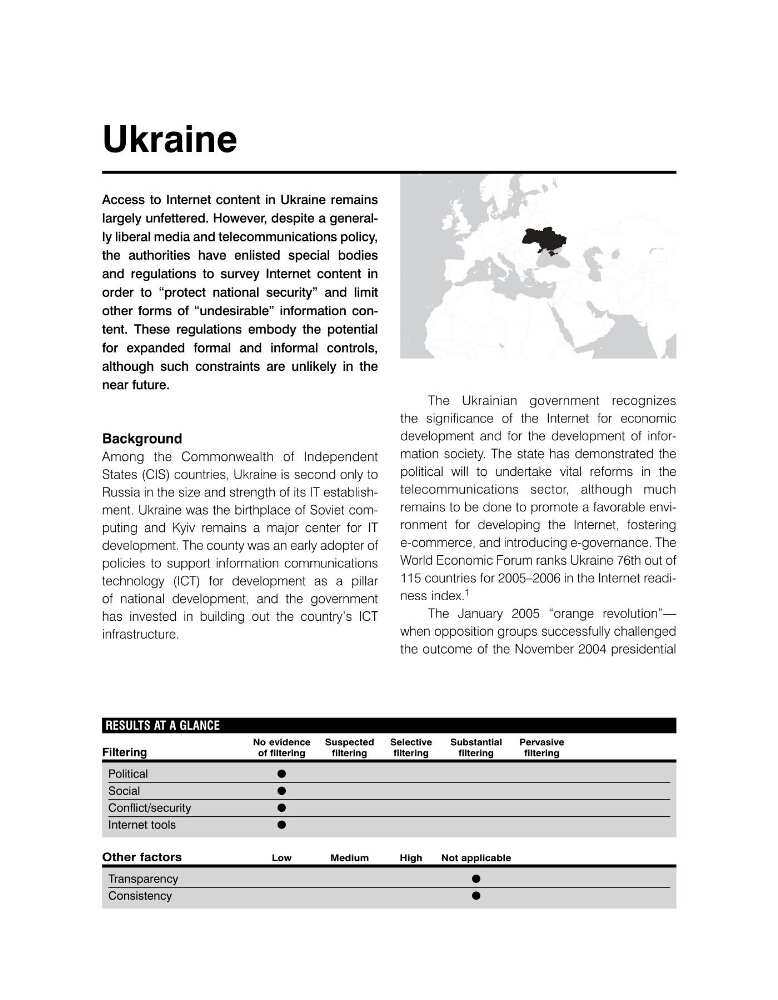
Access to Internet content in Ukraine remains
largely unfettered. However, despite a generally liberal media and telecommunications policy,
the authorities have enlisted special bodies
and regulations to survey Internet content in
order to “protect national security” and limit
other forms of “undesirable” information content. These regulations embody the potential
for expanded formal and informal controls,
although such constraints are unlikely in the
near future.
Background
Among the Commonwealth of Independent
States (CIS) countries, Ukraine is second only to
Russia in the size and strength of its IT establishment. Ukraine was the birthplace of Soviet computing and Kyiv remains a major center for IT
development. The county was an early adopter of
policies to support information communications
technology (ICT) for development as a pillar
of national development, and the government
has invested in building out the country’s ICT
infrastructure.
The Ukrainian government recognizes
the significance of the Internet for economic
development and for the development of information society. The state has demonstrated the
political will to undertake vital reforms in the
telecommunications sector, although much
remains to be done to promote a favorable environment for developing the Internet, fostering
e-commerce, and introducing e-governance. The
World Economic Forum ranks Ukraine 76th out of
115 countries for 2005–2006 in the Internet readiness index. 1
The January 2005 “orange revolution”—
when opposition groups successfully challenged
the outcome of the November 2004 presidential
RESULTS AT A GLANCE
No evidence
Suspected
Selective
Substantial
Pervasive
Filtering
of filtering
filtering
filtering
filtering
filtering
Political
●
Social
●
Conflict/security
●
Internet tools
●
Other factors
Low
Medium
High
Not applicable
Transparency
●
Consistency
●
Ukraine
largely unfettered. However, despite a generally liberal media and telecommunications policy,
the authorities have enlisted special bodies
and regulations to survey Internet content in
order to “protect national security” and limit
other forms of “undesirable” information content. These regulations embody the potential
for expanded formal and informal controls,
although such constraints are unlikely in the
near future.
Background
Among the Commonwealth of Independent
States (CIS) countries, Ukraine is second only to
Russia in the size and strength of its IT establishment. Ukraine was the birthplace of Soviet computing and Kyiv remains a major center for IT
development. The county was an early adopter of
policies to support information communications
technology (ICT) for development as a pillar
of national development, and the government
has invested in building out the country’s ICT
infrastructure.
The Ukrainian government recognizes
the significance of the Internet for economic
development and for the development of information society. The state has demonstrated the
political will to undertake vital reforms in the
telecommunications sector, although much
remains to be done to promote a favorable environment for developing the Internet, fostering
e-commerce, and introducing e-governance. The
World Economic Forum ranks Ukraine 76th out of
115 countries for 2005–2006 in the Internet readiness index. 1
The January 2005 “orange revolution”—
when opposition groups successfully challenged
the outcome of the November 2004 presidential
RESULTS AT A GLANCE
No evidence
Suspected
Selective
Substantial
Pervasive
Filtering
of filtering
filtering
filtering
filtering
filtering
Political
●
Social
●
Conflict/security
●
Internet tools
●
Other factors
Low
Medium
High
Not applicable
Transparency
●
Consistency
●
Ukraine