

those publicly supporting North Korea and its
policies.
7
In a recent celebrated case, a sociology professor at Dongguk University was investigated by authorities and suspended by the university for posting an article on the Internet in
which he argued that North Korea’s invasion of
the South in 1950 should be interpreted as an
attempt to reunify the two Koreas. 8 Overall, however, Korea’s human rights record has steadily
and markedly improved since the 1990s.
9
Internet in South Korea
South Korea is one of the most connected countries in the world. By 2005 more than 89 percent
of South Korean households had Internet
access; 75 percent of these households used
broadband. 10 South Koreans are connected to
the most advanced national network infrastructure in the world. Following the Asian financial crisis in the late 1990s, South Korea invested heavily in its broadband infrastructure, providing its
citizens with a national network that carries data
at speeds up to 50 megabits per second. 11 A
majority of South Korean Internet users use the
Internet more than once per day. 12 The vast
majority of users access the Internet from
home. 13 Even so, playing video games and chatting online remains a popular pastime in the
approximately 30,000 broadband “PC bangs”
(Internet cafés) throughout South Korea.
14
Online
gaming, fueled by South Korea’s ultra high
speed broadband infrastructure, is a national
obsession, with as much as 35 percent of the
population playing online games regularly. 15
By 2004, seventy-six different Internet service providers (ISPs) were providing connection
services to South Korean Internet users.
16
But
three South Korean ISPs control nearly 85 percent of the market for Internet access, the largest
of which—KorNet—provides about half the ADSL
lines in the country, making it the largest ADSL
supplier in the world. 17
In accordance with state ethics guidelines,
most South Korean search engines require users
to verify they are at least nineteen years old
(using a national identification number) before
allowing access to porn sites. 18 Peer-to-peer file
sharing is a popular online activity in South
Korea,
19
though authorities have begun to crack
down on peer-to-peer services and monitor
them for pornography and other content deemed
harmful. Anecdotally, however, many users appear
able to circumvent the various technological
restrictions on Internet use and have unrestricted
370
Country Summaries
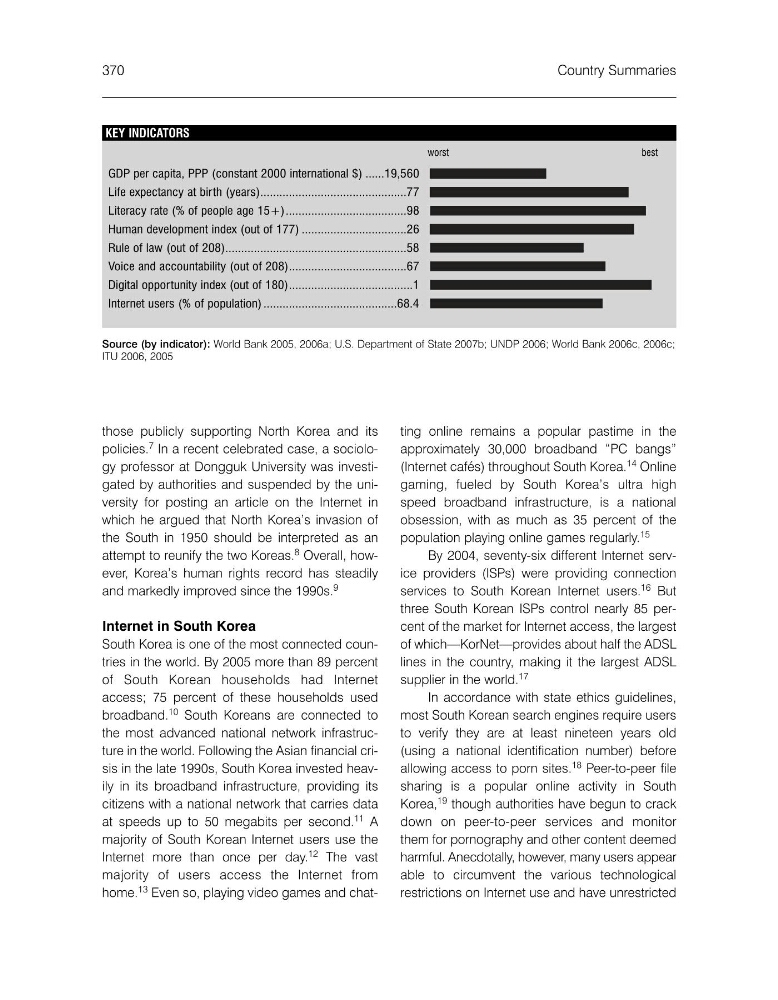
KEY INDICATORS
worst
best
GDP per capita, PPP (constant 2000 international $) ......19,560 6.98
Life expectancy at birth (years)..............................................77 6.76
Literacy rate (% of people age 15+)......................................98 6.78
Human development index (out of 177) .................................26 7.27
Rule of law (out of 208).........................................................58 6.45
Voice and accountability (out of 208).....................................67 6.48
Digital opportunity index (out of 180).......................................1 9.64
Internet users (% of population) ..........................................68.4 9.48
Source (by indicator): World Bank 2005, 2006a; U.S. Department of State 2007b; UNDP 2006; World Bank 2006c, 2006c;
ITU 2006, 2005
policies.
7
In a recent celebrated case, a sociology professor at Dongguk University was investigated by authorities and suspended by the university for posting an article on the Internet in
which he argued that North Korea’s invasion of
the South in 1950 should be interpreted as an
attempt to reunify the two Koreas. 8 Overall, however, Korea’s human rights record has steadily
and markedly improved since the 1990s.
9
Internet in South Korea
South Korea is one of the most connected countries in the world. By 2005 more than 89 percent
of South Korean households had Internet
access; 75 percent of these households used
broadband. 10 South Koreans are connected to
the most advanced national network infrastructure in the world. Following the Asian financial crisis in the late 1990s, South Korea invested heavily in its broadband infrastructure, providing its
citizens with a national network that carries data
at speeds up to 50 megabits per second. 11 A
majority of South Korean Internet users use the
Internet more than once per day. 12 The vast
majority of users access the Internet from
home. 13 Even so, playing video games and chatting online remains a popular pastime in the
approximately 30,000 broadband “PC bangs”
(Internet cafés) throughout South Korea.
14
Online
gaming, fueled by South Korea’s ultra high
speed broadband infrastructure, is a national
obsession, with as much as 35 percent of the
population playing online games regularly. 15
By 2004, seventy-six different Internet service providers (ISPs) were providing connection
services to South Korean Internet users.
16
But
three South Korean ISPs control nearly 85 percent of the market for Internet access, the largest
of which—KorNet—provides about half the ADSL
lines in the country, making it the largest ADSL
supplier in the world. 17
In accordance with state ethics guidelines,
most South Korean search engines require users
to verify they are at least nineteen years old
(using a national identification number) before
allowing access to porn sites. 18 Peer-to-peer file
sharing is a popular online activity in South
Korea,
19
though authorities have begun to crack
down on peer-to-peer services and monitor
them for pornography and other content deemed
harmful. Anecdotally, however, many users appear
able to circumvent the various technological
restrictions on Internet use and have unrestricted
370
Country Summaries
KEY INDICATORS
worst
best
GDP per capita, PPP (constant 2000 international $) ......19,560 6.98
Life expectancy at birth (years)..............................................77 6.76
Literacy rate (% of people age 15+)......................................98 6.78
Human development index (out of 177) .................................26 7.27
Rule of law (out of 208).........................................................58 6.45
Voice and accountability (out of 208).....................................67 6.48
Digital opportunity index (out of 180).......................................1 9.64
Internet users (% of population) ..........................................68.4 9.48
Source (by indicator): World Bank 2005, 2006a; U.S. Department of State 2007b; UNDP 2006; World Bank 2006c, 2006c;
ITU 2006, 2005