

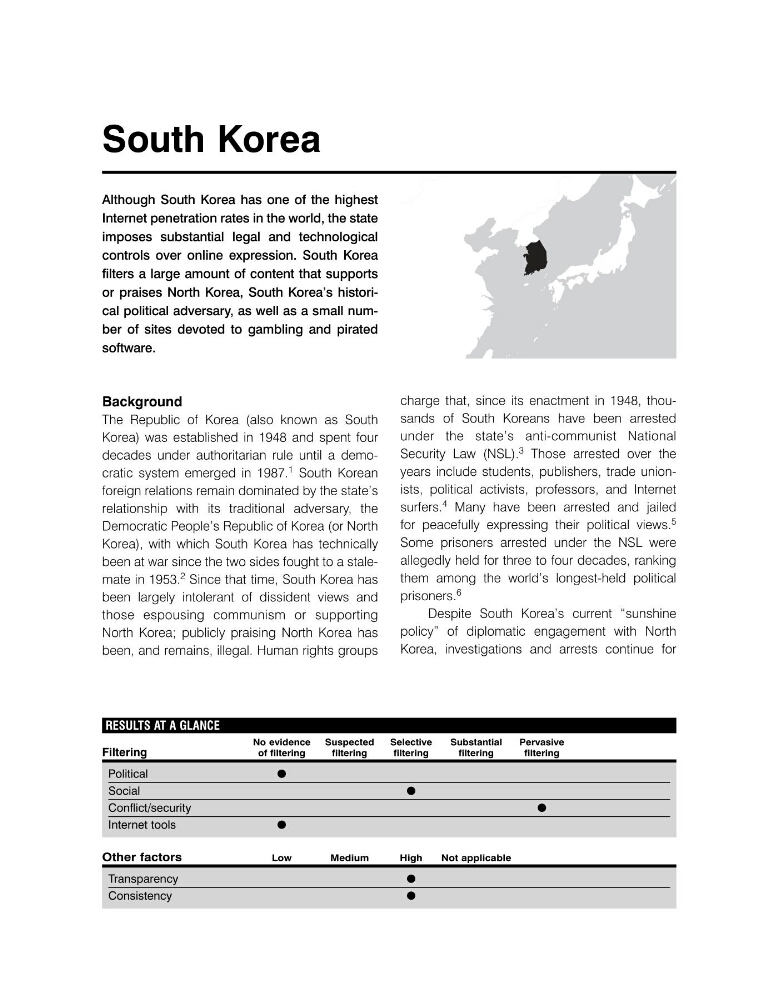
Although South Korea has one of the highest
Internet penetration rates in the world, the state
imposes substantial legal and technological
controls over online expression. South Korea
filters a large amount of content that supports
or praises North Korea, South Korea’s historical political adversary, as well as a small number of sites devoted to gambling and pirated
software.
Background
The Republic of Korea (also known as South
Korea) was established in 1948 and spent four
decades under authoritarian rule until a democratic system emerged in 1987. 1 South Korean
foreign relations remain dominated by the state’s
relationship with its traditional adversary, the
Democratic People’s Republic of Korea (or North
Korea), with which South Korea has technically
been at war since the two sides fought to a stalemate in 1953. 2 Since that time, South Korea has
been largely intolerant of dissident views and
those espousing communism or supporting
North Korea; publicly praising North Korea has
been, and remains, illegal. Human rights groups
charge that, since its enactment in 1948, thousands of South Koreans have been arrested
under the state’s anti-communist National
Security Law (NSL). 3 Those arrested over the
years include students, publishers, trade unionists, political activists, professors, and Internet
surfers. 4 Many have been arrested and jailed
for peacefully expressing their political views.
5
Some prisoners arrested under the NSL were
allegedly held for three to four decades, ranking
them among the world’s longest-held political
prisoners. 6
Despite South Korea’s current “sunshine
policy” of diplomatic engagement with North
Korea, investigations and arrests continue for
RESULTS AT A GLANCE
No evidence
Suspected
Selective
Substantial
Pervasive
Filtering
of filtering
filtering
filtering
filtering
filtering
Political
●
Social
●
Conflict/security
●
Internet tools
●
Other factors
Low
Medium
High
Not applicable
Transparency
●
Consistency
●
South Korea
Internet penetration rates in the world, the state
imposes substantial legal and technological
controls over online expression. South Korea
filters a large amount of content that supports
or praises North Korea, South Korea’s historical political adversary, as well as a small number of sites devoted to gambling and pirated
software.
Background
The Republic of Korea (also known as South
Korea) was established in 1948 and spent four
decades under authoritarian rule until a democratic system emerged in 1987. 1 South Korean
foreign relations remain dominated by the state’s
relationship with its traditional adversary, the
Democratic People’s Republic of Korea (or North
Korea), with which South Korea has technically
been at war since the two sides fought to a stalemate in 1953. 2 Since that time, South Korea has
been largely intolerant of dissident views and
those espousing communism or supporting
North Korea; publicly praising North Korea has
been, and remains, illegal. Human rights groups
charge that, since its enactment in 1948, thousands of South Koreans have been arrested
under the state’s anti-communist National
Security Law (NSL). 3 Those arrested over the
years include students, publishers, trade unionists, political activists, professors, and Internet
surfers. 4 Many have been arrested and jailed
for peacefully expressing their political views.
5
Some prisoners arrested under the NSL were
allegedly held for three to four decades, ranking
them among the world’s longest-held political
prisoners. 6
Despite South Korea’s current “sunshine
policy” of diplomatic engagement with North
Korea, investigations and arrests continue for
RESULTS AT A GLANCE
No evidence
Suspected
Selective
Substantial
Pervasive
Filtering
of filtering
filtering
filtering
filtering
filtering
Political
●
Social
●
Conflict/security
●
Internet tools
●
Other factors
Low
Medium
High
Not applicable
Transparency
●
Consistency
●
South Korea