

countries, was largely the result of the government’s concerns about regulating content. Since
the year 2000, Internet usage has increased from
less than 1 percent to more than 10 percent (over
2.5 million users) of the population. 7 Telecom
companies have begun taking advantage of the
still relatively low penetration rate by unveiling 3G
networks in the country. 8 The government’s
Internet Services Unit (ISU), a department of the
King Abdulaziz City for Science & Technology
(KACST), has been responsible for overseeing
Internet services in Saudi Arabia and for implementing government censorship. 9 As its Web site
explains, twenty-one licensed Internet service
providers (ISPs) and one more not yet in service
connect users to the national network. 10 The ISU
manages the link from the national network to
international networks.
11
In accordance with a
Council of Ministers decision, the Saudi
Communications Commission was renamed the
Communications and Information Technology
Commission (CITC) and took charge of licensing
and filtering processes previously managed by
KACST.
Blogging has grown as a medium for
expression in Saudi Arabia, with the number of
bloggers tripling to an estimated 2,000. 12 Half of
these bloggers are women.
13
In 2005 the government tried to ban the country’s primary blogging
tool, www.blogger.com.
14
However, after a few
days the ban was lifted, with the censors choosing
to block specific content on the blogging Web
site instead. 15 Paralleling the increase in Internet
use has been a proliferation of Internet cafés. As
hourly rates can be too expensive for average
Saudis, some Internet cafés offer monthly subscriptions that are more affordable. 16 From time
to time, the authorities have shut down Internet
cafés for reasons such as “immoral purposes.”
17
Legal and regulatory frameworks
The government of Saudi Arabia allowed public
access to the Internet only after it was satisfied
that an adequate regulatory framework could be
put in place. The authorities use Secure
Computing’s SmartFilter software for technical
implementation and to identify sites for blocking. 18 Furthermore, the expertise of local staff and
input of ordinary citizens aid the filtering regime.
The government makes no secret of its filtering,
which is explained on a section of the ISU Web
site. 19 According to this Web site, KACST is
directly responsible for filtering pornographic
content, while other sites are blocked upon
Country Summaries
361
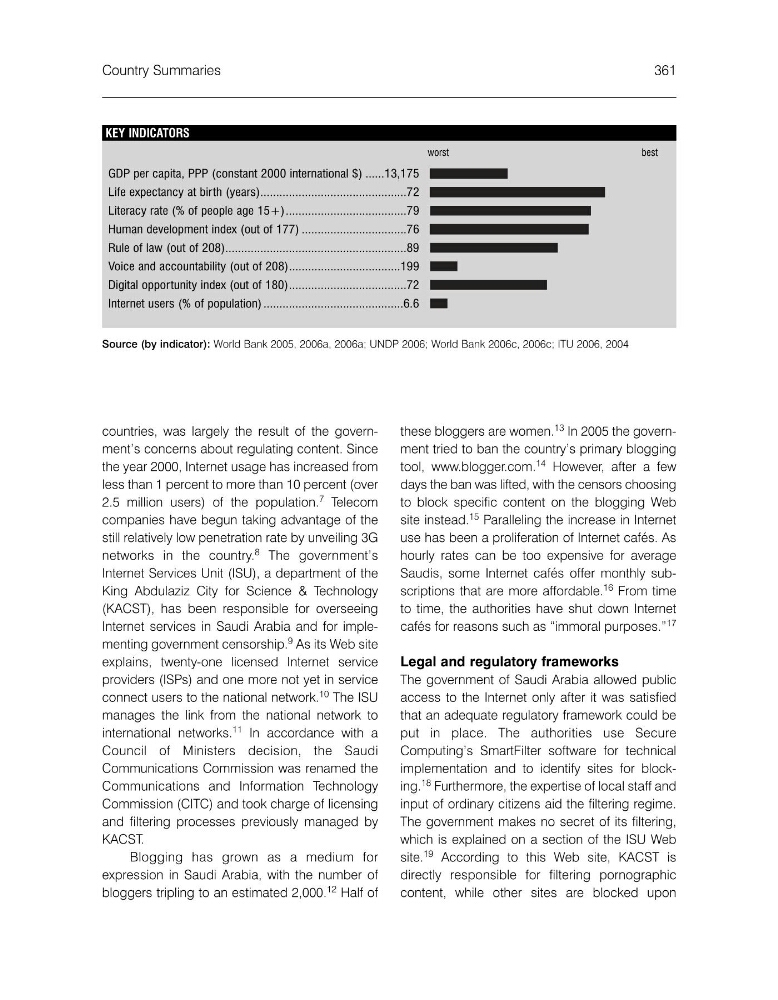
KEY INDICATORS
worst
best
GDP per capita, PPP (constant 2000 international $) ......13,175 5.75
Life expectancy at birth (years)..............................................72 5.96
Literacy rate (% of people age 15+)......................................79 4.92
Human development index (out of 177) .................................76 5.74
Rule of law (out of 208).........................................................89 5.40
Voice and accountability (out of 208)...................................199 1.56
Digital opportunity index (out of 180).....................................72 5.56
Internet users (% of population) ............................................6.6 3.68
Source (by indicator): World Bank 2005, 2006a, 2006a; UNDP 2006; World Bank 2006c, 2006c; ITU 2006, 2004
the year 2000, Internet usage has increased from
less than 1 percent to more than 10 percent (over
2.5 million users) of the population. 7 Telecom
companies have begun taking advantage of the
still relatively low penetration rate by unveiling 3G
networks in the country. 8 The government’s
Internet Services Unit (ISU), a department of the
King Abdulaziz City for Science & Technology
(KACST), has been responsible for overseeing
Internet services in Saudi Arabia and for implementing government censorship. 9 As its Web site
explains, twenty-one licensed Internet service
providers (ISPs) and one more not yet in service
connect users to the national network. 10 The ISU
manages the link from the national network to
international networks.
11
In accordance with a
Council of Ministers decision, the Saudi
Communications Commission was renamed the
Communications and Information Technology
Commission (CITC) and took charge of licensing
and filtering processes previously managed by
KACST.
Blogging has grown as a medium for
expression in Saudi Arabia, with the number of
bloggers tripling to an estimated 2,000. 12 Half of
these bloggers are women.
13
In 2005 the government tried to ban the country’s primary blogging
tool, www.blogger.com.
14
However, after a few
days the ban was lifted, with the censors choosing
to block specific content on the blogging Web
site instead. 15 Paralleling the increase in Internet
use has been a proliferation of Internet cafés. As
hourly rates can be too expensive for average
Saudis, some Internet cafés offer monthly subscriptions that are more affordable. 16 From time
to time, the authorities have shut down Internet
cafés for reasons such as “immoral purposes.”
17
Legal and regulatory frameworks
The government of Saudi Arabia allowed public
access to the Internet only after it was satisfied
that an adequate regulatory framework could be
put in place. The authorities use Secure
Computing’s SmartFilter software for technical
implementation and to identify sites for blocking. 18 Furthermore, the expertise of local staff and
input of ordinary citizens aid the filtering regime.
The government makes no secret of its filtering,
which is explained on a section of the ISU Web
site. 19 According to this Web site, KACST is
directly responsible for filtering pornographic
content, while other sites are blocked upon
Country Summaries
361
KEY INDICATORS
worst
best
GDP per capita, PPP (constant 2000 international $) ......13,175 5.75
Life expectancy at birth (years)..............................................72 5.96
Literacy rate (% of people age 15+)......................................79 4.92
Human development index (out of 177) .................................76 5.74
Rule of law (out of 208).........................................................89 5.40
Voice and accountability (out of 208)...................................199 1.56
Digital opportunity index (out of 180).....................................72 5.56
Internet users (% of population) ............................................6.6 3.68
Source (by indicator): World Bank 2005, 2006a, 2006a; UNDP 2006; World Bank 2006c, 2006c; ITU 2006, 2004