

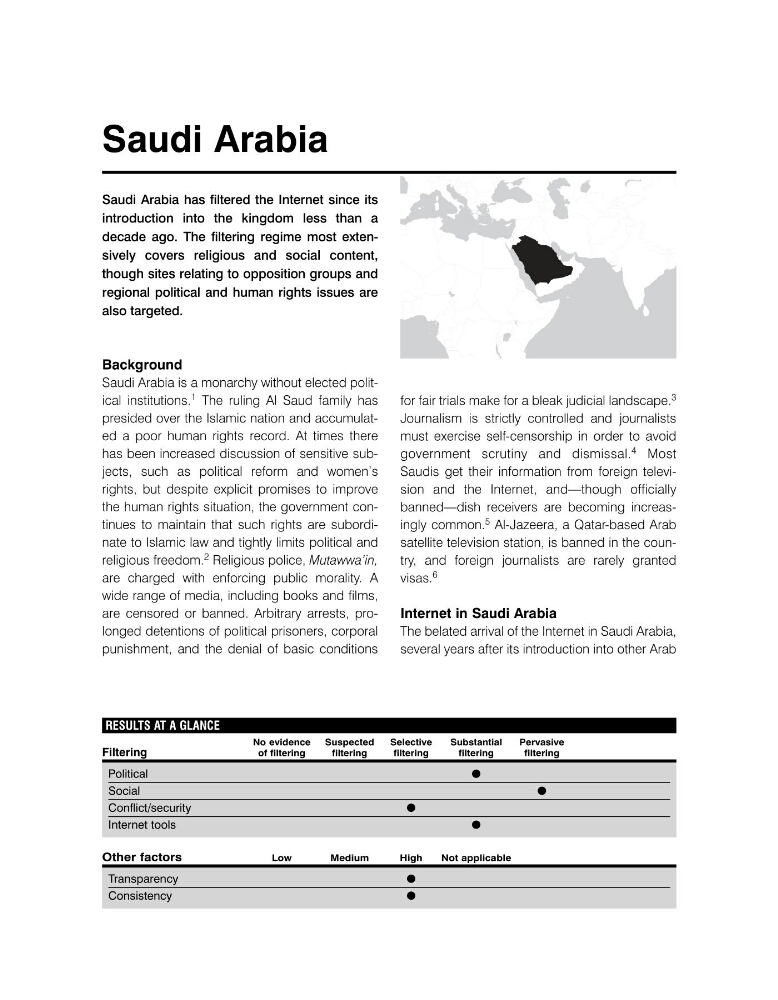
Saudi Arabia has filtered the Internet since its
introduction into the kingdom less than a
decade ago. The filtering regime most extensively covers religious and social content,
though sites relating to opposition groups and
regional political and human rights issues are
also targeted.
Background
Saudi Arabia is a monarchy without elected political institutions.
1
The ruling Al Saud family has
presided over the Islamic nation and accumulated a poor human rights record. At times there
has been increased discussion of sensitive subjects, such as political reform and women’s
rights, but despite explicit promises to improve
the human rights situation, the government continues to maintain that such rights are subordinate to Islamic law and tightly limits political and
religious freedom. 2 Religious police, Mutawwa’in,
are charged with enforcing public morality. A
wide range of media, including books and films,
are censored or banned. Arbitrary arrests, prolonged detentions of political prisoners, corporal
punishment, and the denial of basic conditions
for fair trials make for a bleak judicial landscape. 3
Journalism is strictly controlled and journalists
must exercise self-censorship in order to avoid
government scrutiny and dismissal. 4 Most
Saudis get their information from foreign television and the Internet, and—though officially
banned—dish receivers are becoming increasingly common. 5 Al-Jazeera, a Qatar-based Arab
satellite television station, is banned in the country, and foreign journalists are rarely granted
visas. 6
Internet in Saudi Arabia
The belated arrival of the Internet in Saudi Arabia,
several years after its introduction into other Arab
RESULTS AT A GLANCE
No evidence
Suspected
Selective
Substantial
Pervasive
Filtering
of filtering
filtering
filtering
filtering
filtering
Political
●
Social
●
Conflict/security
●
Internet tools
●
Other factors
Low
Medium
High
Not applicable
Transparency
●
Consistency
●
Saudi Arabia
introduction into the kingdom less than a
decade ago. The filtering regime most extensively covers religious and social content,
though sites relating to opposition groups and
regional political and human rights issues are
also targeted.
Background
Saudi Arabia is a monarchy without elected political institutions.
1
The ruling Al Saud family has
presided over the Islamic nation and accumulated a poor human rights record. At times there
has been increased discussion of sensitive subjects, such as political reform and women’s
rights, but despite explicit promises to improve
the human rights situation, the government continues to maintain that such rights are subordinate to Islamic law and tightly limits political and
religious freedom. 2 Religious police, Mutawwa’in,
are charged with enforcing public morality. A
wide range of media, including books and films,
are censored or banned. Arbitrary arrests, prolonged detentions of political prisoners, corporal
punishment, and the denial of basic conditions
for fair trials make for a bleak judicial landscape. 3
Journalism is strictly controlled and journalists
must exercise self-censorship in order to avoid
government scrutiny and dismissal. 4 Most
Saudis get their information from foreign television and the Internet, and—though officially
banned—dish receivers are becoming increasingly common. 5 Al-Jazeera, a Qatar-based Arab
satellite television station, is banned in the country, and foreign journalists are rarely granted
visas. 6
Internet in Saudi Arabia
The belated arrival of the Internet in Saudi Arabia,
several years after its introduction into other Arab
RESULTS AT A GLANCE
No evidence
Suspected
Selective
Substantial
Pervasive
Filtering
of filtering
filtering
filtering
filtering
filtering
Political
●
Social
●
Conflict/security
●
Internet tools
●
Other factors
Low
Medium
High
Not applicable
Transparency
●
Consistency
●
Saudi Arabia