

sector; in 2003 the government deregulated its
telecom market, opening itself up to corporate
competition in telephone, mobile, and Internet
services. 6 Internet access is widely available at
cybercafés, which accommodate many lowerincome and casual users. Rates for usage range
from USD0.15/hour to upward of USD0.50/hour,
depending on location and amenities. Although
the Net Café Regulation Bill 2006 requires
Internet cafés to monitor their patrons, there is
currently no effective mechanism to verify compliance or enforce this law. 7 Athough Net café
managers are expected to monitor the activities
in their establishments, based on user experience these cafés appear to be unregulated by
the regular police.
Since deregulation the market has become
highly competitive, and there are currently over
thirty Internet service providers (ISPs) in Pakistan
of varying size and quality of service. The largest
ISPs in the country include Cybernet, Comsats,
Brainnet, Gonet, and Paknet (a subsidiary of the
Pakistan Telecommunications Company Limited,
or PTCL). Modem, DSL, and recently high-speed
Internet service are all available in Pakistan, but
the reliability of these connections remains low.
The majority of home Internet users are connected by modem, while cybercafés tend to split one
modem or DSL connection over many computers, reducing connection speed. High-speed
Internet service is currently accessible only to
wealthier patrons or businesses.
All Internet traffic in and out of Pakistan is
routed by the PTCL through its subsidiary, the
Pakistan Internet Exchange (PIE), with three international gateways at Islamabad/Rawalpindi,
Lahore, and Karachi, and small/medium points of
presence (POPs) in six other cities. 8 Currently,
PIE handles 2,324 Mb/s of IP backbone traffic
that comes to Pakistan using SMT4s on SMW4
and STM1s on SMW3 connected with BT, France
Telecom, Telecom Italia, Verizon, and so on. 9
Bandwidth through FLAG Telecom in collaboration with PTCL is at 620 Mb/s. Domestic Internet
traffic is peered at the PIE gateways within the
country. The PIE’s Karachi exchange reportedly
processes at least 95 percent of Pakistan’s
Internet traffic. 10
Bloggers across Pakistan objected to the
intermittent block on www.blogspot.com and the
temporary blocking of Wikipedia in 2006, and initiated a virtual civil society movement to repeal
the orders. 11 This virtual civil society engages in
awareness and advocacy work on Pakistan’s
356
Country Summaries
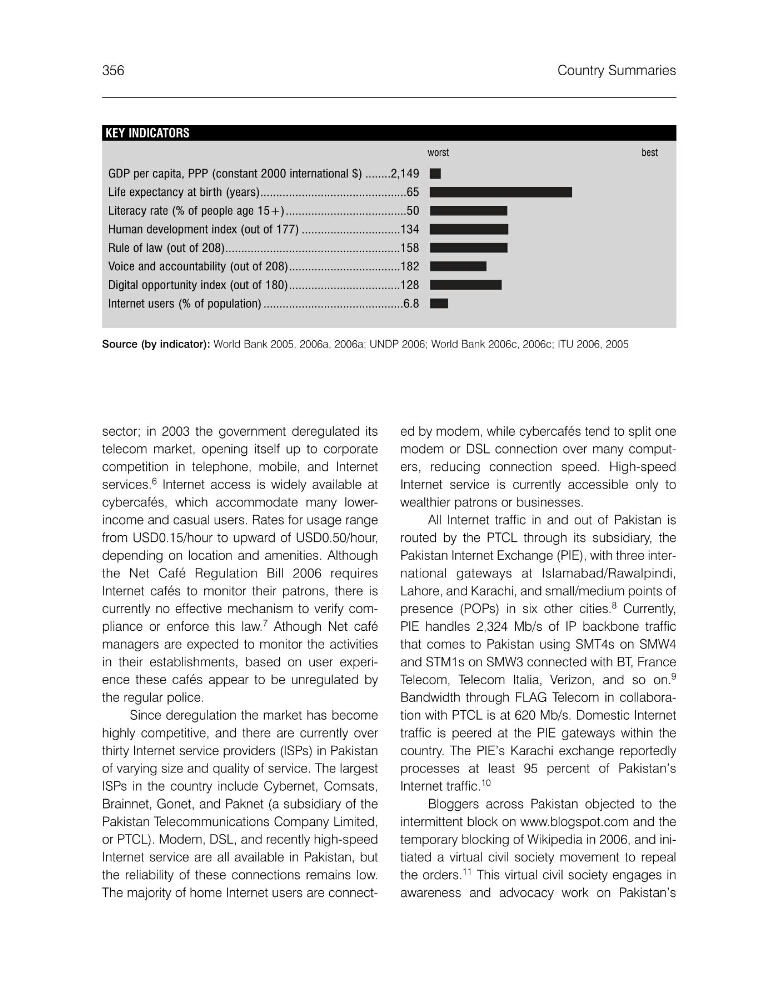
KEY INDICATORS
worst
best
GDP per capita, PPP (constant 2000 international $) ........2,149 3.63
Life expectancy at birth (years)..............................................65 4.83
Literacy rate (% of people age 15+)......................................50 2.10
Human development index (out of 177) ...............................134 3.05
Rule of law (out of 208).......................................................158 3.37
Voice and accountability (out of 208)...................................182 2.53
Digital opportunity index (out of 180)...................................128 3.79
Internet users (% of population) ............................................6.8 3.70
Source (by indicator): World Bank 2005, 2006a, 2006a; UNDP 2006; World Bank 2006c, 2006c; ITU 2006, 2005
telecom market, opening itself up to corporate
competition in telephone, mobile, and Internet
services. 6 Internet access is widely available at
cybercafés, which accommodate many lowerincome and casual users. Rates for usage range
from USD0.15/hour to upward of USD0.50/hour,
depending on location and amenities. Although
the Net Café Regulation Bill 2006 requires
Internet cafés to monitor their patrons, there is
currently no effective mechanism to verify compliance or enforce this law. 7 Athough Net café
managers are expected to monitor the activities
in their establishments, based on user experience these cafés appear to be unregulated by
the regular police.
Since deregulation the market has become
highly competitive, and there are currently over
thirty Internet service providers (ISPs) in Pakistan
of varying size and quality of service. The largest
ISPs in the country include Cybernet, Comsats,
Brainnet, Gonet, and Paknet (a subsidiary of the
Pakistan Telecommunications Company Limited,
or PTCL). Modem, DSL, and recently high-speed
Internet service are all available in Pakistan, but
the reliability of these connections remains low.
The majority of home Internet users are connected by modem, while cybercafés tend to split one
modem or DSL connection over many computers, reducing connection speed. High-speed
Internet service is currently accessible only to
wealthier patrons or businesses.
All Internet traffic in and out of Pakistan is
routed by the PTCL through its subsidiary, the
Pakistan Internet Exchange (PIE), with three international gateways at Islamabad/Rawalpindi,
Lahore, and Karachi, and small/medium points of
presence (POPs) in six other cities. 8 Currently,
PIE handles 2,324 Mb/s of IP backbone traffic
that comes to Pakistan using SMT4s on SMW4
and STM1s on SMW3 connected with BT, France
Telecom, Telecom Italia, Verizon, and so on. 9
Bandwidth through FLAG Telecom in collaboration with PTCL is at 620 Mb/s. Domestic Internet
traffic is peered at the PIE gateways within the
country. The PIE’s Karachi exchange reportedly
processes at least 95 percent of Pakistan’s
Internet traffic. 10
Bloggers across Pakistan objected to the
intermittent block on www.blogspot.com and the
temporary blocking of Wikipedia in 2006, and initiated a virtual civil society movement to repeal
the orders. 11 This virtual civil society engages in
awareness and advocacy work on Pakistan’s
356
Country Summaries
KEY INDICATORS
worst
best
GDP per capita, PPP (constant 2000 international $) ........2,149 3.63
Life expectancy at birth (years)..............................................65 4.83
Literacy rate (% of people age 15+)......................................50 2.10
Human development index (out of 177) ...............................134 3.05
Rule of law (out of 208).......................................................158 3.37
Voice and accountability (out of 208)...................................182 2.53
Digital opportunity index (out of 180)...................................128 3.79
Internet users (% of population) ............................................6.8 3.70
Source (by indicator): World Bank 2005, 2006a, 2006a; UNDP 2006; World Bank 2006c, 2006c; ITU 2006, 2005