

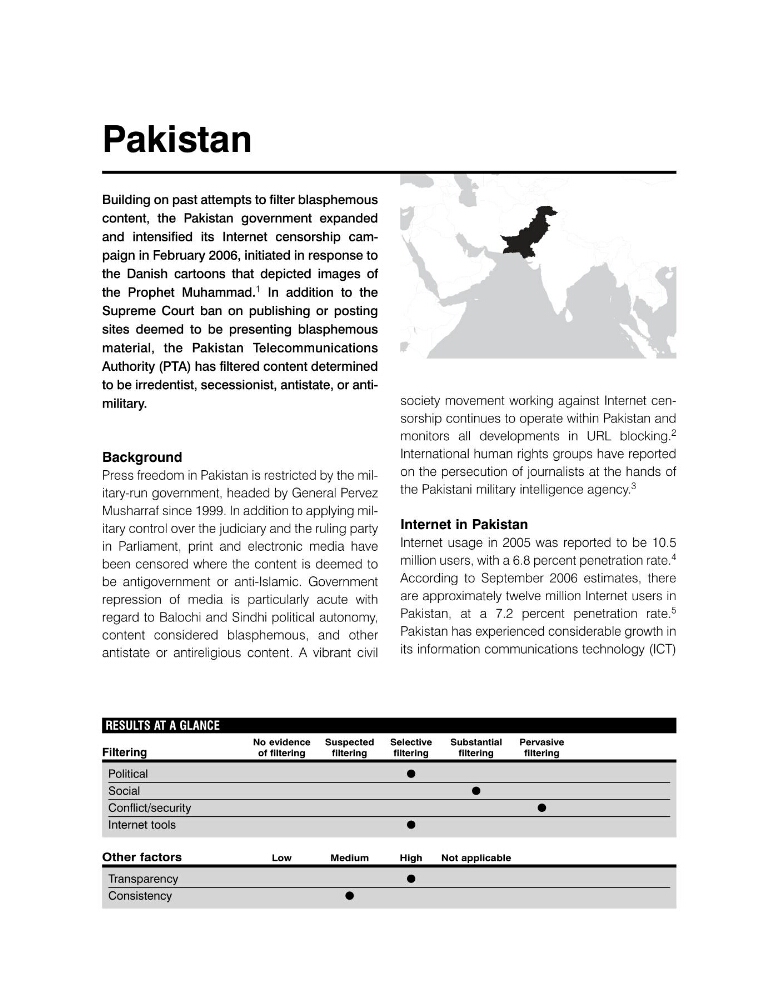
Building on past attempts to filter blasphemous
content, the Pakistan government expanded
and intensified its Internet censorship campaign in February 2006, initiated in response to
the Danish cartoons that depicted images of
the Prophet Muhammad.
1 In addition to the
Supreme Court ban on publishing or posting
sites deemed to be presenting blasphemous
material, the Pakistan Telecommunications
Authority (PTA) has filtered content determined
to be irredentist, secessionist, antistate, or antimilitary.
Background
Press freedom in Pakistan is restricted by the military-run government, headed by General Pervez
Musharraf since 1999. In addition to applying military control over the judiciary and the ruling party
in Parliament, print and electronic media have
been censored where the content is deemed to
be antigovernment or anti-Islamic. Government
repression of media is particularly acute with
regard to Balochi and Sindhi political autonomy,
content considered blasphemous, and other
antistate or antireligious content. A vibrant civil
society movement working against Internet censorship continues to operate within Pakistan and
monitors all developments in URL blocking. 2
International human rights groups have reported
on the persecution of journalists at the hands of
the Pakistani military intelligence agency. 3
Internet in Pakistan
Internet usage in 2005 was reported to be 10.5
million users, with a 6.8 percent penetration rate.
4
According to September 2006 estimates, there
are approximately twelve million Internet users in
Pakistan, at a 7.2 percent penetration rate. 5
Pakistan has experienced considerable growth in
its information communications technology (ICT)
RESULTS AT A GLANCE
No evidence
Suspected
Selective
Substantial
Pervasive
Filtering
of filtering
filtering
filtering
filtering
filtering
Political
●
Social
●
Conflict/security
●
Internet tools
●
Other factors
Low
Medium
High
Not applicable
Transparency
●
Consistency
●
Pakistan
content, the Pakistan government expanded
and intensified its Internet censorship campaign in February 2006, initiated in response to
the Danish cartoons that depicted images of
the Prophet Muhammad.
1 In addition to the
Supreme Court ban on publishing or posting
sites deemed to be presenting blasphemous
material, the Pakistan Telecommunications
Authority (PTA) has filtered content determined
to be irredentist, secessionist, antistate, or antimilitary.
Background
Press freedom in Pakistan is restricted by the military-run government, headed by General Pervez
Musharraf since 1999. In addition to applying military control over the judiciary and the ruling party
in Parliament, print and electronic media have
been censored where the content is deemed to
be antigovernment or anti-Islamic. Government
repression of media is particularly acute with
regard to Balochi and Sindhi political autonomy,
content considered blasphemous, and other
antistate or antireligious content. A vibrant civil
society movement working against Internet censorship continues to operate within Pakistan and
monitors all developments in URL blocking. 2
International human rights groups have reported
on the persecution of journalists at the hands of
the Pakistani military intelligence agency. 3
Internet in Pakistan
Internet usage in 2005 was reported to be 10.5
million users, with a 6.8 percent penetration rate.
4
According to September 2006 estimates, there
are approximately twelve million Internet users in
Pakistan, at a 7.2 percent penetration rate. 5
Pakistan has experienced considerable growth in
its information communications technology (ICT)
RESULTS AT A GLANCE
No evidence
Suspected
Selective
Substantial
Pervasive
Filtering
of filtering
filtering
filtering
filtering
filtering
Political
●
Social
●
Conflict/security
●
Internet tools
●
Other factors
Low
Medium
High
Not applicable
Transparency
●
Consistency
●
Pakistan