

computers, which in 2006 numbered 32 per
1,000 people.
7
Prepaid Internet service cards
and Omantel’s “Log ‘N’ Surf” service provide
alternatives to regular subscriptions; neither
requires prior registration. 8 Omantel is also working on a Wireless Local Loop (WLL) project to
extend telecom services to rural areas where
cable connectivity is either impossible or prohibitively expensive. 9
Oman’s government has plans to use the
Internet to increase e-government and e-education. On January 9, 2007, Omantel launched the
Easy Learning Service to provide hundreds of
electronic training courses in accounting, sales,
marketing, and customer services. 10 In February
2007 Omantel began offering sixty free hours of
Internet access to new subscribers, describing
the initiative as part of a larger plan to spread digital culture. 11
The monarchy has also begun opening
Oman’s telecommunications sector to private
investors and competitors. In 2005, the government sold a 30 percent stake in Omantel to local
investors. The move came shortly after the country’s second mobile-phone operator started
operations, offering for the first time a choice to
local consumers. The government has also
announced plans to offer licenses for fixed-line
telecom services in competition with Omantel. 12
Legal and regulatory frameworks
On November 6, 1996, Sultan Qaboos bin Said
issued the Basic Law of the State (“The White
Book”), considered to be Oman’s first constitution. Article 29 of the White Book guarantees
“freedom of opinion and expression … within the
limits of the Law.” 13 “Material that leads to public
discord, violates the security of the State or abuses a person’s dignity and his rights” may not be
printed or published. 14 In July 2005 former parliamentarian Taiba al-Mawali was arrested and sentenced to eighteen months imprisonment for
insulting a public official and sending allegedly
libelous text messages that criticized government
actions. 15 Her sentence was later reduced and
she was released on January 31, 2006.
16
Arrest and search warrants are not required
by law, and the government can and does monitor both written and oral communications, including cell phone, e-mail, and Internet chat room
exchanges. Publications that contravene cultural
or political norms are subject to government censorship under the 1984 Press and Publication
Law, and online forums admonish visitors that
Country Summaries
351
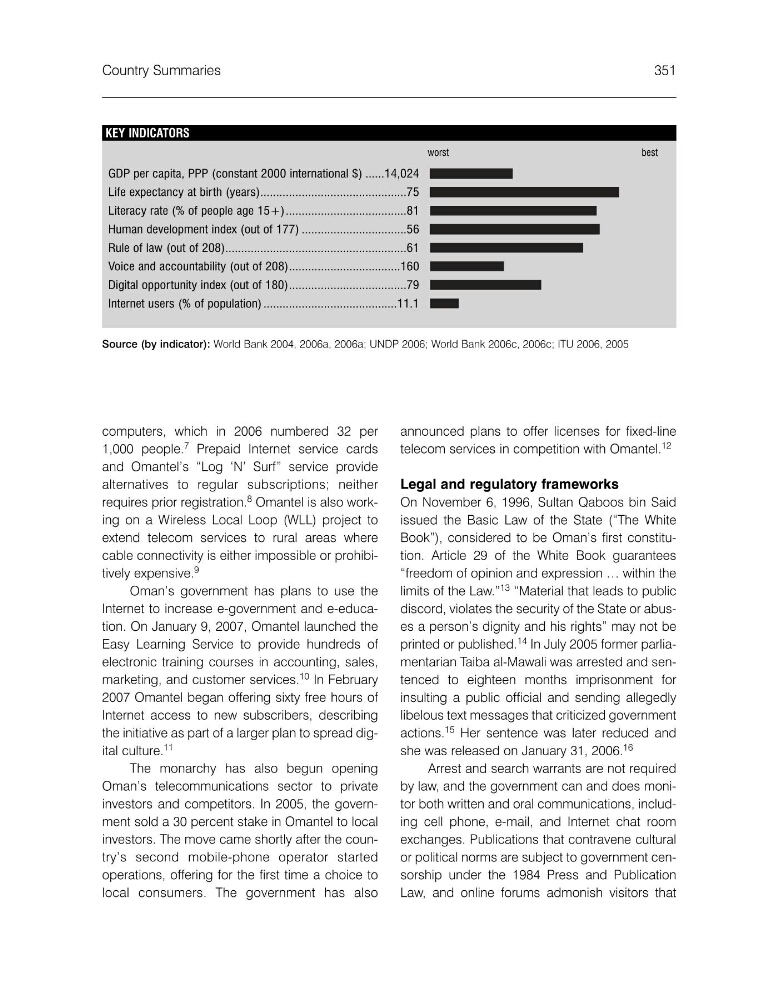
KEY INDICATORS
worst
best
GDP per capita, PPP (constant 2000 international $) ......14,024 5.91
Life expectancy at birth (years)..............................................75 6.44
Literacy rate (% of people age 15+)......................................81 5.12
Human development index (out of 177) .................................56 6.11
Rule of law (out of 208).........................................................61 6.43
Voice and accountability (out of 208)...................................160 3.11
Digital opportunity index (out of 180).....................................79 5.33
Internet users (% of population) ..........................................11.1 4.10
Source (by indicator): World Bank 2004, 2006a, 2006a; UNDP 2006; World Bank 2006c, 2006c; ITU 2006, 2005
1,000 people.
7
Prepaid Internet service cards
and Omantel’s “Log ‘N’ Surf” service provide
alternatives to regular subscriptions; neither
requires prior registration. 8 Omantel is also working on a Wireless Local Loop (WLL) project to
extend telecom services to rural areas where
cable connectivity is either impossible or prohibitively expensive. 9
Oman’s government has plans to use the
Internet to increase e-government and e-education. On January 9, 2007, Omantel launched the
Easy Learning Service to provide hundreds of
electronic training courses in accounting, sales,
marketing, and customer services. 10 In February
2007 Omantel began offering sixty free hours of
Internet access to new subscribers, describing
the initiative as part of a larger plan to spread digital culture. 11
The monarchy has also begun opening
Oman’s telecommunications sector to private
investors and competitors. In 2005, the government sold a 30 percent stake in Omantel to local
investors. The move came shortly after the country’s second mobile-phone operator started
operations, offering for the first time a choice to
local consumers. The government has also
announced plans to offer licenses for fixed-line
telecom services in competition with Omantel. 12
Legal and regulatory frameworks
On November 6, 1996, Sultan Qaboos bin Said
issued the Basic Law of the State (“The White
Book”), considered to be Oman’s first constitution. Article 29 of the White Book guarantees
“freedom of opinion and expression … within the
limits of the Law.” 13 “Material that leads to public
discord, violates the security of the State or abuses a person’s dignity and his rights” may not be
printed or published. 14 In July 2005 former parliamentarian Taiba al-Mawali was arrested and sentenced to eighteen months imprisonment for
insulting a public official and sending allegedly
libelous text messages that criticized government
actions. 15 Her sentence was later reduced and
she was released on January 31, 2006.
16
Arrest and search warrants are not required
by law, and the government can and does monitor both written and oral communications, including cell phone, e-mail, and Internet chat room
exchanges. Publications that contravene cultural
or political norms are subject to government censorship under the 1984 Press and Publication
Law, and online forums admonish visitors that
Country Summaries
351
KEY INDICATORS
worst
best
GDP per capita, PPP (constant 2000 international $) ......14,024 5.91
Life expectancy at birth (years)..............................................75 6.44
Literacy rate (% of people age 15+)......................................81 5.12
Human development index (out of 177) .................................56 6.11
Rule of law (out of 208).........................................................61 6.43
Voice and accountability (out of 208)...................................160 3.11
Digital opportunity index (out of 180).....................................79 5.33
Internet users (% of population) ..........................................11.1 4.10
Source (by indicator): World Bank 2004, 2006a, 2006a; UNDP 2006; World Bank 2006c, 2006c; ITU 2006, 2005