

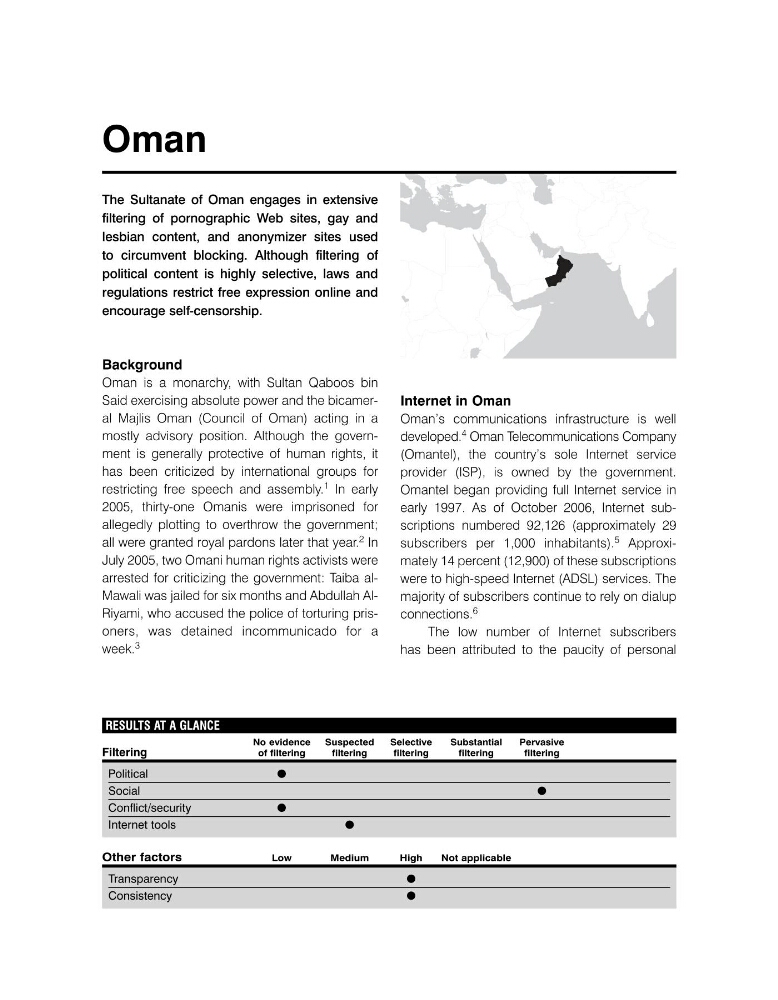
The Sultanate of Oman engages in extensive
filtering of pornographic Web sites, gay and
lesbian content, and anonymizer sites used
to circumvent blocking. Although filtering of
political content is highly selective, laws and
regulations restrict free expression online and
encourage self-censorship.
Background
Oman is a monarchy, with Sultan Qaboos bin
Said exercising absolute power and the bicameral Majlis Oman (Council of Oman) acting in a
mostly advisory position. Although the government is generally protective of human rights, it
has been criticized by international groups for
restricting free speech and assembly. 1 In early
2005, thirty-one Omanis were imprisoned for
allegedly plotting to overthrow the government;
all were granted royal pardons later that year. 2 In
July 2005, two Omani human rights activists were
arrested for criticizing the government: Taiba alMawali was jailed for six months and Abdullah AlRiyami, who accused the police of torturing prisoners, was detained incommunicado for a
week. 3
Internet in Oman
Oman’s communications infrastructure is well
developed.
4
Oman Telecommunications Company
(Omantel), the country’s sole Internet service
provider (ISP), is owned by the government.
Omantel began providing full Internet service in
early 1997. As of October 2006, Internet subscriptions numbered 92,126 (approximately 29
subscribers per 1,000 inhabitants). 5 Approximately 14 percent (12,900) of these subscriptions
were to high-speed Internet (ADSL) services. The
majority of subscribers continue to rely on dialup
connections. 6
The low number of Internet subscribers
has been attributed to the paucity of personal
RESULTS AT A GLANCE
No evidence
Suspected
Selective
Substantial
Pervasive
Filtering
of filtering
filtering
filtering
filtering
filtering
Political
●
Social
●
Conflict/security
●
Internet tools
●
Other factors
Low
Medium
High
Not applicable
Transparency
●
Consistency
●
Oman
filtering of pornographic Web sites, gay and
lesbian content, and anonymizer sites used
to circumvent blocking. Although filtering of
political content is highly selective, laws and
regulations restrict free expression online and
encourage self-censorship.
Background
Oman is a monarchy, with Sultan Qaboos bin
Said exercising absolute power and the bicameral Majlis Oman (Council of Oman) acting in a
mostly advisory position. Although the government is generally protective of human rights, it
has been criticized by international groups for
restricting free speech and assembly. 1 In early
2005, thirty-one Omanis were imprisoned for
allegedly plotting to overthrow the government;
all were granted royal pardons later that year. 2 In
July 2005, two Omani human rights activists were
arrested for criticizing the government: Taiba alMawali was jailed for six months and Abdullah AlRiyami, who accused the police of torturing prisoners, was detained incommunicado for a
week. 3
Internet in Oman
Oman’s communications infrastructure is well
developed.
4
Oman Telecommunications Company
(Omantel), the country’s sole Internet service
provider (ISP), is owned by the government.
Omantel began providing full Internet service in
early 1997. As of October 2006, Internet subscriptions numbered 92,126 (approximately 29
subscribers per 1,000 inhabitants). 5 Approximately 14 percent (12,900) of these subscriptions
were to high-speed Internet (ADSL) services. The
majority of subscribers continue to rely on dialup
connections. 6
The low number of Internet subscribers
has been attributed to the paucity of personal
RESULTS AT A GLANCE
No evidence
Suspected
Selective
Substantial
Pervasive
Filtering
of filtering
filtering
filtering
filtering
filtering
Political
●
Social
●
Conflict/security
●
Internet tools
●
Other factors
Low
Medium
High
Not applicable
Transparency
●
Consistency
●
Oman