

per hour, down from USD0.75 in 2004 and
USD0.95–1.50 in 2003),
8
which are said to be
present in five cities but are planned to reach 324
townships within three years.
9
Connection
speeds are slow, however, as broadband is available primarily to government and businesses and
used mostly for Internet telephony via Voice-over
Internet Protocol (VoIP), though the government
pledged to bring ADSL to every township by the
end of 2006. 10 There are only two Internet service
providers (ISPs) allowed in Myanmar: stateowned telecom Myanmar Posts and Telecom
(MPT), which is the only source of new Internet
services, 11 and Myanmar Teleport (MMT, formerly
Bagan Cybertech), which is reportedly the infrastructure arm of Myanmar’s Internet system and
responsible for blocking content. In September
2005 the Ahaed Co. of Myanmar and the
Canadian ICT company Teleglobe reportedly
signed a memorandum of understanding to
establish a private ISP. 12 Infrastructural reliability
is also an issue: in May 2006 the entire country
was disconnected for four days because of
alleged damage to an undersea cable. 13
Legal and regulatory frameworks
Myanmar heavily regulates online access and
content via legal, regulatory, and economic constraints. As in other areas, however, the state’s
policies are difficult to assess because they are
rarely published or explained.
Network-ready computers must be registered (for a fee) with the MPT; failure to do so can
result in fines and prison sentences of seven to
fifteen years. 14 Sharing registered Internet connections is also punishable by revocation of
access and presumably similar “legal action.” 15
Broad laws and regulations confer power upon
the SPDC, which is also involved in all judicial
appointments, 16 to punish citizens harshly for any
activity deemed detrimental to national interests
or security. Regulations issued in 2000 subjected
online content to the same kind of strict filtering
that the Press Scrutiny and Registration Division
carries out (despite print media being almost
exclusively state owned): 17 users must obtain
MPT permission before creating Web pages, and
they cannot post anything “detrimental” to the
government or simply related to politics. The MPT
can “amend and change regulations on the use
of the Internet without prior notice.” 18
Country Summaries
339
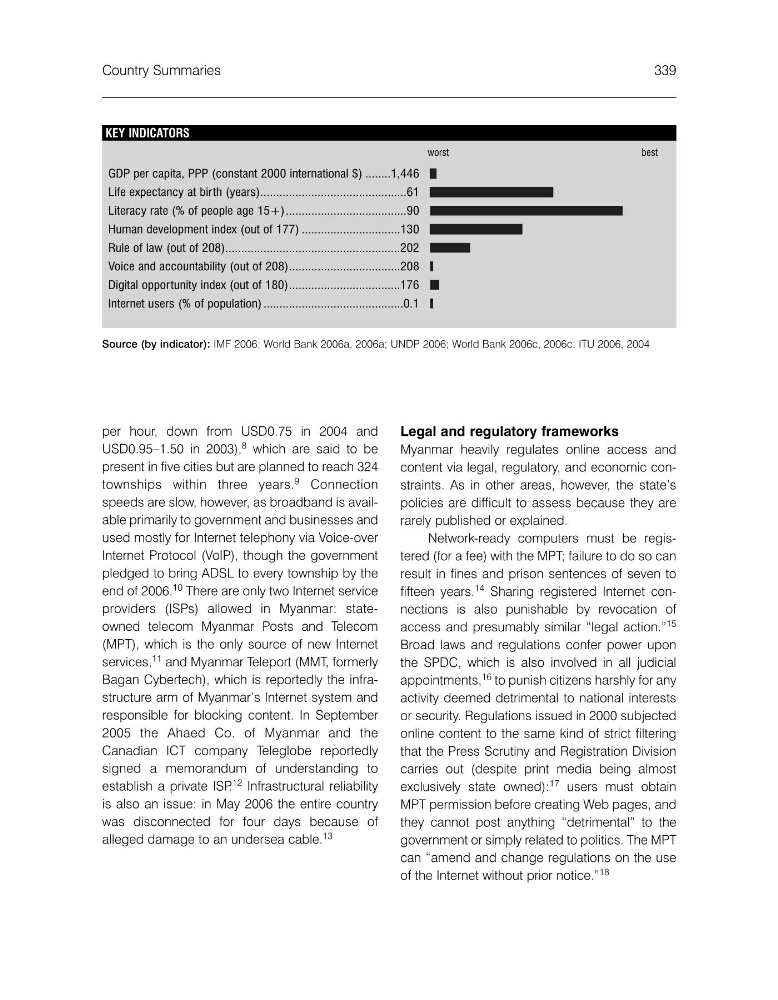
KEY INDICATORS
worst
best
GDP per capita, PPP (constant 2000 international $) ........1,446 3.50
Life expectancy at birth (years)..............................................61 4.19
Literacy rate (% of people age 15+)......................................90 6.00
Human development index (out of 177) ...............................130 3.52
Rule of law (out of 208).......................................................202 1.87
Voice and accountability (out of 208)...................................208 0.69
Digital opportunity index (out of 180)...................................176 1.36
Internet users (% of population) ............................................0.1 3.07
Source (by indicator): IMF 2006; World Bank 2006a, 2006a; UNDP 2006; World Bank 2006c, 2006c; ITU 2006, 2004
USD0.95–1.50 in 2003),
8
which are said to be
present in five cities but are planned to reach 324
townships within three years.
9
Connection
speeds are slow, however, as broadband is available primarily to government and businesses and
used mostly for Internet telephony via Voice-over
Internet Protocol (VoIP), though the government
pledged to bring ADSL to every township by the
end of 2006. 10 There are only two Internet service
providers (ISPs) allowed in Myanmar: stateowned telecom Myanmar Posts and Telecom
(MPT), which is the only source of new Internet
services, 11 and Myanmar Teleport (MMT, formerly
Bagan Cybertech), which is reportedly the infrastructure arm of Myanmar’s Internet system and
responsible for blocking content. In September
2005 the Ahaed Co. of Myanmar and the
Canadian ICT company Teleglobe reportedly
signed a memorandum of understanding to
establish a private ISP. 12 Infrastructural reliability
is also an issue: in May 2006 the entire country
was disconnected for four days because of
alleged damage to an undersea cable. 13
Legal and regulatory frameworks
Myanmar heavily regulates online access and
content via legal, regulatory, and economic constraints. As in other areas, however, the state’s
policies are difficult to assess because they are
rarely published or explained.
Network-ready computers must be registered (for a fee) with the MPT; failure to do so can
result in fines and prison sentences of seven to
fifteen years. 14 Sharing registered Internet connections is also punishable by revocation of
access and presumably similar “legal action.” 15
Broad laws and regulations confer power upon
the SPDC, which is also involved in all judicial
appointments, 16 to punish citizens harshly for any
activity deemed detrimental to national interests
or security. Regulations issued in 2000 subjected
online content to the same kind of strict filtering
that the Press Scrutiny and Registration Division
carries out (despite print media being almost
exclusively state owned): 17 users must obtain
MPT permission before creating Web pages, and
they cannot post anything “detrimental” to the
government or simply related to politics. The MPT
can “amend and change regulations on the use
of the Internet without prior notice.” 18
Country Summaries
339
KEY INDICATORS
worst
best
GDP per capita, PPP (constant 2000 international $) ........1,446 3.50
Life expectancy at birth (years)..............................................61 4.19
Literacy rate (% of people age 15+)......................................90 6.00
Human development index (out of 177) ...............................130 3.52
Rule of law (out of 208).......................................................202 1.87
Voice and accountability (out of 208)...................................208 0.69
Digital opportunity index (out of 180)...................................176 1.36
Internet users (% of population) ............................................0.1 3.07
Source (by indicator): IMF 2006; World Bank 2006a, 2006a; UNDP 2006; World Bank 2006c, 2006c; ITU 2006, 2004