

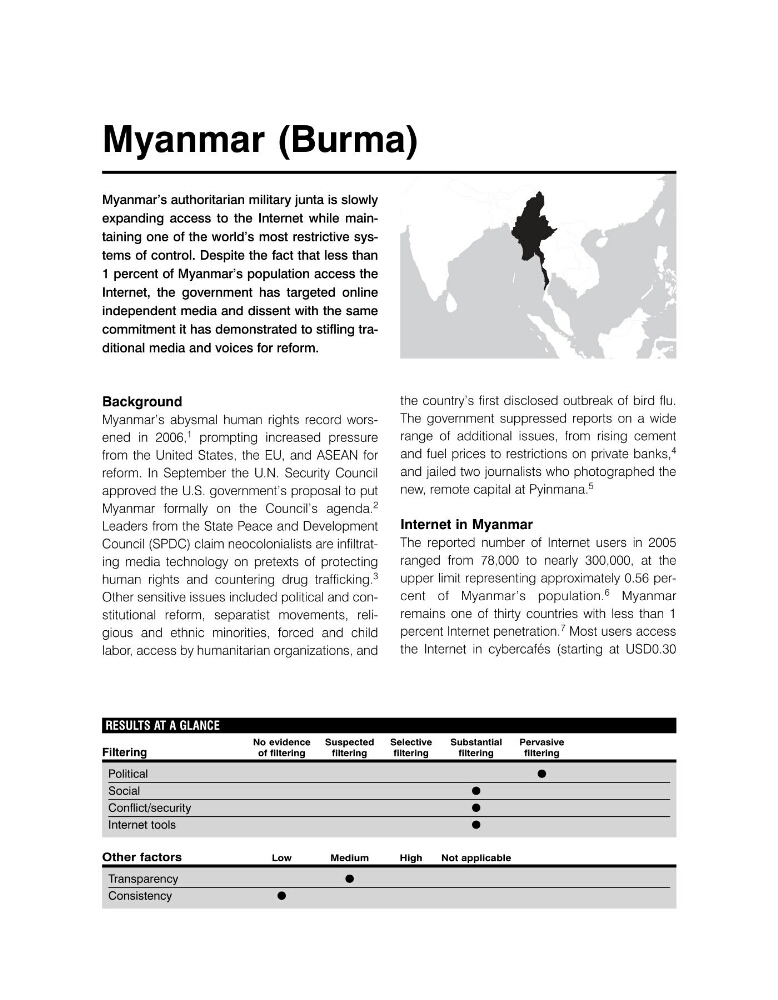
Myanmar’s authoritarian military junta is slowly
expanding access to the Internet while maintaining one of the world’s most restrictive systems of control. Despite the fact that less than
1 percent of Myanmar’s population access the
Internet, the government has targeted online
independent media and dissent with the same
commitment it has demonstrated to stifling traditional media and voices for reform.
Background
Myanmar’s abysmal human rights record worsened in 2006,
1
prompting increased pressure
from the United States, the EU, and ASEAN for
reform. In September the U.N. Security Council
approved the U.S. government’s proposal to put
Myanmar formally on the Council’s agenda. 2
Leaders from the State Peace and Development
Council (SPDC) claim neocolonialists are infiltrating media technology on pretexts of protecting
human rights and countering drug trafficking. 3
Other sensitive issues included political and constitutional reform, separatist movements, religious and ethnic minorities, forced and child
labor, access by humanitarian organizations, and
the country’s first disclosed outbreak of bird flu.
The government suppressed reports on a wide
range of additional issues, from rising cement
and fuel prices to restrictions on private banks, 4
and jailed two journalists who photographed the
new, remote capital at Pyinmana.
5
Internet in Myanmar
The reported number of Internet users in 2005
ranged from 78,000 to nearly 300,000, at the
upper limit representing approximately 0.56 percent of Myanmar’s population. 6 Myanmar
remains one of thirty countries with less than 1
percent Internet penetration. 7 Most users access
the Internet in cybercafés (starting at USD0.30
RESULTS AT A GLANCE
No evidence
Suspected
Selective
Substantial
Pervasive
Filtering
of filtering
filtering
filtering
filtering
filtering
Political
●
Social
●
Conflict/security
●
Internet tools
●
Other factors
Low
Medium
High
Not applicable
Transparency
●
Consistency
●
Myanmar (Burma)
expanding access to the Internet while maintaining one of the world’s most restrictive systems of control. Despite the fact that less than
1 percent of Myanmar’s population access the
Internet, the government has targeted online
independent media and dissent with the same
commitment it has demonstrated to stifling traditional media and voices for reform.
Background
Myanmar’s abysmal human rights record worsened in 2006,
1
prompting increased pressure
from the United States, the EU, and ASEAN for
reform. In September the U.N. Security Council
approved the U.S. government’s proposal to put
Myanmar formally on the Council’s agenda. 2
Leaders from the State Peace and Development
Council (SPDC) claim neocolonialists are infiltrating media technology on pretexts of protecting
human rights and countering drug trafficking. 3
Other sensitive issues included political and constitutional reform, separatist movements, religious and ethnic minorities, forced and child
labor, access by humanitarian organizations, and
the country’s first disclosed outbreak of bird flu.
The government suppressed reports on a wide
range of additional issues, from rising cement
and fuel prices to restrictions on private banks, 4
and jailed two journalists who photographed the
new, remote capital at Pyinmana.
5
Internet in Myanmar
The reported number of Internet users in 2005
ranged from 78,000 to nearly 300,000, at the
upper limit representing approximately 0.56 percent of Myanmar’s population. 6 Myanmar
remains one of thirty countries with less than 1
percent Internet penetration. 7 Most users access
the Internet in cybercafés (starting at USD0.30
RESULTS AT A GLANCE
No evidence
Suspected
Selective
Substantial
Pervasive
Filtering
of filtering
filtering
filtering
filtering
filtering
Political
●
Social
●
Conflict/security
●
Internet tools
●
Other factors
Low
Medium
High
Not applicable
Transparency
●
Consistency
●
Myanmar (Burma)